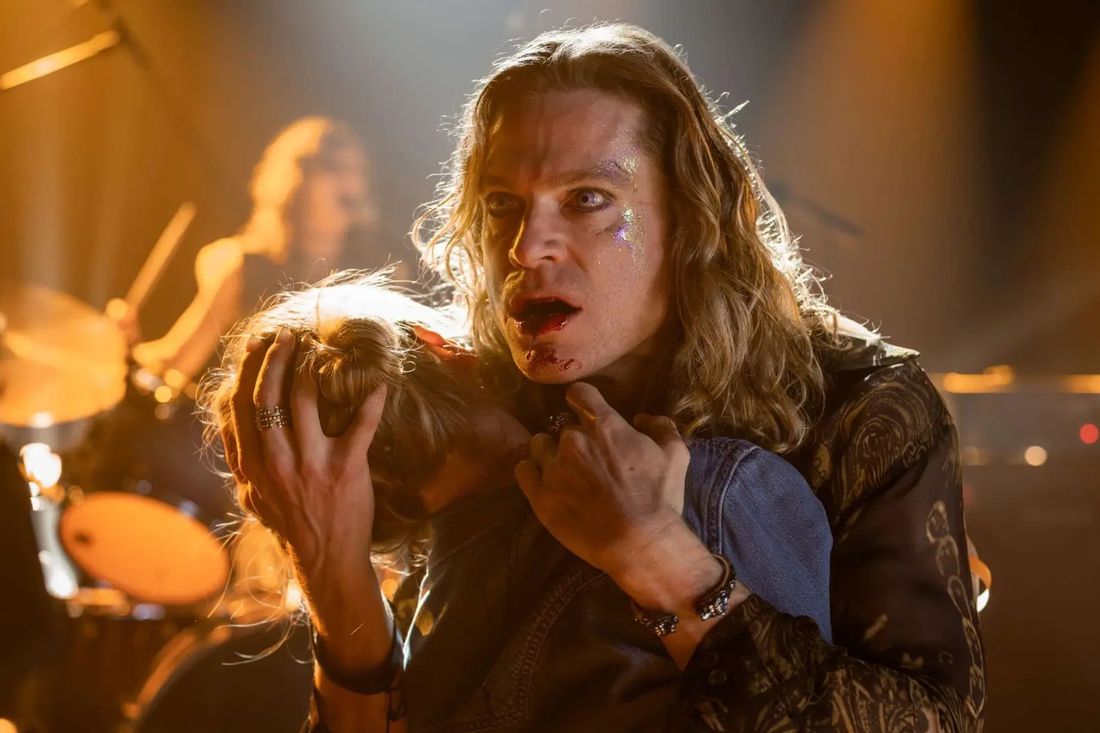
Okay, if you’re still with me after that… well, let’s just say the show threw a lot at us with that last reveal! Honestly, though, it’s not the drama itself – the abuse, the murder, the… everything – it’s the terrible puns that really get to me. Like, seriously? It did remind me of Lesley Manville winning a Tony for Oedipus, which, by the way, the Tonys were last week! And speaking of amazing, if you missed Ali Louis Bourzgui’s acceptance speech for The Lost Boys, you absolutely need to watch it. It’s surprisingly relevant to what’s happening on Interview with the Vampire. He said something that really stuck with me: “Sometimes, humanity needs a fantastical lens outside of ourselves to look at and explore questions about our own nature. Vampires represent those who have shunned their own humanity in order to achieve a nonexistent sense of superiority. The billionaires will never find happiness from their money. The colonizers will never find fulfillment from the land and lives they steal. The fascists will never find meaning from their conformity, not in this lifetime or eternity.” As we move forward with this season and face the threat of the Great Conversion, I’m definitely going to be thinking about that speech and hoping the showrunners can find a way to bring Ali Louis Bourzgui into the AMC Immortal Universe somehow.
The show delves into Lestat de Lioncourt’s troubled past, filled with symbolic imagery and dysfunctional family dynamics. The narrative returns to 1772, portraying Lestat as a young, stuttering boy burdened by a nightmarish family. His father and brothers are crude and losing their status, while his mother, Gabriella, is a complex and resentful Italian noblewoman – imagine Belle from Beauty and the Beast with a sharp, unforgiving edge. She’s trapped in a provincial castle, despises her family, and feels trapped by her life in France. Though lacking maternal instincts, Gabriella connects with Lestat as a kindred spirit – someone who shares her intellectual nature amidst a family she considers unrefined. Their unusual bond is often justified by the claim that she never felt like a mother to him. This dynamic helps explain the roots of Lestat’s later arrogance, which develops as a way to protect his sensitive nature. As a teenager, Lestat briefly joins a traveling theatre group, a bold act of self-expression for the time. While Gabriella respects this artistic defiance, his father and brothers react violently, ultimately breaking his legs and cursing him. Even during this brutal attack, Lestat looks to his mother, captivated by her cold, striking beauty – a beauty that is both chilling and psychologically complex.
It would have been wonderful to see a young Lestat finding his passion for acting. This period of his life clearly meant a lot to him – he references Lelio just as Gus in Cats constantly mentions Firefrorefiddle the Fiend. The story then shifts to Lestat as a young man, recklessly playing with a gun at dinner while villagers plead with his father to protect their animals from wolves. His mother pressures them to be brave, so Lestat impulsively decides to fight the wolves alone. Feeling hopeless and wanting his mother’s approval, he almost welcomes being killed by them. While a wolf attack would have been expensive for the show to film, the scene is beautifully done; Lestat looks strikingly like a figure from Barry Lyndon standing in the wildflowers with his gun, beside his injured dog and missing horse.
Lestat manages to return home, but he doesn’t want food or comfort—he just wants his mother. And his mother’s performance is hilariously over-the-top, complete with a thick, exaggerated European accent. He’s distraught over the death of his dog, repeatedly saying, “Eight,” while crying. He then reveals a disturbing fantasy: teaming up with Gabriella to kill his father and brothers. Gabriella, aroused by how Lestat’s heroic actions diminished her husband and sons, starts touching his wounds and making suggestive advances, launching into a detailed description of her own sexual desires. She describes a scene of unrestrained freedom—drinking wine, stripping naked, and seducing any man she encounters—all while maintaining intense eye contact with a vulnerable, confused, and infatuated Lestat. This fantasy excites her because it represents complete liberation. When Lestat asks if she might belong to him, she immediately pulls away. She claims she’s dying and won’t survive the winter, then abruptly leaves. This scene perfectly encapsulates the bizarre and unique nature of the story—it’s psychologically complex, dramatic, and offers both darkly comedic moments and genuine heartbreak. More than the attack by the wolves, this encounter is the root of Lestat’s trauma. He craves maternal care, but his mother can only offer inappropriate attention, bordering on grooming and incest. This confusion of intimacy shapes Lestat, explaining his intense reaction to being abandoned and ultimately forming the basis of his violent tendencies.
Lestat is haunted by fragmented memories of his short, unhappy life as a human, which feel like unsettling dreams he experiences while traveling on his tour bus at sunset. His mother, now calling herself Sophia, recently rejoined the band, and they’re still reeling from the discovery that their singer is a real vampire. Lestat is simply pleased she traveled so far to support him, completely oblivious to her hidden motives. He addresses the audience in a voiceover, jokingly acknowledging the awkwardness of the vampire family situation and thanking them for their understanding. It’s unclear whether this direct, somewhat obvious writing style is working, and it’s hard to say if it’s effective.
About thirteen minutes into the episode, the opening music finally plays—a great moment! Then, the band relentlessly questions Lestat about how vampire life works. We learn modern vampires get their blood from a place called “the farm,” have existed for thousands of years as part of nature, and that the band is breaking vampire rules by revealing secrets. Lestat casually dismisses this, claiming he has Akasha’s blood running through his veins (it’s one of his best lines!). This leads Larry to ask what “kasha” even is. Alex, horrified by the idea of drinking human blood, decides he can’t continue and leaves the tour bus. Lestat then mentally threatens him, warning that if he tells anyone about what he’s learned, his brother will suffer.
Lestat tries to create distance between himself and his newly turned vampire, Gabriella, treating her as separate from his mother. However, Gabriella rejects this distinction, playfully asserting her role as his maternal figure with the repeated phrase, “I came…and came…and came” when he calls for his ‘mama.’ Lestat desires his mother’s presence but wants a platonic relationship – companionship without intimacy – and jokingly asks how long she intends to stay after not seeing her for centuries. She avoids giving a direct answer, and they proceed to a strip club where they feed on a businessman. While Gabriella entertains herself with the club’s activities, Lestat receives a disturbing call from his lawyer, Christine, revealing that he’s being forced into a compromising situation involving sexual favors for hotel owner Thomas Pitt as repayment for damages. The complicated dynamic between mother and son is further tested as they listen to their victim having sex while Gabriella drinks blood from Lestat’s neck, subtly pushing the boundaries of the ‘no intimacy’ agreement they had just made.
The following night, Lestat and his lawyer met with Louis (using the name Thomas Pitt) and Louis’s lawyer, who also happens to be a vampire and Louis’s lover. Similar to the previous episode where Daniel claimed Lestat specifically requested him for the tour documentary, Louis’s lawyer now states that Lestat initiated this meeting. It’s frustrating how Lestat pretends to be caught off guard when he’s clearly the one orchestrating everything. The meeting unfolds like a comedic version of Marriage Story, with Lestat becoming increasingly agitated and jealous about Louis’s other relationships. Lestat discovers Louis owns 45% of the profits from his tour merchandise, leading to the absurd question of whether Lestat is unknowingly being exploited, considering Louis’s past as a pimp. It’s hard to feel sympathy for Lestat at all. During a concert in Toledo, Lestat dramatically flew into the mezzanine section and thrust a heavily marked-up copy of Interview with the Vampire into Louis’s lap – it was covered in so much pink highlighter, it rivaled Chappell Roan’s aesthetic.
Following the performance, Daniel and Louis connect at a hotel bar. Through narration, Lestat reveals he’ll be recounting events even when he wasn’t there, claiming it’s his story to tell and he’ll voice all characters within it. He frames this as detailing how he awakened a powerful queen and unleashed her fury on the world – though it seems unlikely that simply bringing Louis along for the ride counts! Lestat, acting as an all-knowing narrator, boasts that his version of the vampire tale will have “less whining,” which feels immediately untrue. He even admits to making up the bar where they’re sitting. While he casually hints at a coming apocalypse involving Akasha, I’m more fascinated by the show’s ongoing exploration of history and how truth is manipulated. The distinctive voice introducing Lestat’s narration each episode belongs to filmmaker Guy Maddin, known for his work like My Winnipeg, which explores the unreliable nature of memory and storytelling in film – a theme also present in films by Sarah Polley (Stories We Tell), Nathan Fielder (The Rehearsal), Sophy Romvari (Blue Heron), and Matt Johnson. It’s great to see this Toronto-based influence, as the show is filmed locally, beautifully complementing its themes; it feels fitting that Southern Ontario is where the vampires reside.
The first meeting between Louis and Daniel since Daniel published Louis’s private journal wasn’t as dramatic as expected. Louis explained they were starting to reconnect before the book came out, and Daniel admitted he doesn’t have any impressive vampire abilities – just a strange curse that makes him feel connected to Armand, which, frankly, seems more like a strong infatuation than a power. The situation gets interesting when Raglan James unexpectedly appears, bringing along Real Rashid. It turns out Real Rashid has been working for the Talamasca all along! Knowing Louis has a history of eliminating large groups of vampires – including a theater full in Paris and 31 in Dubai – the Talamasca wants his help. They need him to deal with a problematic group of vampires in Detroit, led by a dangerous figure named Killa (formerly known as Bruce). Killa is the biker vampire who attacked Claudia in the first season, so Louis is now being recruited as a vampire hunter.
Meanwhile, Lestat is out on a date at a cozy Italian restaurant with his mother. He’s just finished consuming the other patrons and staff – think a ferocious, monstrous version of a hungry dog and a bum. He plays the piano and sings one of his poems by Baudelaire, but she’s not thrilled with his French. “It reminds me of your father,” she comments.
He declares, “My tongue…” The scene cuts to fragmented memories: him transforming her into a vampire as she lay dying, and then the two of them carrying out his desire to murder his father and brothers – who were also her sons – all while he sings the lyrics to “La Fontaine de Sang” (“The Fountain of Blood”). As with other flashbacks in this episode, it would have been better to see these moments fully developed, but Lestat’s memories arrive as sudden, disconnected bursts. He attempts to rationalize his relationship with his mother through a voiceover, comparing it to Noah’s family repopulating the world after the flood. But even he doesn’t believe his own explanation. Ultimately, he shrugs it off: “Forget it. It’s just different for vampires.”
Notes on Vamp
Thanks everyone for sharing what you noticed in the summaries! I appreciate you all pointing out that Louis’s foot (or part of his leg) appears to be missing during the auction scene. It’s hard to see clearly because the preview site is dark and there are no subtitles, so I’m relying on quick glimpses. I also thought the character’s name was Baby Jinx!
The TV show made a change to Lestat’s backstory: in the book, his father rejected the monks’ offer to educate him, but in the show, he rejects their help with his stutter. The book portrays Lestat’s mother, Gabrielle, as uncaring because she loves reading but doesn’t bother to help her son with his speech impediment – a flaw the show addresses by giving them both a shared interest in reading.
• Daniel is “a Taurus on the cusp of Aries” and is hitting on Lestat’s mom.
• I don’t like the trope of vampires talking about blood types like wine types.
• “Do you have a lot of sex?” “Of course I do, I’m a rockstar now.” Lol.
• Another reference to the rapture in as many episodes. I’m sure it’s nothing to worry about.
Read More
- Off Campus Season 1 Soundtrack Guide
- Netflix’s Little House On The Prairie Reboot: Release Date, Cast & Everything We Know
- Infinity Nikki Candlelight Reverie Challenge and Rewards Guide
- Gold Rate Forecast
- Brent Oil Forecast
- Silver Rate Forecast
- Prime Video’s New R-Rated Spy Thriller Is Officially No.1 On Streaming Despite Poor Reviews
- KPop Demon Hunters Meets Avatar: The Last Airbender In Netflix’s 3-Part Fantasy Series
- 24 Jump Street in the works with Jonah Hill and Channing Tatum set to return
- The Hunting Wives Star Teases “Wild” Major Character Death in Season 2
2026-06-15 06:05