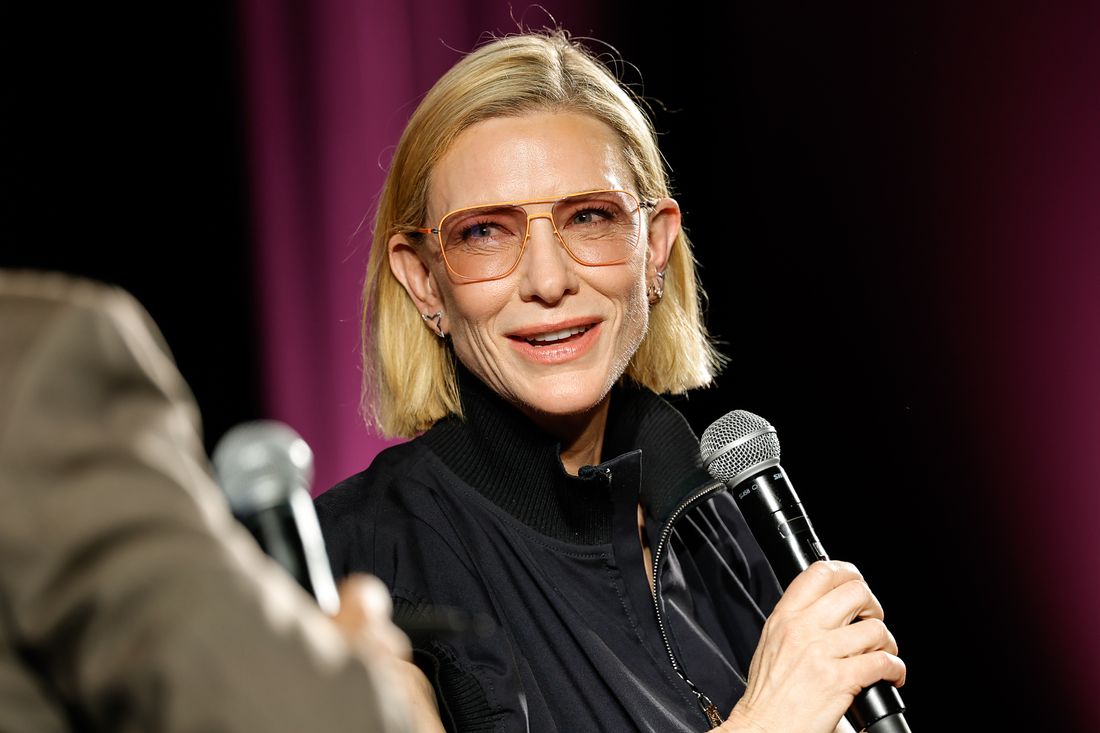
Cate Blanchett was the guest of honor at a Cannes Film Festival event on Sunday afternoon. The Australian actress, who has a certain French flair, was there to discuss the Displacement Film Fund, a project she started to help filmmakers who have been displaced. The Fund is now in its second year. The conversation eventually shifted to Blanchett’s acting career, with clips shown from films like Tár and Lord of the Rings, and even the emotionally intense voiceover scene from Carol where the character Carol leaves Therese. The event’s moderator, Didier Allouch, playfully noted that Blanchett seemed to be channeling her Tár character. Dressed in a black jumpsuit and pink sunglasses, Blanchett jokingly asked the audience to put away their phones and focus on the conversation – a request that unfortunately went largely unheeded.
The interviewer brought up the 2018 film festival, specifically when Cate Blanchett, as jury president, joined Kristen Stewart, Léa Seydoux, Agnès Varda, and Ava DuVernay in a show of support for the Me Too movement as they walked the red carpet. Blanchett called this period “the time of Me Too,” but quickly added, “It’s sad that we’re talking about ‘the time of Me Too’ as if it’s over. It faded away so quickly, which I find really telling. The movement was simply about giving people with a public voice the chance to safely share their experiences, and acknowledging that everyday women were saying ‘Me too’ – so why was that conversation silenced?”
She explained that the situation exposed a widespread pattern of mistreatment, not just in the entertainment industry, but across all professions. She emphasized that acknowledging a problem is the first step to fixing it. Even now, while working on film sets, she routinely counts the crew each day and finds a significant gender imbalance – ten women compared to seventy-five men. While she enjoys working with men, she noted that the same types of jokes and comments tend to repeat, requiring her to mentally prepare. She admitted she’s grown accustomed to it, but believes a lack of diversity creates a monotonous environment and ultimately impacts the quality of the work.
Allouch wondered if things had genuinely improved. She explained that some people with influence started adding clauses to their contracts – initially called inclusion riders – to promote diversity. However, studios quickly responded by saying they already had their own versions. A similar thing happened with ‘green riders,’ which aimed to make productions more environmentally sustainable. Studios also dismissed those, often going through the motions – like visibly recycling – just to appear like they were making an effort. Allouch found this performative action frustrating.
The film Carol was mentioned several times. She remembered that it had been difficult to get funding for it initially. While the film wasn’t exclusively for LGBTQ+ audiences—it resonated with many people—it was considered a risk at the time. She believes things have changed, with more stories featuring same-sex relationships now appearing even in major film festivals. Later, someone in the audience asked her what was going through her mind during the final scene of Carol, when her character sees Therese (played by Rooney Mara) walking towards her.
Cate Blanchett recently shared that she’s directing a stage adaptation combining Ingmar Bergman’s films Persona and Electra, starring Nina Hoss at the National Theatre in London, which is why she’s been revisiting Bergman’s work. She recounted how Bergman used to dismiss questions about his intentions, believing that once a work is finished, the artist no longer has ownership over its meaning. However, Blanchett then offered a behind-the-scenes detail about a specific shot in the production. She explained that due to the camera setup, she and Rooney Mara couldn’t make direct eye contact, forcing them to react to imagined versions of each other rather than truly connecting. It required precise timing and a sense of internal dialogue, even though they weren’t actively engaging with each other. Blanchett admitted this explanation might not be a complete answer.
As a huge fan, it’s always fascinating to hear actors talk about their process. Cate Blanchett was discussing some past projects, starting with Todd Haynes’ I’m Not There. She explained that all her preparation felt pointless until she was actually on set with Haynes, wearing the costume and makeup. Apparently, a friend gave her the surprisingly helpful suggestion to, well, stuff a sock down her pants! She said it completely changed her physicality and gave her the ‘package’ she needed for the role. It’s those little details that really show how actors transform themselves!
Cate Blanchett remembered the demanding direction she received from Alejandro Iñárritu while filming Babel in 2006. She described the shoot as incredibly chaotic, compounded by a personal trauma – her son had an accident in Morocco. She jokingly suggested the on-screen turmoil mirrored her real life. She recalled a particularly blunt exchange on the first day of shooting with Brad Pitt, where Iñárritu stopped them after a few takes and harshly criticized their work, declaring the scene – and potentially the entire film – would fail if it didn’t improve. Blanchett laughed, admitting this approach was disorienting but ultimately a form of direction. While some might find it disrespectful, she recognized it as a very direct, albeit harsh, way for a director to push for the best performance. When asked about a specific expression in the final scene, she even wondered if it stemmed from fear of receiving another negative critique from Iñárritu.
The moderator asked if people often ask her what the film Tár is about. She explained that while it might seem like a commentary on ‘cancel culture’ at first glance, she always saw it as an exploration of power. She pointed out that ‘Tár’ is an anagram of ‘art,’ and for her, the film really delves into the harsh realities of being creative – the self-criticism artists often face and how that can manifest outwardly. She then shared a story Guillermo del Toro once told her, a fable about a body’s organs arguing over their importance. In the story, the anus points out that without it, the body wouldn’t function, and the body ultimately fails when the anus stops working. She used this to illustrate that we sometimes need a challenging force to push back. The audience seemed a little lost, and she laughed, asking, “See what it’s like to be inside my head?”
Someone in the audience asked her about artificial intelligence, and she talked about RSL Media, a nonprofit she helped start that works on establishing guidelines for obtaining artists’ permission to use their work. She acknowledged that AI is becoming unavoidable and is a strong technology, but shared she doesn’t use it often, preferring activities like reading or taking walks.
Read More
- Netflix’s Little House On The Prairie Reboot: Release Date, Cast & Everything We Know
- Off Campus Season 1 Soundtrack Guide
- Silver Rate Forecast
- Prime Video’s New R-Rated Spy Thriller Is Officially No.1 On Streaming Despite Poor Reviews
- Gold Rate Forecast
- Brent Oil Forecast
- EUR ZAR PREDICTION
- Amazon Primes new GenAI cartoon looks like K-Pop Demon Hunters with aliens
- Inkford Hermitage Chest Locations In HSR (Honkai: Star Rail)
- KPop Demon Hunters Meets Avatar: The Last Airbender In Netflix’s 3-Part Fantasy Series
2026-05-18 18:55