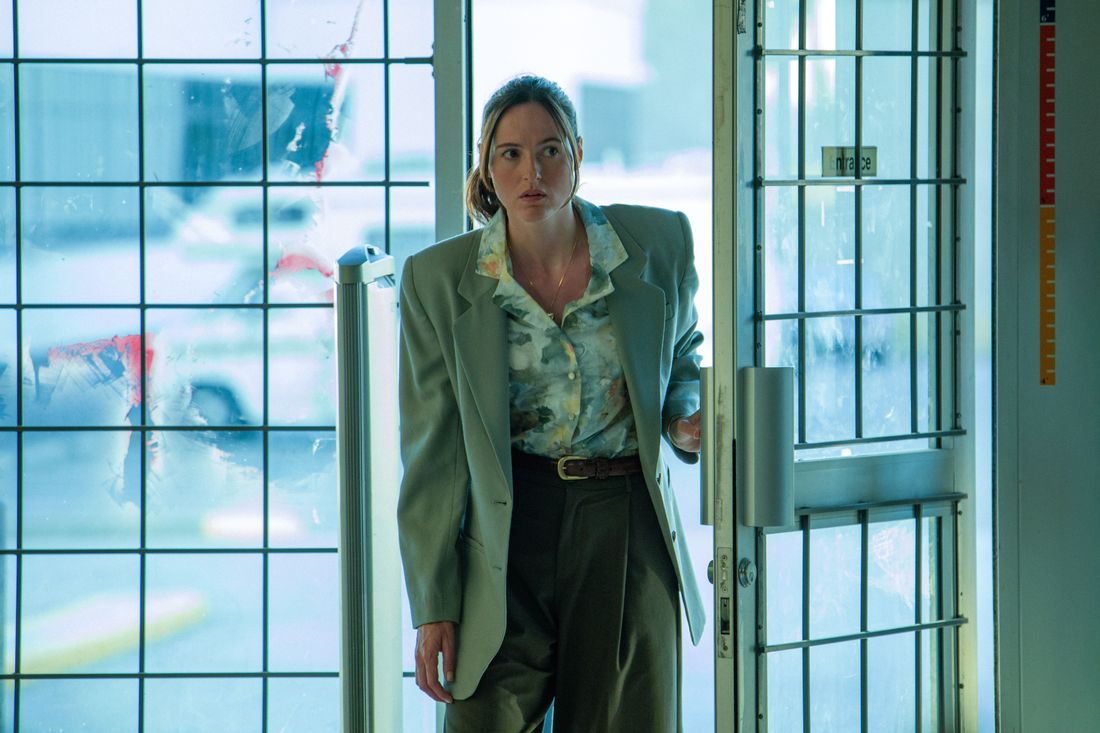
Slight spoilers follow for Backrooms ahead.
Kane Parsons’s Backrooms follows a furniture store worker who finds a strange, impossible space in the stockroom. His attempts to understand this place and where it leads have disastrous consequences for others. Revealing more would spoil the story, but if you’re intrigued by the idea of a bizarre, unsettling place that messes with your mind, you should definitely check out House of Leaves.
Mark Z. Danielewski’s influential 2000 horror novel is considered a key inspiration for the popular online phenomenon known as the ‘backrooms,’ which gained widespread attention thanks to videos by content creator Parsons. The backrooms are typically depicted as empty, abandoned spaces like offices, retail areas, or hallways – places designed for specific activities that become unsettling when deserted. This emptiness creates a sense of unease because we’re used to these spaces serving us. When they’re devoid of people, they seem to develop their own strange presence and feel disconnected from our control.
Mark Z. Danielewski’s House of Leaves taps into a primal fear – the idea that the scariest things can happen where we feel most safe, like our own homes. This creates a deeper, unsettling question: if you can’t trust your own home, what can you trust? The novel unfolds through a complex structure. It starts with a note questioning the story’s truthfulness and then introduces Johnny Truant, who recounts discovering and attempting to make sense of the work of a deceased researcher named Zampanò. Zampanò’s extensive manuscript details a documentary called The Navidson Record – a film that may or may not be real – and focuses on a house that seems to be bigger on the inside than the outside, with strange and terrifying qualities. The manuscript is filled with pages of text, often difficult to decipher, as Johnny tries to piece together the truth behind Zampanò’s research and the mysterious events surrounding it, including strange markings found in the floorboards of the house.
A nearly six-minute film appears to show something inexplicable. Pulitzer Prize-winning photographer Tom Navidson filmed a doorway in his new Virginia home that shouldn’t exist. The doorway leads to a hallway about ten feet long, even though the house’s layout means it should open onto an outside wall. The mystery deepens as the film follows the Navidson family’s exploration of this impossible space, which expands into even stranger areas. They hear a growling creature within, but never see it. The story raises questions: Is this creature responsible for the injuries found on Zampanò’s body? Could it have escaped through the documentary film or Zampanò’s research? And is Johnny, the person recounting the story, losing his mind from imagination, or is he witnessing something real that no one else will accept?
Mark Z. Danielewski’s House of Leaves isn’t just a scary story – though it definitely delivers on that front. It playfully critiques the often competitive and nitpicky world of academic research through multiple narrators and constant debate about the truth of the central text, The Navidson Record. At its heart, however, the novel is a deeply unsettling exploration of how one family reacts to a terrifying mystery within their own home, particularly as Tom Navidson delves further into an impossible space. Danielewski’s detailed descriptions of what Tom experiences are frightening on their own, but they become even more unnerving when combined with Johnny Truant’s increasingly desperate interruptions about the impact reading the book has on his life. The novel also touches on big philosophical questions – like whether our perceptions define reality – and cleverly plays with familiar tropes of domestic horror.
Mark Z. Danielewski’s House of Leaves is designed to be unsettling, and its unusual format is a key part of that. The book intentionally disrupts the reading experience with constantly changing fonts, random text boxes, numerous footnotes, and text arranged in disorienting ways – sometimes upside down, reversed, or vertically. You might find a page with text in multiple directions, or even just a single word. This inconsistency isn’t just stylistic; it’s meant to confuse you and make you acutely aware of the book’s physical design. This approach also mirrors the story itself, which is complex and layered, and creates a feeling that you’re intruding on something you shouldn’t be seeing. House of Leaves both draws you in and pushes you away, making it a perfect read for fans of the Backrooms who enjoy exploring unsettling, forbidden spaces.
Read More
- Netflix’s Little House On The Prairie Reboot: Release Date, Cast & Everything We Know
- Off Campus Season 1 Soundtrack Guide
- YouTuber arrested after viral AI bodycam videos spark real police complaints
- Silver Rate Forecast
- Prime Video’s New R-Rated Spy Thriller Is Officially No.1 On Streaming Despite Poor Reviews
- EUR ZAR PREDICTION
- Gold Rate Forecast
- Peaky Blinders: The Immortal Man’s Tommy Shelby Is a Better Father Than Michael Corleone
- Brent Oil Forecast
- Bulgakov’s Take: Koreans Bet the Farm on Chips, Crypto, and Chaos
2026-06-12 16:54