Tether, the crypto equivalent of a bureaucratic nightmare, has once again proven why they’re the kings of the centralized coin world.
-
Key Takeaways:
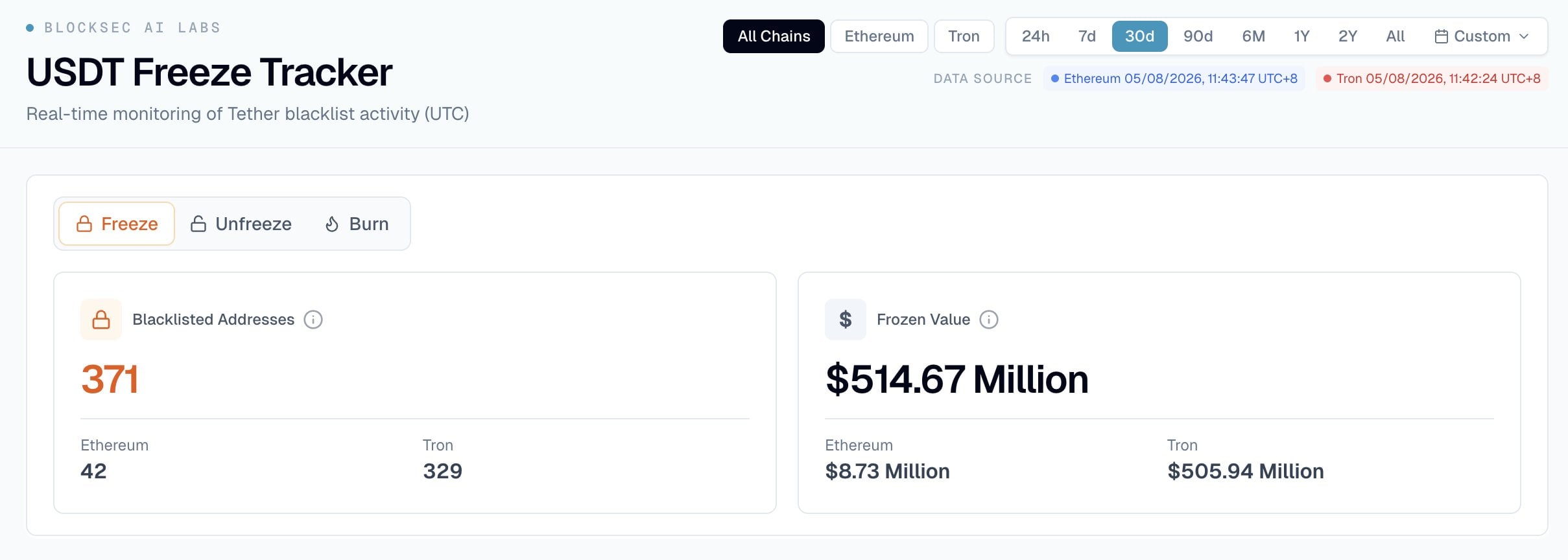
- Tether blacklisted 371 addresses, freezing ~$515M in USDT on Ethereum and Tron over 30 days ending May 7. Because who needs privacy when you can be part of a list?
- Of the 371 freeze actions, 329 occurred on Tron. Because Ethereum is for people who actually want to be trusted with their own money.
- The crackdown has once again showcased Tether’s growing compliance role as the world’s largest stablecoin issuer. Because nothing says “trust us” like a company that can freeze your funds on a whim.
Escalating Compliance Measures
According to data from Blocksec’s USDT Freeze Tracker, Tether blacklisted 371 addresses on Ethereum and Tron combined. Of those, 329 freeze actions were executed on Tron, while 42 occurred on Ethereum. A distribution that reflects USDT’s disproportionately heavy usage on Tron, which has become the dominant chain for stablecoin transactions in emerging markets. Because nothing says “democracy” like a blockchain that’s basically a magnet for bad actors.
Tether’s ability to freeze funds stems from a centralized administrative key embedded in the USDT smart contract. When an address is flagged, typically at the request of law enforcement agencies or following verified evidence of theft, fraud, or sanctions violations, Tether can unilaterally prevent that wallet from moving its funds. The mechanism has been used in cooperation with agencies including the U.S. Department of Justice and Europol. Because nothing says “freedom” like a company that can shut down your wallet if you’re “bad.”
The Centralization Debate and Tron Scrutiny
This centralized freeze capability has become a double-edged sword as critics have argued that it fundamentally contradicts the self-custody ethos of crypto, where users are supposed to have full sovereignty over their own assets. Tether and its supporters frame it as an essential tool against money laundering, ransomware payouts, and large-scale financial crime. Because nothing says “trust us” like a system that can erase your coins if you’re “uncooperative.”
The scale of May’s freeze activity is notable as the freezing of over half a billion dollars in a single month suggests either a surge in enforcement requests or a broadened internal compliance sweep, or both. The data by Blocksec does not specify how many of the 371 addresses were frozen at direct government request versus Tether’s own internal protocols. Because why let the facts get in the way of a good conspiracy theory?
Tron has faced particular scrutiny in all of this as the network, founded by Justin Sun, has been repeatedly flagged by blockchain analytics firms for high volumes of illicit fund flows. Tether has not issued a public statement on the 30-day freeze totals as of this writing. Because transparency is overrated, obviously.
Read More
- Gold Rate Forecast
- What is Omoggle? The AI face-rating platform taking over Twitch
- Wartales Curse of Rigel DLC Guide – Best Tips, POIs & More
- The Devil Wears Prada 2 Cameos You May Have Blinked and Missed (Plus Lady Gaga)
- Audible opens first ‘bookless bookstore’ in New York
- How To Grow Money Trees In Animal Crossing: New Horizons
- Sony’s Venom Animated Movie Is Bad News for Spider-Man Fans
- Woman born without arms goes viral after revealing how she uses feet to eat
- Below Deck Down Under Recap: Battle of the Egos
- 10 Forgotten Terrifying MCU Scenes No One Ever Talks About
2026-05-08 12:29