It appears that the great cryptocurrency, Bitcoin, is on the brink of a supply shock, a situation that has been quietly brewing as the small investors, driven by the relentless pressure of the market, sell their holdings, while the long-term holders, like the ancient oak trees of the financial forest, remain steadfast in their dormancy, as though awaiting a signal from the heavens.
//media.crypto.news/2026/03/image-63.webp”/>
This dynamic suggests that the current selling pressure is driven primarily by retail investors exiting positions during periods of market volatility, a behavior as predictable as the sunrise and as tragic as a love affair doomed to failure.
Meanwhile, large holders-often referred to as whales-have remained largely inactive, with older bitcoin holdings showing little movement on-chain, their inaction as enigmatic as the riddles of the Sphinx.
Analysts interpret this dormancy as a sign that institutional or long-term investors remain confident in Bitcoin’s broader market outlook, a confidence as steadfast as a Russian winter and as cold as a bank vault.
Exchange reserves decline as coins move off trading platforms
Another key signal highlighted in the analysis is the continued decline in Bitcoin exchange reserves, a quiet revolution where coins are moving from the hands of the anxious to the secure embrace of long-term custodians.
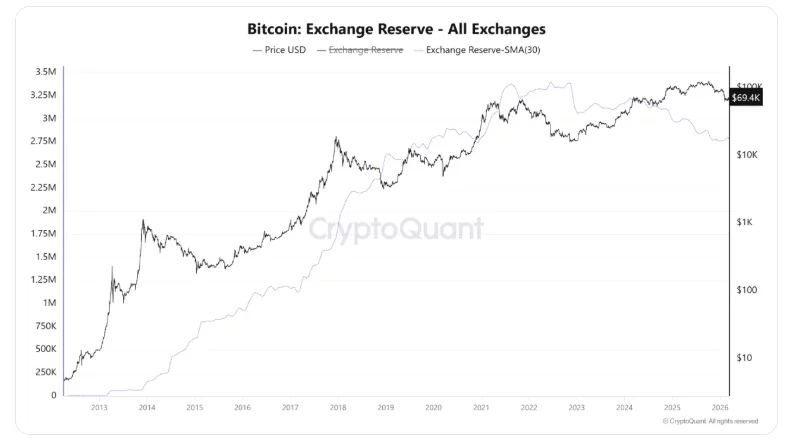
Year-to-date, reserves have dropped from 2.990 million BTC to 2.786 million BTC, representing a reduction of roughly 204,000 BTC across trading platforms, a number so large it would make a mathematician weep into their coffee.
Such outflows often indicate that investors are transferring coins to cold storage or long-term custody wallets rather than preparing them for immediate sale, a move as prudent as a squirrel storing acorns for winter.
According to CryptoQuant, this trend suggests coins are gradually moving from “nervous hands” to longer-term holders, a process as inevitable as the changing of the seasons.
The combination of falling exchange reserves and inactive whale wallets could set the stage for a potential supply shock, a scenario as thrilling as a train approaching a cliff.
A supply shock occurs when sell-side liquidity becomes scarce, meaning fewer coins are available for sale on exchanges. If demand rises during such conditions, prices can move sharply higher, a phenomenon as unpredictable as a drunk man’s dance.
CryptoQuant analysts argue that the current market environment reflects “fear exhaustion,” where retail capitulation gradually clears excess selling pressure, a process as wearying as a marathon without a finish line.
If that forced selling cycle ends while long-term holders continue to hold their positions, the market could enter a phase where reduced supply amplifies the impact of new demand on Bitcoin’s price, a development as tantalizing as a mystery novel’s final chapter.
Read More
- Netflix’s Little House On The Prairie Reboot: Release Date, Cast & Everything We Know
- Off Campus Season 1 Soundtrack Guide
- Silver Rate Forecast
- Prime Video’s New R-Rated Spy Thriller Is Officially No.1 On Streaming Despite Poor Reviews
- Gold Rate Forecast
- Brent Oil Forecast
- EUR ZAR PREDICTION
- Amazon Primes new GenAI cartoon looks like K-Pop Demon Hunters with aliens
- Inkford Hermitage Chest Locations In HSR (Honkai: Star Rail)
- KPop Demon Hunters Meets Avatar: The Last Airbender In Netflix’s 3-Part Fantasy Series
2026-03-12 12:10