In a world teetering on the brink of either diplomatic triumph or catastrophic blunder, the ever-unpredictable President Donald Trump has declared his Iran policy a “solid 50/50” toss-up-a decision that has sent Polymarket traders into a frenzy, wagering a staggering $154 million on whether the United States and Iran will kiss and make up by 2026. Meanwhile, Bitcoin, ever the barometer of global whimsy, has surged 1.5%, reclaiming the $77,000 mark with the aplomb of a society hostess entering a drawing room.
-
Key Takeaways:
- Polymarket’s US-Iran peace market has ballooned to $154M in volume, with December 31, 2026, contracts at a sanguine 91% odds-because nothing says optimism like betting on peace in the Middle East.
- Trump, in a moment of characteristic indecision, described his Iran conundrum as “50/50” on May 23, 2026, prompting emergency consultations with Vance, Hegseth, and the ever-stoic Gen. Caine.
- A proposed 60-day ceasefire extension dangles the carrot of reopening the Strait of Hormuz and easing sanctions on Iran by mid-2026-a gesture as likely to succeed as a fox guarding a henhouse.
- Bitcoin reached an intraday high of $77,303 on Bitstamp at 4:30 p.m. ET, proving once again that cryptocurrency thrives on chaos.
U.S.-Iran Ceasefire Dangles as Polymarket Volume Surges on Peace Deal Wager
The Polymarket contract, whimsically titled “US x Iran permanent peace deal by…?”, debuted on April 8, 2026, and has since amassed $154.44 million in volume across various date-based outcome contracts. Each contract, like a poorly written novel, tracks a specific deadline, with odds fluctuating as diplomatic talks lurch between hope and despair.
The May 26, 2026, deadline, with $3.9 million in volume, carries a 56% chance of resolution-a figure as reliable as a weather forecast in April. The May 31 contract, with $42.8 million in volume, boasts 62% odds, while the June 30 contract, with $12.5 million traded, leans toward a 70% probability-a testament to the market’s faith in procrastination.
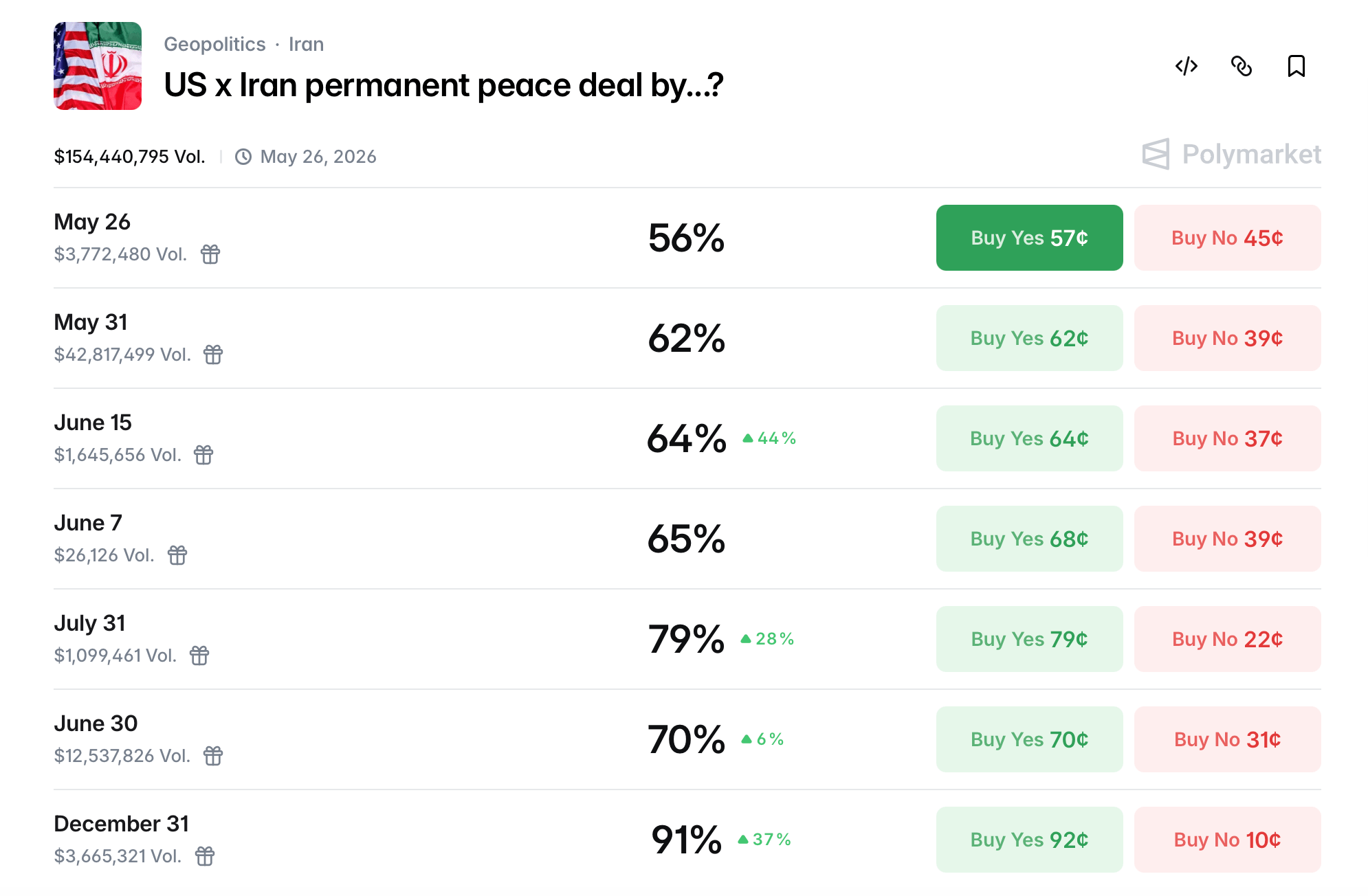
The December 31, 2026, contract, however, commands the most confidence, with $3.6 million wagered and a 91% probability-reflecting the widespread belief that if peace is to be achieved, it will be just in time for New Year’s Eve fireworks.
This frenzy of betting is set against the backdrop of a fragile ceasefire brokered in April 2026, following U.S. and Israeli strikes on Iranian nuclear facilities. The truce, initially a two-week affair, has been extended but remains as stable as a house of cards in a hurricane. Sticking points include Iran’s uranium stockpile, control of the Strait of Hormuz, and the perennial question of whether Tehran will accept long-term nuclear constraints-a prospect as likely as a cat volunteering for a bath.
Negotiations Reportedly in Play
Indirect negotiations, mediated through Oman (the Switzerland of the Middle East), have continued in fits and starts. A proposed 60-day ceasefire extension is under consideration, serving as a framework for deeper talks on nuclear and security issues. Iran seeks the gradual lifting of a U.S. naval blockade and the unfreezing of overseas assets, while Washington demands uranium transfers and enrichment caps-conditions Tehran views with the enthusiasm of a vegan at a steakhouse.
Trump, ever the showman, canceled his Memorial Day weekend plans to remain near Washington, reviewing Iran’s latest counterproposal. He convened sessions with Vice President JD Vance, Defense Secretary Pete Hegseth, and Joint Chiefs Chairman Gen. Dan Caine. Secretary of State Marco Rubio has been involved, insisting that any deal must prevent Iran from developing nuclear weapons and ensure free passage through the Strait of Hormuz-a tall order, akin to asking a leopard to change its spots.
Trump has publicly stated he could have an answer by May 24 or 25, 2026, framing the choice as between accepting a deal he deems strong enough or resuming military action. The Polymarket contracts, meanwhile, reflect the market’s interpretation of this uncertainty, with shorter deadlines carrying lower odds and higher volatility, and longer contracts showing a collective belief that diplomacy will outlast the immediate standoff-a hope as fragile as a soap bubble.
Bitcoin Surges 1.5% on Diplomatic Optimism
Oil markets have reacted to the Hormuz situation throughout the ceasefire, with a reopening of the strait promising to stabilize energy flows. Gulf states and Israel watch with bated breath, while hawkish factions in Washington and Jerusalem oppose concessions-a dynamic as predictable as a soap opera plot twist.
Bitcoin reacted swiftly to the diplomatic developments, rising from a local low of $74,192 to $77,000 on the Bitstamp BTC/USD hourly chart as of May 23, 2026. Traders attribute this move to optimism surrounding a potential U.S.-Iran agreement-a sentiment as fleeting as a summer breeze.
A resolution that reopens the Strait of Hormuz and eases geopolitical tension would remove a significant risk premium from risk assets, and bitcoin traders and Polymarket bettors appear to be pricing in this possibility ahead of Trump’s decision. If talks collapse and strikes resume, the Polymarket contracts would shift dramatically against resolution. If Trump accepts a framework agreement, shorter-term contracts could pay out, and the December contract would likely move toward certainty-a scenario as uncertain as a coin toss in a hurricane.
As of May 23, 2026, no formal deal has been signed. The ceasefire holds, the bets remain open, and bitcoin continues its upward trajectory-a testament to the market’s unshakable faith in chaos.
Read More
- Netflix’s Little House On The Prairie Reboot: Release Date, Cast & Everything We Know
- Off Campus Season 1 Soundtrack Guide
- YouTuber arrested after viral AI bodycam videos spark real police complaints
- Silver Rate Forecast
- Prime Video’s New R-Rated Spy Thriller Is Officially No.1 On Streaming Despite Poor Reviews
- Brent Oil Forecast
- Bulgakov’s Take: Koreans Bet the Farm on Chips, Crypto, and Chaos
- EUR ZAR PREDICTION
- Peaky Blinders: The Immortal Man’s Tommy Shelby Is a Better Father Than Michael Corleone
- Gold Rate Forecast
2026-05-24 02:24