Spoilers follow for The Boys through series finale “Blood and Bone,” as well as the comics.
After a long build-up spanning almost 40 episodes, the season finale of The Boys, titled “Blood and Bone,” finally kills off the villain Homelander. Stripped of his powers by Kimiko, he desperately pleads for his life, but Butcher ultimately kills him with a crowbar in a brutal and graphic scene. While Antony Starr’s performance as Homelander has been consistently excellent and deserving of an Emmy, the show arguably waited too long to remove the character. It seems The Boys was hesitant to lose him and Starr’s compelling portrayal, extending his storyline beyond what the story – and the original comic books – needed. This resulted in a weaker ending, particularly by downplaying Butcher’s death in the comics and turning it into a minor plot point.
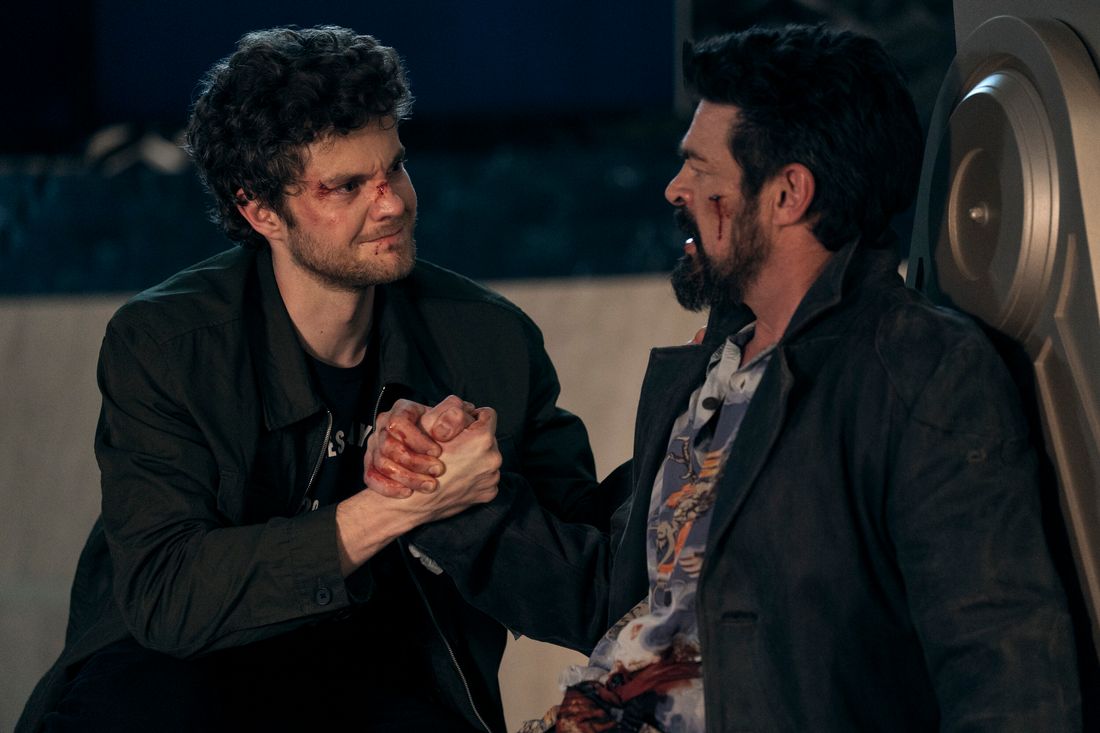
The finale of The Boys felt rushed. Butcher’s quick decision to release the virus in Vought Tower, and Hughie’s equally fast response by killing Butcher to stop him, were crammed into a short space to reach a neat and optimistic conclusion – a trustworthy government and a happy future for Hughie and Annie. This speed and focus on sentimentality didn’t do justice to Butcher’s character or the complex relationship he shared with Hughie. Throughout the series, The Boys seemed hesitant to fully embrace Butcher as a villain, preventing him from having the full character arc needed to resolve his long-standing conflict with Hughie. While the ending gives Hughie a peaceful resolution – he kills his mentor but saves the world that harmed him – the storytelling felt weak, much like the fate of Deep, who was unceremoniously killed by the creatures he was meant to protect.
From the start, the relationship between Homelander, Butcher, and Hughie has been at the heart of The Boys, showcasing the show’s constant cycle of violence. It began when Hughie’s girlfriend was killed by the reckless speedster A-Train, leading him to join Butcher’s vigilante team. Butcher was driven by a desire for revenge against Homelander, who had assaulted his wife, Becca, and he was willing to kill any superpowered individual to achieve it. Homelander, the unstable and attention-seeking leader of Vought’s superhero team, the Seven, committed increasingly horrific acts, from abandoning a plane full of passengers to publicly murdering people while his fans cheered. By the final seasons, he even believed he was a divine being destined to rule the U.S. As the series progressed, tension grew between Butcher, who became convinced that the only way to prevent another Homelander was to eliminate all supes with a virus, and Hughie, who couldn’t accept that all supes were as monstrous as Homelander. When Butcher took Compound-V to gain powers and fight Homelander directly, the show began to portray them as mirror images of each other. Both Homelander’s disregard for human life and Butcher’s hatred of supes were presented as equally wrong, blurring the lines between hero and villain.
I always felt there was a problem with how the show presented Butcher. He was meant to be a cautionary tale – a look at how far we could fall if we fought fire with fire. But honestly, the show often made the supes genuinely awful, and we were supposed to hate them, which we did. While some characters resisted Homelander, most just went along with him, eager to benefit from his rule. As the series moved away from criticizing the military and focused more on Vought being rooted in Nazi ideas and Homelander mirroring someone like Trump, any comparison between him and Butcher felt really weak. Even when Butcher did terrible things – like killing Victoria Neumann – it just didn’t measure up to Homelander’s actions. I mean, staging a coup, taking over the country, setting up internment camps, trying to kill his own son, and murdering people like Firecracker and Frenchie? How could you possibly compare those things? It felt impossible to weigh them on the same scale.
Throughout The Boys series, Hughie consistently raised moral objections, but these felt less impactful as Homelander became increasingly unhinged and attracted more superpowered followers. In the episode “Blood and Bone,” Hughie questioning Butcher’s plan to release a supe-killing virus into Vought Tower is consistent with his character. However, the comic book version of this conflict, written by Garth Ennis, feels more justified. That’s because in the comics, Butcher had been secretly developing his plan to eliminate all supes for over a decade. He spent twelve years forcing the original creator of Compound-V to create a weaponized strain and planted 260 bombs worldwide designed to kill anyone with even a trace of the substance. (He also built missiles to take down flying supes – he was very proactive.) He kept this all hidden from his team – Hughie, Mother’s Milk, Frenchie, and the Female (Kimiko in the TV show) – and when they discovered his plan, they felt betrayed and tried to stop him. Butcher then began killing their allies, and eventually turned on his own team, to ensure his plan succeeded. This dramatic turn, which happens after Homelander’s death in the comics, unfolds over seven issues and creates a sense of mounting horror – it becomes clear Butcher truly meant his ruthless approach, and his plan would wipe out around 40% of the global population. This raises a difficult question: were we wrong to support his methods earlier on?
In the comics, Hughie wants to kill Butcher both to avenge their fallen friends and because he’s terrified by how extreme Butcher has become in his pursuit of justice. Their final showdown in the Empire State Building is emotionally complex, reflecting their strange, brotherly bond. Hughie attacks Butcher, and they both fall through a window. When Hughie hesitates to kill the immobilized Butcher, Butcher falsely confesses to murdering Hughie’s parents, knowing this is the only way to push Hughie to commit violence. Hughie kills Butcher, devastated to learn it was a lie, but also influenced by Butcher’s ruthless mindset. He then uses the bombs to threaten Vought’s leaders, vowing to detonate them if Vought ever weaponizes supes by deploying them in the military. The story concludes with Vought’s research team admitting their new generation of supes – dressed in white, reminiscent of the KKK – are fundamentally flawed and incapable of change, reinforcing Hughie’s realization that they should have focused on dismantling the corporation itself instead of chasing individual supes. Hughie doesn’t want to resort to mass destruction, but he accepts that someone must stop Vought, even if it means taking drastic action.
These events don’t happen in the comic book source material, and the show’s characters feel the impact. Over five seasons, The Boys has significantly diverged from the comics, most notably by revealing Butcher’s plan to wipe out all supes in season four. The constant debate among Hughie, Frenchie, Mother’s Milk, Kimiko, Butcher, and Annie about using the virus made Butcher’s eventual decision feel underwhelming. It seemed less about stopping supes and more about his personal pain – being rejected by Ryan, Homelander’s son, and losing his dog, Terror. Instead of a large-scale, meaningful stand, Butcher is essentially on a suicide mission with a single vial of the virus, heading to Vought Tower. Without the groundwork laid in the comics, the final confrontation with Hughie feels flat and lacks the weight of their history. In the comic The Scores on the Doors, Hughie accurately calls Butcher a supervillain, and Butcher’s claim that Hughie remained true to himself is a bittersweet reassurance. Hughie still has a capacity for violence, but with Butcher gone, he’s less likely to give in to it. He’s now taking on the system directly, honoring Butcher’s memory while realizing his own strength.
The final season of “The Boys” echoes themes from the comic book, but ultimately feels unsatisfying. Despite a moment where Butcher tries to justify his actions to Hughie, the characters have become so one-dimensional and repetitive that the sentiment rings hollow. Unlike earlier seasons where the show powerfully depicted anger towards Vought and Hughie’s drive for justice, the ending offers overly neat and self-contained resolutions for each character – Mother’s Milk reconnects with family, Kimiko finds solace in France, Hughie and Annie open a shop, and even Annie’s pregnancy feels secondary to minor heroics. The world itself feels strangely peaceful, with Congress and the FBI taking care of the problems Vought created.
The show suggests that the world is better off without Homelander, and the team is better off without Butcher, reinforcing Hughie’s earlier argument against Butcher’s extreme methods. However, by clinging to the idea that both sides are flawed, “The Boys” delivers a conclusion that feels small in scope. It never quite manages to surpass the depth of its source material, remaining a superficial exploration of heroism and villainy until the very end.
Read More
- Netflix’s Little House On The Prairie Reboot: Release Date, Cast & Everything We Know
- Off Campus Season 1 Soundtrack Guide
- Silver Rate Forecast
- Prime Video’s New R-Rated Spy Thriller Is Officially No.1 On Streaming Despite Poor Reviews
- Gold Rate Forecast
- Brent Oil Forecast
- EUR ZAR PREDICTION
- YouTuber arrested after viral AI bodycam videos spark real police complaints
- EUR USD PREDICTION
- Inkford Hermitage Chest Locations In HSR (Honkai: Star Rail)
2026-05-20 23:59