I once thought that the movie Walk Hard perfectly satirized musical biopics like Ray and Walk the Line, and would effectively end the genre. How could those standard biopic stories continue after a comedy so accurately and hilariously poked fun at all their clichés – the difficult fathers, the flashback scenes, and the idea that so many musicians seemed to follow the same predictable life story? I didn’t realize how much fans actually enjoy that formula. They’re the same people who made Bohemian Rhapsody a huge box office success, earning over $900 million. You can certainly try to be different, experiment with timelines, or show a flawed side to a musician. But there will always be an audience for a familiar story – a journey of success, struggle, and ultimately, triumph, with a few darker moments along the way. Interestingly, the new Michael Jackson movie, Michael, produced by the same team behind Bohemian Rhapsody and with the Jackson estate’s approval, doesn’t even bother with much innovation.
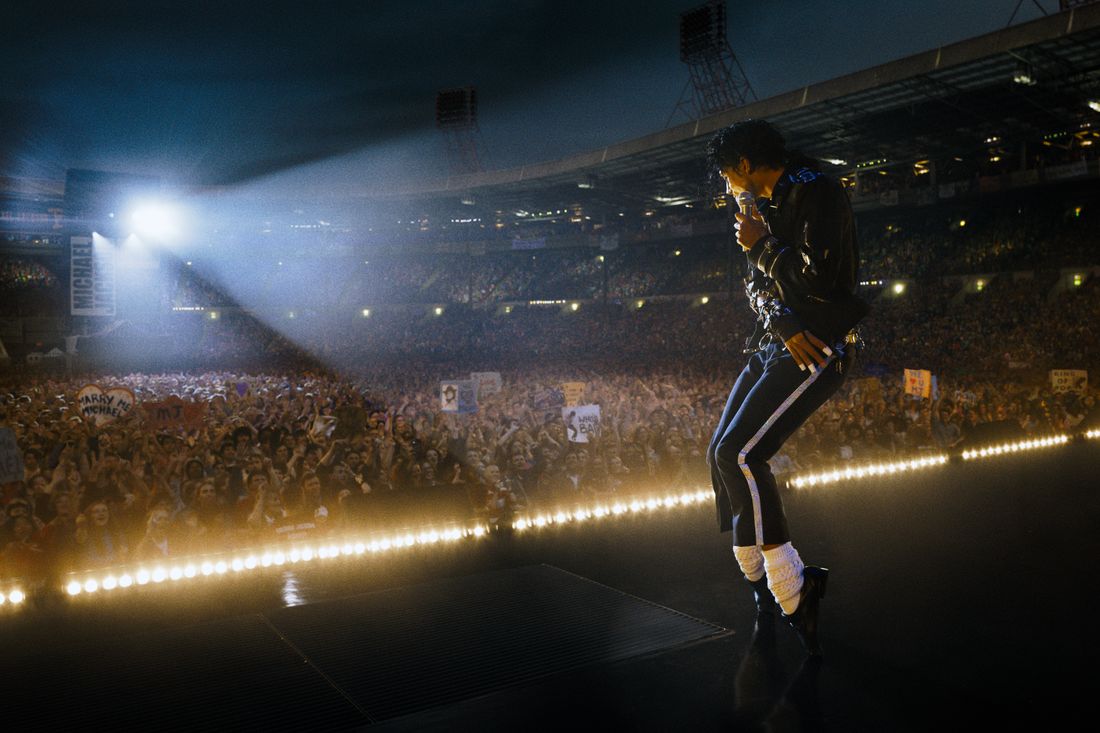
This isn’t about the child molestation accusations that began in 1993. A previous cut of the film initially presented the first accusation as a shakedown, but that was changed with costly revisions. Now, the film stops covering Jackson’s life before the 1988 Bad tour, circling back to that period and hinting at a possible continuation. However, the movie struggles to connect key moments from Jackson’s life into a compelling narrative, lacking dramatic tension. It doesn’t offer much insight into his personal life, his artistry, or his complicated family relationships. Michael barely maintains enough momentum to move between musical performances, which seem to be the film’s primary focus. Watching it feels less like experiencing a movie and more like being led through a lifeless museum exhibit, where each scene is recreated with an unsettling, almost-but-not-quite-right accuracy and without any emotional depth.
Despite having a well-known director, Antoine Fuqua, and screenwriter, John Logan, the upcoming film about Michael Jackson feels less like a creative project and more like an attempt to improve his public image. It’s been almost 17 years since his death, but his music and legacy are still incredibly valuable, and this film seems designed to maximize that value. Janet Jackson, already a rising star in the late 80s, chose not to participate, so she’s completely absent from the story, as are her siblings Rebbie and Randy. Interestingly, Michael Jackson’s lawyer, John Branca, who helps manage his estate, is a major character played by Miles Teller, and receives more screen time than any of Michael’s actual siblings. Jaafar Jackson, Jermaine’s son, plays Michael, and while he’s a talented dancer, his acting is somewhat unconvincing. He bears enough resemblance to his uncle that he’ll likely be used for future projects related to the film.
Jaafar Jackson’s performance feels more like imitation than genuine portrayal. He accurately mimics Michael Jackson’s voice and dance moves, but struggles to convey deeper emotions. Young Michael, played by Juliano Krue Valdi, actually delivers a more compelling performance, showcasing impressive talent as a child singing adult songs. However, any actor would face a huge challenge playing Michael, as the story requires him to be seen as a victim while never allowing for the possibility that he could also be flawed. The film therefore focuses on Joe Jackson, the father and manager, as the primary source of conflict within the family’s carefully constructed world, particularly at their Encino home. Colman Domingo portrays Joe with heavy makeup and prosthetics, creating a strikingly artificial appearance. He’s depicted as either greedy and smirking or cold and stern, and is ultimately presented as the reason Michael remained stuck in a state of arrested development.
Joe Jackson controls his family harshly, and his wife, Katherine, watches with worry but rarely steps in, even when he physically abuses Michael and forces all his sons to practice constantly. The film shows Michael’s insecurity offstage, his dependence on his pets (including a computer-generated chimpanzee named Bubbles), and his obsession with the story of Peter Pan. The hero’s distinctive nose in the book’s illustrations, combined with Joe’s critical comments, contribute to Michael’s decision to have a nose job (though further surgeries are only suggested). However, the movie avoids fully exploring Michael’s inner life, likely to avoid connecting his unusual behavior to the allegations of child abuse that he always denied. Even without knowing the future, scenes of adult Michael playing in a toy store or preferring the company of children in hospital wards feel unsettling, because he repeatedly emphasizes to his father that he is no longer a child.
He’s no longer seen as a person, but as a product – Michael presents himself as an ‘IP,’ something to be protected, polished, and carefully managed. We often discuss separating the work from the artist, but this film suggests a more troubling idea: instead of grappling with the difficult truths about the creator of something we enjoy, we can simply reshape their image into something more acceptable. This carefully crafted ‘Michael’ is far easier to control than the real man, and if those in charge decide it’s time, they can effectively erase him and start fresh with a new version.
Read More
- Netflix’s Little House On The Prairie Reboot: Release Date, Cast & Everything We Know
- Off Campus Season 1 Soundtrack Guide
- YouTuber arrested after viral AI bodycam videos spark real police complaints
- Silver Rate Forecast
- Prime Video’s New R-Rated Spy Thriller Is Officially No.1 On Streaming Despite Poor Reviews
- Brent Oil Forecast
- Gold Rate Forecast
- Peaky Blinders: The Immortal Man’s Tommy Shelby Is a Better Father Than Michael Corleone
- EUR ZAR PREDICTION
- Bulgakov’s Take: Koreans Bet the Farm on Chips, Crypto, and Chaos
2026-04-23 16:54