Spoilers for Blue Heron ahead.
A worried neighbor asks young Sasha why she did something risky. In director Sophy Romvari’s first feature film, Blue Heron, Sasha is playing with friends when she climbs onto the cover of a swimming pool. The cover isn’t strong enough, and she begins to fall into the water. The film doesn’t explain why Sasha climbed onto the pool cover, and that’s not really the point. Ultimately, she’s okay, though soaked from the experience.
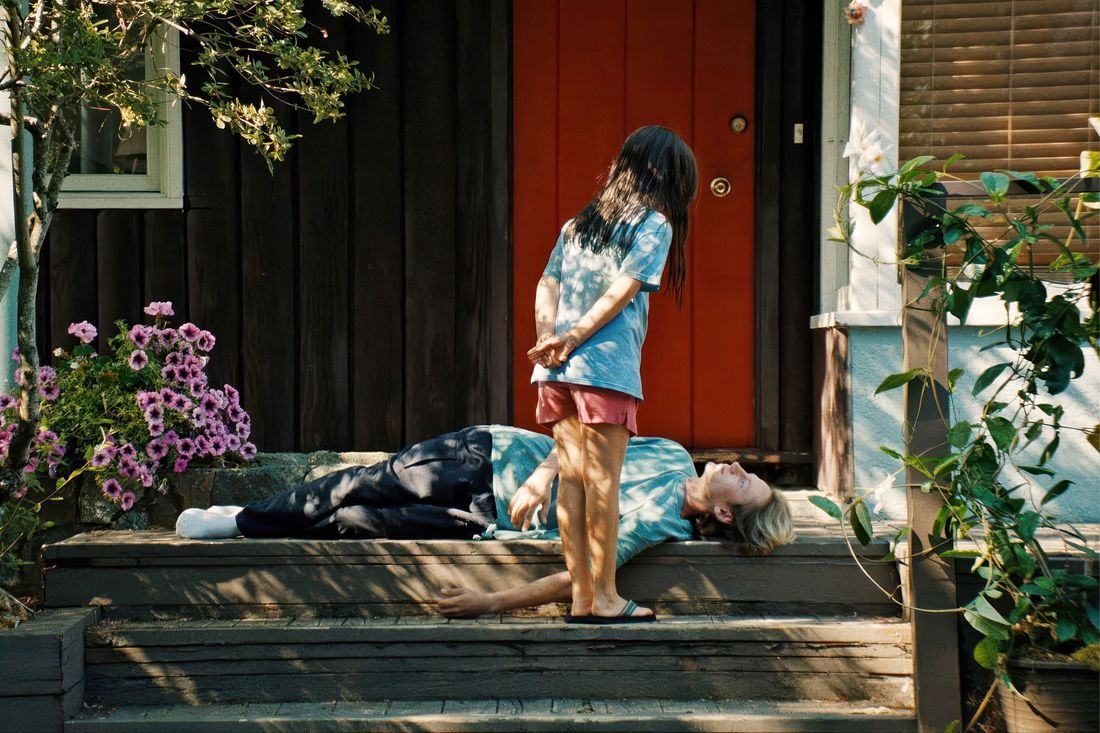
The question, “Why did you do that, sweetheart?” really gets to the heart of Blue Heron, a film loosely based on the director’s own family. The movie follows a fictionalized version of the director’s Hungarian family as they move to Vancouver Island for a summer in the 1990s. The story centers on Sasha and her parents (Iringó Réti and Ádám Tompa) as they struggle to understand the increasingly troubling behavior of her older half-brother, Jeremy (Edik Beddoes). Throughout the summer, they search for answers, but nothing they try seems to help or explain his actions. Beyond the family drama, Blue Heron is also a coming-of-age story for young Sasha, who is fascinated by her father’s constant filming and photographing of their everyday life.
Blue Heron is a film, like many others, that explores a filmmaker’s difficult childhood and how it shaped them as an artist. It’s most similar to Aftersun, which depicts a young girl’s vacation with her troubled father, but also shares elements with films like Joanna Hogg’s Souvenir and Steven Spielberg’s The Fabelmans. A common theme in these types of movies is the way making art becomes a way to heal. While filmmaking can’t change the past, it allows the director to revisit and re-examine events, potentially leading to understanding and self-forgiveness.
Blue Heron unfolds with a growing sense of emotional intensity. The film takes a noticeable turn halfway through, jumping to the present day. We see Sasha, now an adult woman played by Amy Zimmer, using a blend of documentary and fictional techniques – similar to those of Romvari – to explore and try to understand the family relationships that shaped her childhood. Like the character Julie in The Souvenir Part II, who investigates her boyfriend’s true identity, adult Sasha seeks answers by asking a group of social workers to review her brother’s case file. She wants to know what could have been done differently. However, there are no easy answers – some suggest he may have had a personality disorder, while others point out that support for families hasn’t improved much in recent years.
I’ve been trying to see this as just a bump in Sasha’s road, but honestly, it feels like she keeps hitting dead ends. It’s clear there aren’t any easy answers to what she’s searching for, and it explains why Jeremy acted the way he did. It just makes you wonder what anyone could have done to fix things. Then the movie throws this huge curveball – Sasha somehow goes back in time to see her family. She essentially steps into the shoes of a social worker we met earlier and has this really tough talk with her parents. She confronts them about how they struggled to care for Jeremy, or any of their kids, after his problems started. It’s a heartbreaking scene, but it doesn’t offer any relief. Sasha ends up reading a letter to them where she basically admits that nothing ever really worked. They tried everything over the years – even, and this is a sensitive point within the family, temporarily putting Jeremy in foster care – but nothing could stop the terrible thing that was going to happen.
In Aftersun, director Charlotte Wells isn’t interested in offering easy answers or solving a mystery surrounding Jeremy’s struggles. Instead, she uses the film to explore the process of coming to terms with loss and the limitations of understanding. It’s a deliberately unresolved approach that feels honest and impactful. The film invites viewers to connect with the fragments of memory and find meaning in quiet moments. A key sequence depicts an adult Sophie confronting her father in a dreamlike rave, filled with unspoken emotions – her anger, fear, and sadness are palpable, even without hearing their words. Later, a seemingly important conversation between Sasha and Jeremy remains unheard, replaced by a shared walk filled with laughter and nostalgia. There’s no dramatic reveal, just a simple connection between siblings. The film subtly reinforces its focus on memory when Sasha recalls a forgotten detail, and Jeremy gently points out the fallibility of recollection. This isn’t about uncovering a hidden truth, but about acknowledging that our memories are reconstructions, not perfect recordings.
Sasha’s father used to tell her that watching a photo develop in his basement darkroom was like time running in reverse. Seeing the image appear felt like hitting rewind, though the process eventually stopped, leaving a clear but fixed moment in time. As Sasha’s imagination takes hold, the film begins to erase Jeremy from the pictures. Despite the nostalgic charm of developing photos or using an old camcorder, the film ends with a modern iPhone recording the streets of Vancouver Island. The movie Sasha makes – and perhaps the one Romvari creates too – offers only a glimpse into the past and present, much like the maps Jeremy used to draw. It isn’t comforting, but it’s honest.
Read More
- Netflix’s Little House On The Prairie Reboot: Release Date, Cast & Everything We Know
- Off Campus Season 1 Soundtrack Guide
- YouTuber arrested after viral AI bodycam videos spark real police complaints
- Silver Rate Forecast
- Prime Video’s New R-Rated Spy Thriller Is Officially No.1 On Streaming Despite Poor Reviews
- Brent Oil Forecast
- Peaky Blinders: The Immortal Man’s Tommy Shelby Is a Better Father Than Michael Corleone
- Gold Rate Forecast
- EUR ZAR PREDICTION
- Bulgakov’s Take: Koreans Bet the Farm on Chips, Crypto, and Chaos
2026-04-23 16:56