TL;DR
- Binance Lists BitMine Stock: Binance launched equity trading by listing BitMine (BMNR), while the firm holds a massive treasury of 5.54 million ETH (5% of global supply).
- XRP Hidden Accumulation: Institutional buyers continue to stack XRP through spot ETFs despite broader market panic. The Franklin XRP ETF alone added $1.19 million in a single day.
- Japan Elevates Shiba Inu: Japan’s lower house passed a law to treat crypto like ordinary stocks by 2027. It slashes tax on profits to a fixed 20%. SHIB is poised to benefit because it is already on the regulator’s trusted “Green List”.
- Crypto Market Outlook: Heavy macro pressures and money moving into AI IPOs pulled BTC down to a four-month low between $59,000 and $62,580.
- Hot U.S. Inflation Data: May PPI data showed producer inflation jumped to 6.5%, keeping pressure high on crypto assets. Traders are now watching upcoming consumer inflation expectations for the next big market move.
Binance expands Equity Trading platform with BitMine stock listing
The world’s largest crypto exchange, Binance, listed stocks of BitMine Immersion Technologies (BMNR). The event is notable because BitMine holds the world’s largest corporate Ethereum treasury, controlling 5.54 million ETH, or almost 5% of the entire global supply.
The listing took place as part of the launch of Binance’s new Equity Trading service. In its first week of operation, the tokenized stock segment accounted for 2% of the exchange’s total crypto derivatives trading volume.
Binance Lists Ethereum’s Largest Treasury BitMine; XRP Loses $1 Billion ETF Threshold Despite Record Lock Up; Shiba Inu (SHIB) Eyes Regulatory Breakthrough via Japan’s New Framework – Morning Crypto Report
XRP Vindicated? Ripple CEO Says ‘Yes’
Interestingly, according to Binance Research, investors are now betting on artificial intelligence infrastructure, directing 57% of all capital into the IT sector. At the same time, 84% of trading volume came from residents of emerging markets, who used the new instrument to bypass strict local restrictions on buying U.S. assets.

In this context, BitMine stocks are legal U.S. securities, while their price is tightly tied to ETH because of the company’s massive coin reserves. For retail traders, this instrument could become a hybrid that allows them to pursue both opportunities simultaneously: the stock market and the cryptocurrency market.
This allows BitMine to directly access funds from users worldwide, bypassing U.S. brokers. This could help stabilize its price, especially after recently losing $11 billion related to its Ethereum holdings.
Investors are buying XRP despite ETF assets falling
U.S. exchange-traded funds (ETFs) focused on XRP have seen record investment, totaling $1.43 billion. However, recent market declines have caused the total value of these funds to dip below $1 billion, currently at $948.98 million, according to SoSoValue.
A significant price difference appeared because the value of XRP has remained around $1.10 for the last day. This automatically lowered the dollar value of the assets that companies like Bitwise, Canary, Franklin Templeton, and Grayscale are required to hold as backing for their shares.
In effect, the market saw a hidden accumulation effect. While retail traders were dumping XRP amid broader panic, funds continued increasing their holdings. In the latest reporting day alone, the Franklin XRP ETF recorded a net inflow of $1.19 million.
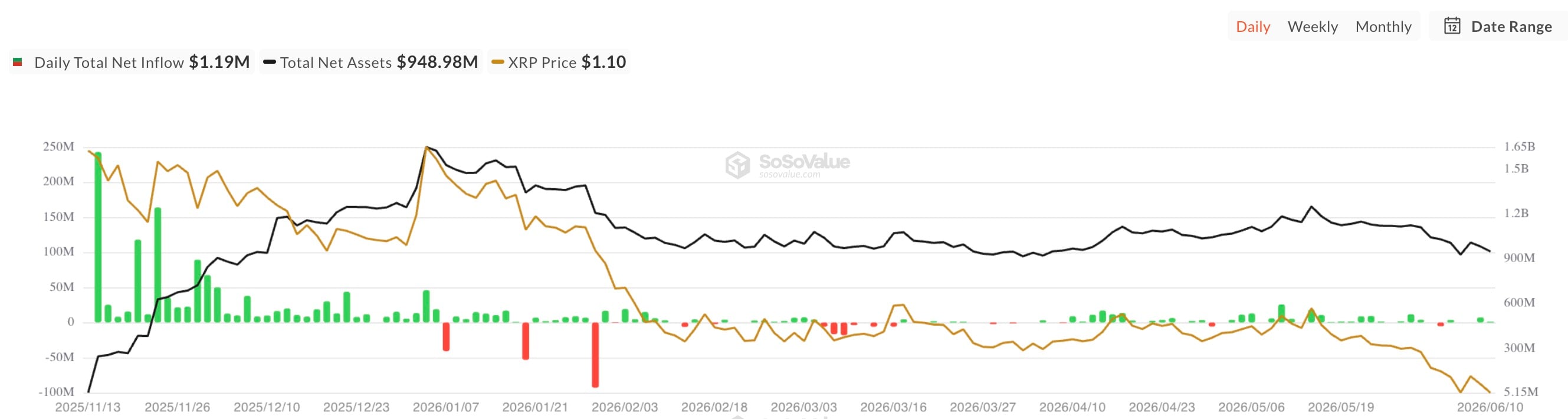
Recent buying activity when the price dropped led to a record amount of XRP held in ETFs. Institutional investors now manage 1.39% of all XRP in circulation.
Early in June, XRP ETFs are behaving differently than Bitcoin and Ethereum ETFs. While Bitcoin and Ethereum ETFs experienced continued net outflows – losing over $77 million on June 9th alone – XRP ETFs are bucking that trend.
The recent decrease in XRP funds under management, falling below $1 billion, doesn’t indicate major investors are selling off their holdings. Instead, it appears to be a planned adjustment by institutions, allowing them to gradually buy XRP at a lower price.
Japan to treat crypto like stocks: Why this is a chance for Shiba Inu (SHIB)
Japan’s parliament has unexpectedly passed a law that will regulate digital assets similarly to traditional stocks. Expected to be implemented by 2027, the new rules aim to create a more organized market and offer benefits like a lower tax rate of 20% on crypto profits. Additionally, the law will allow major financial institutions to legally offer cryptocurrency investment funds.
Unlike many other cryptocurrencies that are bracing for tighter regulations, Shiba Inu (SHIB) seems well-positioned to thrive in the changing landscape. Its potential for wider acceptance by major investors is growing, primarily due to two key developments:
- The JVCEA association has already included SHIB in its elite “Green List” of trusted assets alongside Bitcoin and Ethereum. The local regulator, the FSA, has checked the token’s safety, so leading Japanese exchanges such as BitTrade, SBI VC Trade, Coincheck and Rakuten Wallet can list it without lengthy bureaucratic reviews.
- Legal institutional lending programs in SHIB are already operating in Japan, and the token is already being widely accepted for payment on the giant local marketplace Mercari, which was one of the latest platforms to adopt it.
Tokyo is aiming to draw in cautious, experienced investors, so investment funds need to be officially approved and well-defined. Because Shiba Inu already meets these requirements, it’s well-positioned to attract new investment.
Crypto market outlook: BlackRock clients realize Bitcoin losses as inflation accelerates
The cryptocurrency market is experiencing significant selling pressure right now, driven by increased tensions in the Middle East, a surge of investment into new artificial intelligence companies, and challenging economic conditions in the US.
Key points:
- Institutional capital is moving into AI: Major funds are temporarily changing strategy, pulling money out of crypto in favor of AI giants’ stocks amid the launch of mega-IPOs from SpaceX and xAI. In the past 24 hours alone, BlackRock transferred $151 million in BTC and $21 million in ETH to Coinbase Prime, while total outflows from spot Bitcoin ETFs in recent weeks exceeded $2 billion.
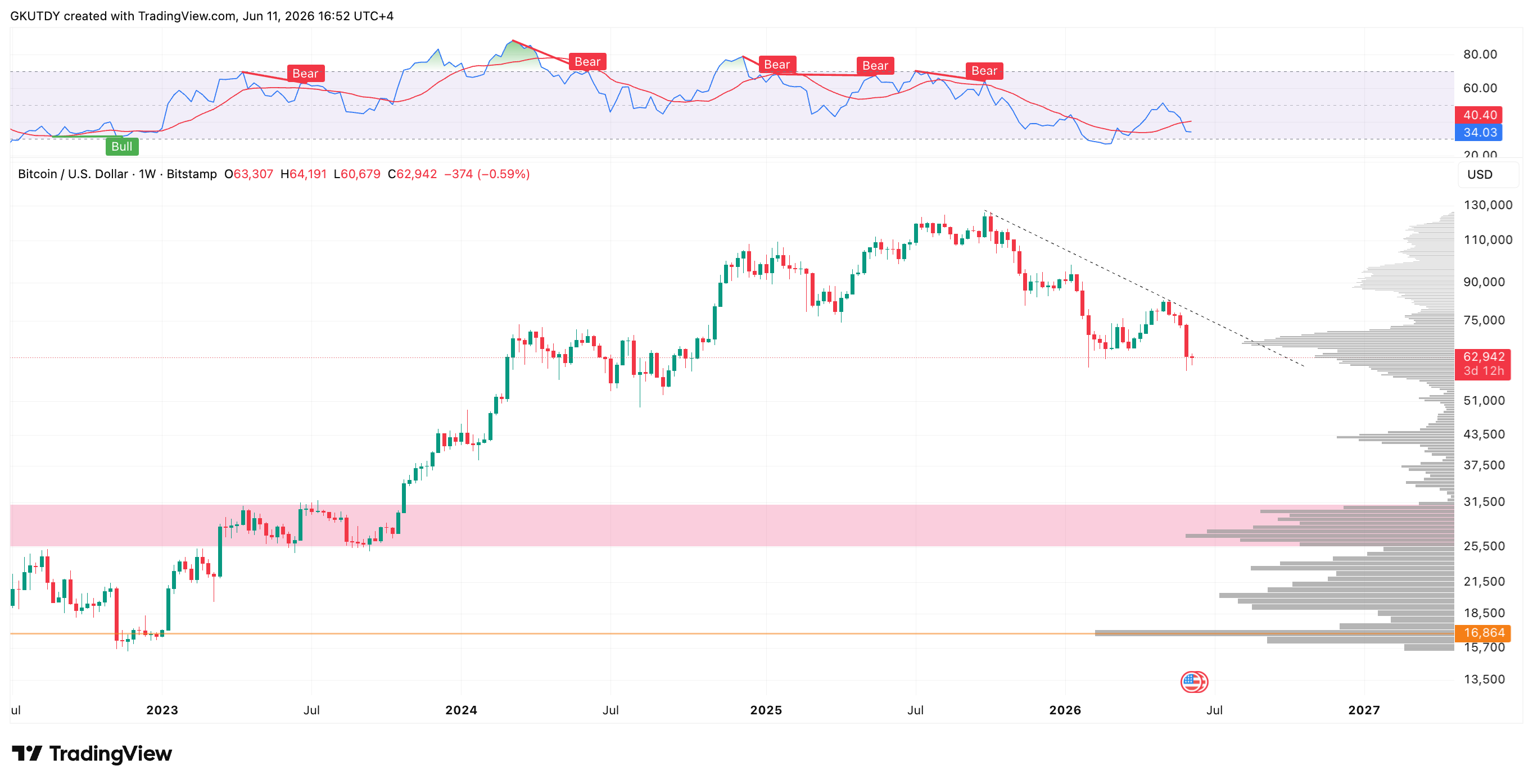
- Bitcoin is testing the capitulation zone: BTC broke its weekly support structure and fell to a four-month low around $59,000-$62,580. This triggered a cascade of forced long-position liquidations worth $1.63 billion.
- Pressure from producer inflation (PPI): Fresh May PPI data in the U.S. confirmed the market’s worst fears. Producer inflation jumped to 6.5% year over year, compared with the previous reading of 6%, while monthly growth reached 1.1%, compared with the previous 1.4%. Although core PPI fell to 4.9% from 5.2%, and jobless claims rose to 229,000, the overall acceleration in prices leaves little room for a soft landing.
- The next macro trigger: On Friday, June 12, preliminary U.S. consumer inflation expectations data will be released. Any negative numbers against the backdrop of an overheated labor market and expensive oil will deepen the decline.
Read More
- Netflix’s Little House On The Prairie Reboot: Release Date, Cast & Everything We Know
- Off Campus Season 1 Soundtrack Guide
- YouTuber arrested after viral AI bodycam videos spark real police complaints
- Silver Rate Forecast
- Prime Video’s New R-Rated Spy Thriller Is Officially No.1 On Streaming Despite Poor Reviews
- EUR ZAR PREDICTION
- Peaky Blinders: The Immortal Man’s Tommy Shelby Is a Better Father Than Michael Corleone
- Bulgakov’s Take: Koreans Bet the Farm on Chips, Crypto, and Chaos
- Gold Rate Forecast
- Brent Oil Forecast
2026-06-11 16:27