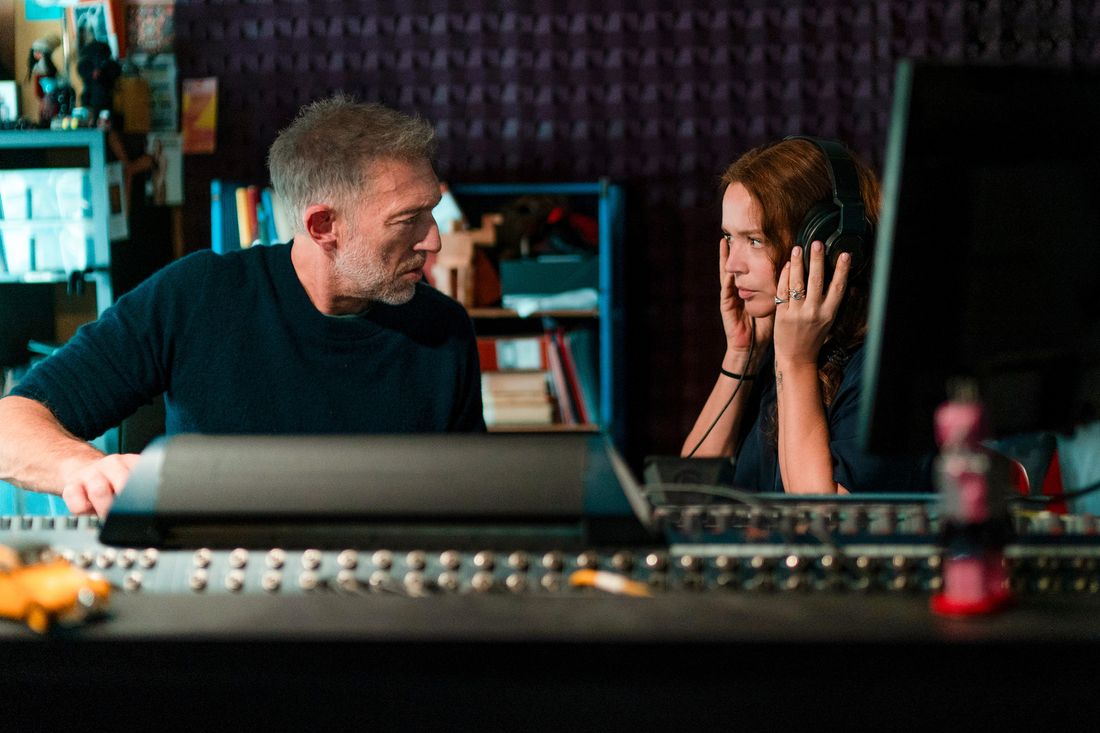
Asghar Farhadi‘s latest film, Parallel Tales, is set in two apartments facing each other in Paris. One belongs to Sylvie (Isabelle Huppert), a somewhat isolated author who is struggling to finish her new book and has become increasingly withdrawn. Her niece, Laurence (India Hair), hires help to get her back on track. Across the street, the other apartment is now a sound effects studio where Nicolas (Vincent Cassel), Nita (Virginie Efira), and Théo (Pierre Niney) work. Sylvie, who rarely leaves her apartment, spends her time observing her neighbors through a telescope and using them as the basis for her novel. In her imagination, Nita transforms into Anna, a seductive and manipulative woman involved in a complex relationship with the gentle Christophe (Niney) and a secret affair with her married boss, Pierre (Cassel). Through her observations, Sylvie creates a dramatic fictional story filled with passion, infidelity, and even murder, all brought to life through sound and set against a backdrop of stormy weather and nighttime drives.
Whether it’s a truly great film is debatable, but Parallel Tales is certainly engaging. However, when Sylvie presents it to her editor, the renowned Catherine Deneuve, she finds it uninspired, labeling it predictable and old-fashioned. These are criticisms that could easily apply to the movie itself – it’s Farhadi’s first French-language film that doesn’t quite feel authentic to the culture. It feels like the kind of film that used to fill gaps in art-house theaters between bigger releases – a simple drama that receives undue praise simply because of its location and cast. The film is based on a script by Farhadi and his brother Saeed, loosely adapted from the sixth part of Krzysztof Kieślowski’s 1989 series Dekalog, which focused on a young postal worker’s obsession with an older woman. Parallel Tales is more complex, but it features a similar, troubled character: Adam (Adam Bessa), who goes from being homeless to becoming Sylvie’s live-in assistant after helping her recover a stolen wallet.
Okay, so I have to admit, I was really bothered by Adam. He’s not some naive young guy, and his obsessive focus on Nita – after just reading a story about her – felt genuinely unsettling. The movie never really seemed to decide if we were supposed to sympathize with him, and that was frustrating. I’m used to Asghar Farhadi being a master of nuance, really getting inside people’s heads and making even flawed characters relatable. But here, everyone just felt…off. Adam is intentionally mysterious, we learn he has a criminal past, but it doesn’t quite land. And it’s not just him! Nita, who I expected to be this complicated, alluring figure, turned out to be a pretty grounded, career-focused woman. The contrast between the dramatic lives in the novel Sylvie writes and the everyday struggles of the Foley artists – dealing with commutes, work overload, and sick partners – was striking, but it also contributed to the overall feeling that something wasn’t quite working. It all felt a bit…artificial, honestly.
A central joke in the film Parallel Tales revolves around Adam presenting Nita with a manuscript (claiming it’s his) that depicts a scandalous love triangle between the three of them. Surprisingly, they’re initially shocked, but then become strangely fascinated, almost as if the story is influencing their own behavior. While this is an interesting concept, the film takes a while to develop it, and it would be more effective if the characters felt more fully realized. The film also struggles with its female characters; their actions often feel unbelievable and don’t reflect a realistic understanding of women’s experiences. For example, Nita receives fan fiction detailing an affair, and then casually allows a creepy stranger to follow her home. The film seems unable to recognize the genuinely frightening aspects of Adam’s behavior, and this is a significant flaw considering the many other issues it presents.
Read More
- Netflix’s Little House On The Prairie Reboot: Release Date, Cast & Everything We Know
- Off Campus Season 1 Soundtrack Guide
- YouTuber arrested after viral AI bodycam videos spark real police complaints
- Silver Rate Forecast
- Prime Video’s New R-Rated Spy Thriller Is Officially No.1 On Streaming Despite Poor Reviews
- Brent Oil Forecast
- Gold Rate Forecast
- Bulgakov’s Take: Koreans Bet the Farm on Chips, Crypto, and Chaos
- EUR ZAR PREDICTION
- Peaky Blinders: The Immortal Man’s Tommy Shelby Is a Better Father Than Michael Corleone
2026-05-15 23:54