For Those Who Prefer Their News Served in Small, Unassuming Portions, Rather Than a Full Three-Volume Novel
It is a truth not so universally acknowledged, perhaps, among the bustling circles of crypto speculators, that a single quantum computer in possession of a good algorithm must be in want of a blockchain to break. Yet while half the industry has been wringing its hands over the impending threat of quantum-enabled rogues siphoning every last satoshi and ether from under their noses, one enterprising gentleman of the Ethereum Foundation has seen fit to devise a solution so reasonable, so economical, one wonders why no one thought of it sooner.
This most sensible proposal comes courtesy of Monsieur Nicolas Consigny, a researcher of no small repute, who has laboured in concert with the illustrious Mr. Vitalik Buterin, the learned Mr. Justin Drake, and the entire corps of Ethereum’s cryptography gentlemen, to adapt the well-regarded SPHINCS+ signature standard into an Ethereum-optimized variant fit for purpose, without the need to meddle with the blockchain’s very core protocols-a prospect that would have sent half the developer community into fits of vapours, had it been suggested even a month prior.
The scheme, for so we may term it, permits even the humblest retail investor to fortify their accounts against the quantum marauders of the future, using nought but Ethereum’s existing infrastructure, at a cost of a mere seven cents per account. No grand hard fork, no contentious vote, no weeks of Twitter spats over parameter choices-just quiet, unassuming security, procured for less than the price of a decent pot of tea at a London coffee house in my day. What a novelty, to solve a problem without first manufacturing three more.
The proposal has already won the approbation of many a developer, who have long cast anxious glances at the rapid advances in quantum hardware, aware that the standard public-key cryptography that underpins all our digital holdings is as secure as a locked parlour door left ajar for a clever thief. For years, nay, decades, experts have warned of this very peril, but it was not until a recent experiment in which a quantum computer cracked a 15-bit elliptic-curve key that the industry began to stir from its complacency, as one might rouse a household cat from a sunbeam when the dinner bell rings.
On the New Signature Scheme, Which Promises to Keep Quantum Rogues at Bay
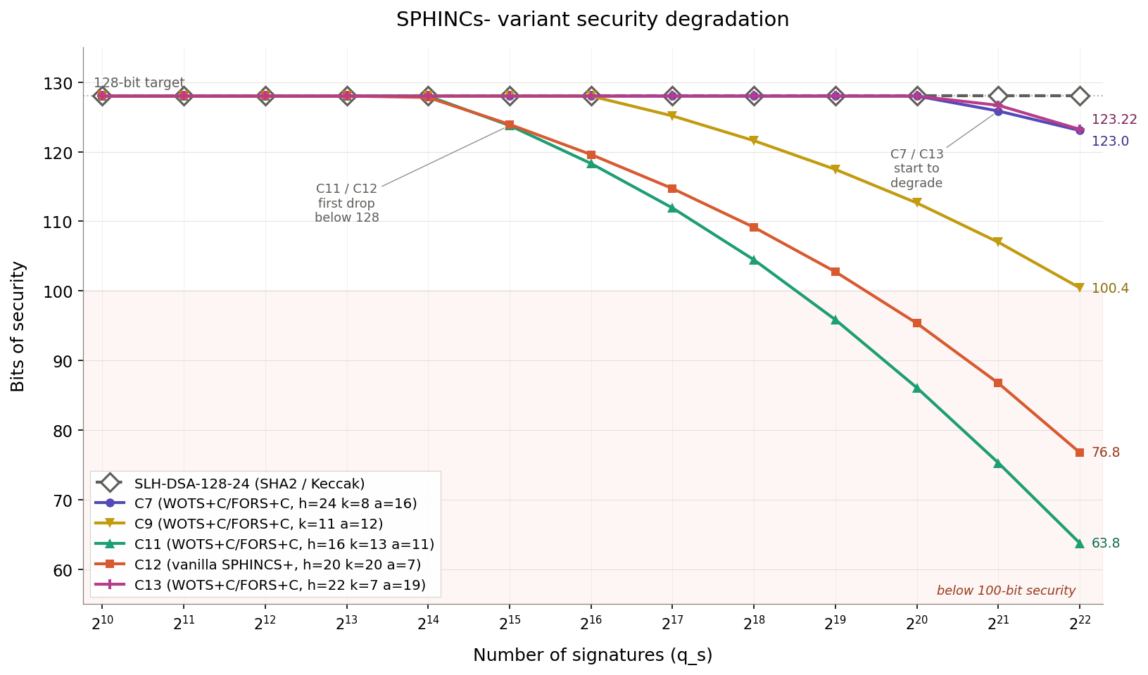
The crux of the proposal is the introduction of SPHINCS-, an Ethereum-tailored take on the trusted SPHINCS+ standard, engineered to withstand even the most determined quantum assault, and fully compatible with the Ethereum Virtual Machine to boot. Now, it is well known that the standard SPHINCS+ signature carries a heft that would make a country squire’s luggage look light, and verifying such a behemoth directly on a blockchain would cost a small fortune in gas fees, enough to make even the most flush of traders blanch. Consigny’s design, however, has outmanoeuvred this obstacle by swapping the standard SHAKE256 hashing function for KECCAK256, Ethereum’s own native hashing primitive-so beloved, so familiar to the EVM, that it can compute it faster than a lady can refuse a second dance at a ball.
As a result, the cost of verifying a post-quantum signature via smart contract sits at a mere 150,000 gas, according to the research papers, with further optimizations in the works to shrink signature sizes and cut verification costs even further. One cannot help but marvel at the ingenuity of it all, when a simple swap of a hashing function can render the impracticable, practical.
Consigny has been at pains to credit his collaborators in this endeavour: Mr. Buterin, whose insight into Ethereum’s long-term trajectory is as sharp as any; Mr. Drake, whose attention to cryptographic detail is the envy of the field; and the many members of the cryptography team, whose quiet labour often goes unremarked, though it is the very backbone of the network’s security. ‘Tis a rare thing to see credit passed round so generously, in an industry not always known for its politeness.
On the Looming Quantum Peril, Which Grows Closer With Each Passing Experiment
The proposal arrives at a most opportune moment, as anxieties over quantum computing grow apace across the crypto sphere. For years, the most learned among us have cautioned that a quantum computer of sufficient power could one day shatter the cryptographic systems that guard Ethereum, Bitcoin, and every other major blockchain, leaving the holdings of millions exposed to any clever operator with access to such a machine. A recent experiment only served to bring this peril into sharper focus: this past April, researcher Giancarlo Lelli was lauded by Project Eleven after he used a quantum computer and a modified Shor’s algorithm to crack a 15-bit elliptic-curve key. While the key in question was far smaller than those used by our leading blockchains, the experiment served as a most unwelcome reminder that quantum capabilities advance faster than many had supposed.
For now, both Bitcoin and Ethereum remain secure, relying as they do on 256-bit cryptography far stronger than the test key. Yet Glassnode, the esteemed blockchain analytics firm, has estimated that some 1.92 million Bitcoin could be exposed to structural risk should quantum computers ever grow powerful enough to breach current encryption standards. And while the rest of the industry has yet to match Ethereum’s industrious response, with Bitcoin, Solana, and several other networks still relying heavily on ECDSA, and none having announced post-quantum security initiatives of comparable scale, one cannot help but feel that Ethereum has, for once, taken a most sensible lead.
Thus, this latest proposal is not merely a technical improvement, no, no. It is a concerted, well-considered effort to ready the platform for a future in which quantum computing turns all our current assumptions about digital security to dust. One can only hope that the rest of the industry takes note, before it is too late, and before the quantum rogues come to make off with all our digital fortunes, leaving nothing but a pile of worthless cryptographic ash in their wake.
Read More
- Netflix’s Little House On The Prairie Reboot: Release Date, Cast & Everything We Know
- Off Campus Season 1 Soundtrack Guide
- Gold Rate Forecast
- Infinity Nikki Candlelight Reverie Challenge and Rewards Guide
- Prime Video’s New R-Rated Spy Thriller Is Officially No.1 On Streaming Despite Poor Reviews
- Silver Rate Forecast
- Brent Oil Forecast
- EUR ZAR PREDICTION
- 24 Jump Street in the works with Jonah Hill and Channing Tatum set to return
- KPop Demon Hunters Meets Avatar: The Last Airbender In Netflix’s 3-Part Fantasy Series
2026-06-15 10:29