panic, disbelief, and a whale with the emotional restraint of a toddler in a candy aisle.
A single whale-because of course it was-dumped 670 million SIREN tokens in just two days. That’s 92% of the circulating supply, or as I like to call it, “the financial equivalent of flipping the table during family game night.” The whale walked away with $64.8 million in USDT, while thousands of retail holders were left clutching their now‑worthless tokens like expired coupons.
Once boasting a market cap north of $1.7 billion, SIREN is now more of a ghost story told to frighten new investors.
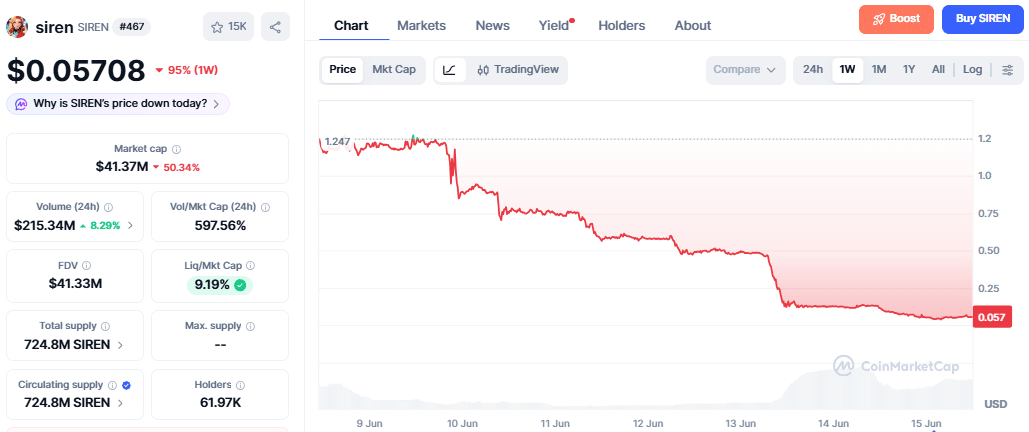
At the moment, SIREN trades around $0.053-down 95% on the week and 54% in the last 24 hours. Its market cap has shriveled to roughly $38 million, with just 61,970 holders still hanging on, presumably out of stubbornness or denial.
The whale that ate the market
On June 14, Lookonchain spotted the whale receiving 28 million USDT from token sales in a single day. Most of it was promptly shipped off to centralized exchanges, the crypto equivalent of someone quietly packing their suitcase and whistling while they head for the door. At that point, the whale still held 478 million SIREN tokens, prompting Lookonchain to issue the kind of warning usually reserved for horror movies: “The dump isn’t over yet.”
SIREN’s 24‑hour trading volume hit $224 million-over five times its market cap. When your turnover ratio looks like that, it’s less a market and more a yard sale where everything must go, including your dignity.
A pattern that keeps repeating
This isn’t SIREN’s first rodeo. The token has been pumped and dumped so many times it should qualify for frequent‑flyer miles. It once surged 6,800% in March before crashing 90% in under a week. Another rally pushed it above $1 before whales once again decided it was time to cash out and leave retail investors holding the world’s saddest digital bag.
Analysts repeatedly warned that whales controlled up to 94% of the supply. One cluster alone allegedly held 88.5%-which is less a “market” and more a “hostage situation with extra steps.”
Broader market stands in contrast
What makes this collapse especially embarrassing is that the rest of the crypto market was doing just fine. Bitcoin was up 2%, total market cap up 1.9%, and SIREN… well, SIREN was reenacting the final act of a Shakespeare tragedy.
Open interest in SIREN futures fell nearly 40% as long positions were liquidated. The derivatives market turned so bearish it might as well have been wearing a black veil and humming funeral hymns.
What comes next
The big question: is the whale done? Arkham shows the wallet still holding around $39.7 million worth of assets. If more deposits hit exchanges, brace yourself for another episode of “How Low Can It Go?”-a game nobody asked to play.
Technically, $0.055 is the first level to watch for stabilization. If volume drops below $50 million, maybe-just maybe-the panic is slowing. If not, we may revisit the $0.045 region, also known as “the whale’s favorite shopping spot.”
SIREN still advertises its AI‑powered DEX and trading agent as “coming soon,” which at this point feels like the crypto version of “my band is totally about to release an album.” The gap between marketing and reality, combined with whale‑level supply concentration, created the perfect setup for this week’s spectacular implosion.
For now, the chart tells the whole story: when one wallet controls nearly everything, it’s not a market. It’s a one‑man show, and the rest of us are just paying for tickets.
Read More
- Netflix’s Little House On The Prairie Reboot: Release Date, Cast & Everything We Know
- Off Campus Season 1 Soundtrack Guide
- Gold Rate Forecast
- Infinity Nikki Candlelight Reverie Challenge and Rewards Guide
- Prime Video’s New R-Rated Spy Thriller Is Officially No.1 On Streaming Despite Poor Reviews
- Silver Rate Forecast
- Brent Oil Forecast
- EUR ZAR PREDICTION
- 24 Jump Street in the works with Jonah Hill and Channing Tatum set to return
- KPop Demon Hunters Meets Avatar: The Last Airbender In Netflix’s 3-Part Fantasy Series
2026-06-15 10:14