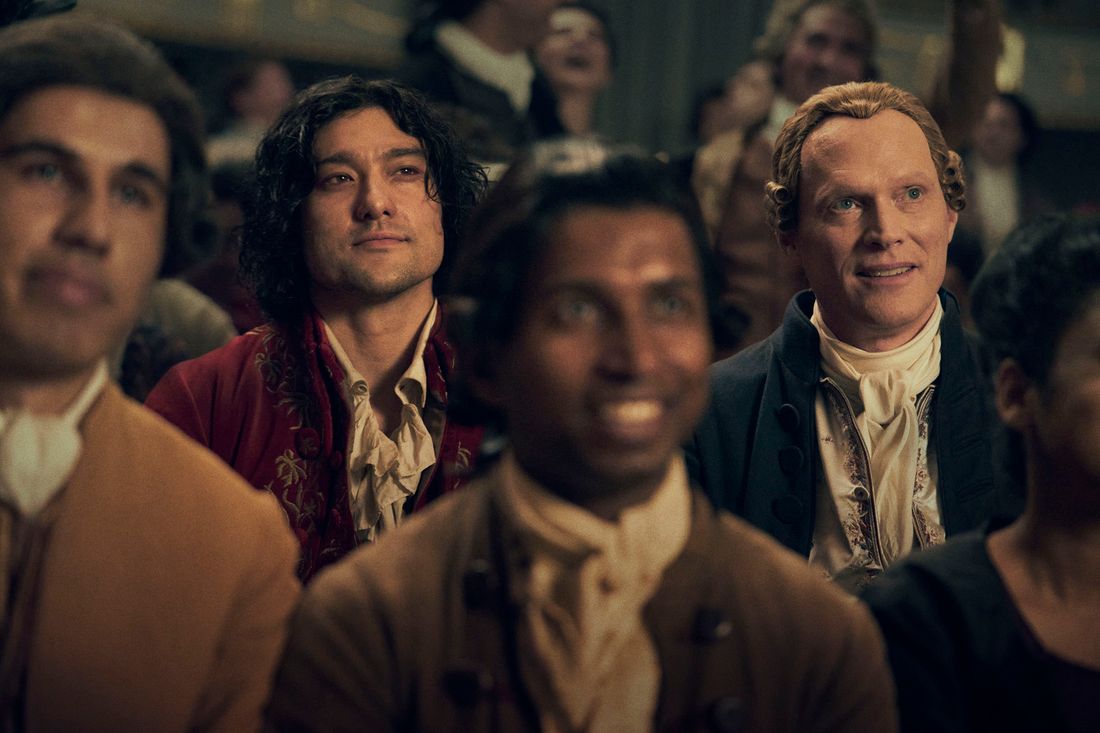
The second episode of Joe Barton’s compelling and unusual series, Amadeus, focuses on Antonio Salieri (Paul Bettany), the famous composer at the Viennese court, who feels abandoned by God. Bettany, shedding the restrained acting style he used as the android Vision in the Marvel films, powerfully portrays Salieri’s deep self-hatred. The episode opens with Salieri sitting in a church, seemingly about to confront Wolfgang Amadeus Mozart (Will Sharpe), the talented young composer who has overshadowed him and whose infant son’s funeral mass Salieri just attended. However, the scene quickly reveals Salieri’s anger isn’t directed at Mozart, but at the image of Jesus Christ on the cross. He laments that God gave him just enough talent to realize how inadequate he is, declaring a bitter rivalry with God and vowing to destroy Mozart. Amadeus is a study of a man grappling with his own limitations and losing his faith, and Bettany’s brilliant performance as Salieri drives the series’ exploration of ambition and the desire for control.
This new five-episode series, which already aired in the U.K. and premiered on Starz May 8th, is based on the same source material as the famous 1984 film Amadeus and Peter Shaffer’s original 1979 play. Like its predecessors, it explores the imagined rivalry between Mozart and Salieri, focusing on how obsession and envy can be destructive. While staying true to elements like Salieri’s unreliable storytelling and a framing narrative about Mozart’s death, this version takes a different approach. The creator, Robert Barton, is particularly interested in the power dynamics within relationships – a theme he’s explored in previous shows like Giri/Haji and Black Doves. As a result, he’s reimagined the connection between Mozart and Salieri, bringing them into constant interaction. Mozart is portrayed as more worldly and aware, while Salieri’s initial distant resentment is heightened. The series also expands the story to include more perspectives, particularly those of Mozart’s wife, Constanze. By giving Mozart a more complex personality, exploring troubled relationships with his father and wife, and making Constanze a more assertive and resentful character who becomes a confidante to Salieri, Barton creates richer, more nuanced roles for the actors and adds depth to the central love triangle.
The series Amadeus opens with an elderly Salieri, now largely forgotten, attempting suicide. He then tells Constanze, Mozart’s wife, a story confessing to the murder of her husband years prior. The narrative jumps between this confession and flashbacks to Vienna ten years before Mozart’s death. These flashbacks show Salieri at the height of his power, a newly arrived Mozart, and Constanze as an up-and-coming singer. As the court composer, Salieri enjoys a close relationship with Emperor Joseph II, who tasks him with revising an old opera to support a series of reforms. The Emperor’s request feels like another setback for Salieri, who is struggling with his own creativity. Salieri desperately needs the Emperor’s favor to maintain his position and is portrayed as insecure and boastful, outwardly charming but inwardly tormented, frequently praying for inspiration.
Salieri finds it harder and harder to imagine music, while Mozart is constantly overflowing with it. Though Mozart escaped his controlling father, Leopold, the film shows he’s still deeply affected by their relationship. He even wishes his talent and constant stream of ideas would stop. The movie features conversations between Mozart and Salieri exploring how they create music – whether it comes naturally or is learned, from God or from within – highlighting both men’s hidden anxieties. While Salieri, played by Bettany, is rigid and horrified, Sharpe’s Mozart is a playful troublemaker who seems to always succeed. The original film showed Mozart being somewhat uncouth, but this version pushes further: he deliberately misbehaves in shocking ways, like messing with desserts and getting drunk before a musical challenge. He’s also brutally honest, even telling Salieri that God might ignore him because he’s uninspired.
As a critic, I found this new take on Amadeus fascinating, though it doesn’t quite reach the heights of the original film. The series really digs into the bitter rivalry between Mozart and Salieri, charting how Salieri’s envy spirals as Mozart’s talent shines brighter. We see them constantly trying to outdo each other, and Salieri’s scheming ultimately leads Mozart and his wife, Constanze, into financial hardship. The music is wonderfully woven throughout, and the opera staging is immersive, though the visual design doesn’t have the same rich, foreboding feel as the film. What struck me most was how the series constantly reminds us of the larger historical context – the looming threat of war – making you question why we’re so invested in these two men. But it’s a powerful question, because they represent that universal feeling of being trapped, like the recurring image of a caged bird. The narrative tension stems from their complex relationship, and especially from how Salieri’s aggression towards Mozart was, at its core, a rage against God. Where this version falls short is in showing Mozart’s genius – the film had that incredible scene with Tom Hulce effortlessly composing, leaving F. Murray Abraham’s Salieri stunned. This series, however, offers a more nuanced exploration of genius as a burden, and how easily it can be exploited and manipulated by those in power. It really drives home the point that Mozart’s decline wasn’t just about artistic rejection, but a deliberate crushing of his spirit by a system that wouldn’t tolerate anything that didn’t serve its own agenda. The series repeatedly demonstrates how readily the powerful will sacrifice even their most brilliant talents if they don’t fall in line.
Much of this echoes themes found in other historical dramas like The Great, The Favourite, Marie Antoinette, Mussolini: Son of the Century, and Death by Lightning. Like those series, Amadeus uses language and attitudes from the past to show how surprisingly relevant those old ways of thinking still are today. Despite its shocking imagery – from Mozart’s provocative acts to Salieri’s struggles with creativity – the show ultimately explores two enduring questions: where does inspiration come from, and what happens when it disappears? Amadeus sets this exploration within the complex politics of the Habsburg Empire, framing Salieri’s belief that good deeds should be rewarded as a justification for his actions. This creates a world where almost everyone is flawed, driven by ambition and a desire for more than they need. By the end, Salieri steps outside the story itself, becoming a symbol of the lengths desperate people will go to when they feel entitled to success. While the show’s period details are entertaining, its most lasting impact comes from suggesting that this kind of self-destructive ambition is still present in our own time, and that’s what makes it so unsettling.
Read More
- Gold Rate Forecast
- Assassin’s Creed is getting a live stage spin-off with parkour and choreographed fights
- Avengers: Doomsday Spoilers & Leaks Addressed By Director Joe Russo: “It’s Over-Policed”
- Crimson Desert Guide – How to Pay Fines, Bounties & Debt
- Apple TV’s Imperfect Women Becomes No. 1 Most-Watched Show Globally
- What is Omoggle? The AI face-rating platform taking over Twitch
- Pragmata: Every Hacking Mode, Ranked
- Blake Lively & Justin Baldoni Settle It Ends With Us Lawsuit 18 Months After Bitter Feud Began
- Man pulls car with his manhood while on fire to raise awareness for prostate cancer
- The 7-Part Dystopian Series Streaming For Free This Month Deserves Its 93% Rotten Tomatoes Score
2026-05-11 22:55