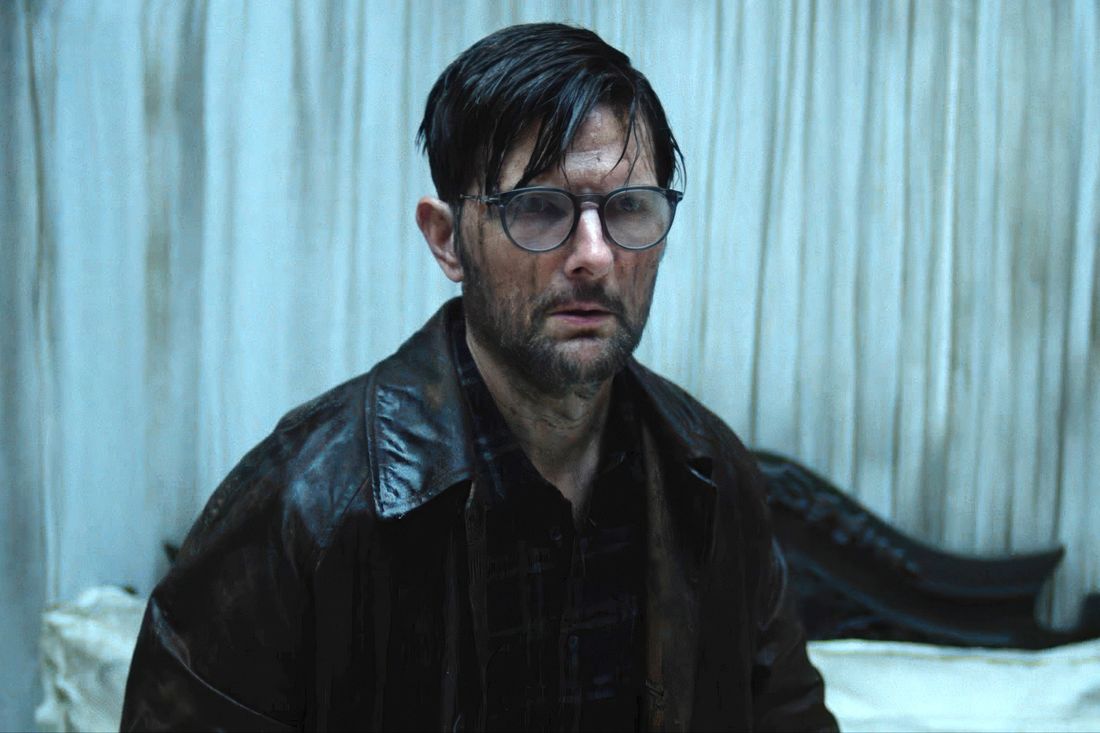
Spoilers ahead for the plot and ending of Hokum.
The story of Hokum doesn’t begin at the start of the movie, but at the end of a story being written by author Ohm Bauman (Adam Scott). We see a conquistador and a young boy journeying through the desert with a map inside a bottle. When they finally reach their destination – possibly treasure, but more importantly, a way to escape the harsh landscape – the conquistador discovers the bottle’s cork is jammed. He tries everything to break the bottle open, but fails. He exclaims, “This can’t end like this,” but the words on Ohm’s computer screen reveal their fate: “They were doomed.” There’s a grim possibility, however. The conquistador realizes a human skull might be strong enough to shatter the glass. He forces the boy to turn his back, then raises the bottle, preparing to strike.
Thankfully, the film doesn’t show us what happens immediately after a particularly dark moment. Instead, we hear the rest of the story from Ohm, who is finishing a series of books. He tells it to Fiona, a bartender at an Irish hotel where he’s scattering his parents’ ashes. Fiona notes how depressing the story seems, and Ohm hints that the ending might be unresolved. They share a toast “to bleak endings.” This conversation, along with the dark tale of a conquistador within the film, leads viewers to expect a similarly somber conclusion to Hokum. Irish folk horror films rarely offer neat, happy resolutions. Even Ohm suggesting Fiona wait for a brighter movie version of his book feels like a trick. However, director Damian McCarthy surprises us all: Hokum delivers a genuinely happy ending – something we haven’t seen in his work before.
If you haven’t seen any films by director Declan McCarthy – which is likely if you don’t subscribe to Shudder – Hokum is his third feature film. His previous movies, Caveat (2020) and Oddity (2024), are scary ghost stories centered around people doing terrible things. This one includes both a ghost and a witch, who is trapped in the hotel’s sealed-off honeymoon suite. But the main focus is a mystery: when Fiona goes missing, the quirky local Jerry (David Wilmot) becomes the prime suspect. He insists he’s innocent, but believes Fiona is dead and haunting the hotel. Jerry tells Ohm he’s seen her ghost leading him to the honeymoon suite. With the hotel about to close for the season, the two decide to sneak in and investigate. While searching separately, Jerry is caught by a hotel worker, Fergal (Michael Patric), who takes him to the police. This leaves Ohm to explore on his own, and the sound of a bell coming from the honeymoon suite draws him towards the supposedly cursed room.
Okay, so this whole situation is clearly heading for trouble, but our main guy, Ohm, is a skeptic – he thinks anything supernatural is just nonsense, so he’s not too worried at first. He doesn’t immediately run into the witch everyone’s talking about, but he does start seeing some seriously creepy things. He has a ghostly visit from his mother after dozing off, and then a terrifying flash of a monstrous rabbit face on the TV! It quickly becomes clear these visions are tied to his past – he accidentally shot and killed his mom when he was a kid, and his father turned to alcohol afterward. It’s a heavy backstory, and you can tell the writer is exploring some deep themes. But honestly, there’s a more pressing issue: Fiona’s disappearance. He finally tracks her down by calling up the old dumbwaiter in the room, and it’s… well, it’s Fiona, but she’s been dead for a while, still in the rabbit costume she wore to the hotel’s Halloween party. Unfortunately, his discovery is interrupted by Mal, a hotel employee, who immediately locks Ohm in the suite and runs off!
McCarthy’s movies are often similar to classic horror stories, acting as moral lessons where criminals face supernatural consequences for their actions. These films aren’t known for being nuanced; for example, the villain in Hokum has a name that literally means “evil.” Through flashbacks, we learn what happened to Fiona: she was pregnant with Mal’s child and wanted to keep it. Mal feared his wife finding out, but even more, he worried about his wife’s father, Mr. Cob, the hotel owner, who would likely fire him. At a Halloween party, Mal drugged Fiona, then trapped her in the hotel’s dumbwaiter, sending her down to the basement where she died. Later, as Ohm desperately searches for an escape route using the dumbwaiter, he realizes the witch isn’t just a story. In a particularly frightening scene, she pursues him from the basement into the honeymoon suite, chasing him around the bedroom. Ohm only survives by remembering a trick from a folklore book and drawing a protective chalk circle around himself.
Things are looking grim for Ohm, and they’ll get worse when Mal arrives the next day, intent on covering up his crimes. Meanwhile, Jerry returns, having escaped Fergal and searching for his friend. Mal tries to trick Jerry into believing Ohm has gone back to America, but Ohm manages to ring the bell of their honeymoon suite, luring Jerry upstairs. Unfortunately, Jerry is immediately shot in the head with a crossbow. Mal starts a fire in the hotel, seemingly about to get away with three murders. However, Ohm has learned a few things during his confinement. He uses the dumbwaiter to escape to the basement, forcing a worried Mal to follow—and only one of them knows how to defend against the witch. Protected by a chalk circle, Ohm watches as she arrives and drags Mal away to join her other tormented victims. Ohm manages to escape the suite and head for the exit, but collapses near the doors as the fire continues to burn.
Given the dark tone hinted at in Hokum and the generally pessimistic nature of director Ryan McCarthy’s other films, it seems improbable that Ohm would have a happy ending. While McCarthy usually ensures villains are punished in films like Caveat and Oddity, there’s always a significant price to pay, often extending beyond just someone’s death. However, Hokum takes a different turn. Ohm is rescued by Fergal and recovers in the hospital, appearing transformed by the ordeal – he stops drinking and even agrees to read Alby’s manuscript, though not without hesitation. Most notably, he rewrites the ending of his book trilogy. The film culminates in a surprising scene: the conquistador, about to commit a violent act, has a change of heart and asks the boy to do it instead. The boy, unable to go through with it, throws the glass away and embraces the conquistador. It’s a decidedly sentimental conclusion, both for Ohm’s story and for the film Hokum itself.
Perhaps the ending of this film signifies more than just the conclusion of a single story. Could the character Ohm’s focus on finishing his book trilogy be a reflection of what director McCarthy is doing with this movie? While Hokum works perfectly well on its own, it’s actually the third film in a series of Irish folk-horror movies that share common themes and subtle connections. For example, the creepy rabbit toy from Caveat reappears in Oddity, and its unsettling eyes are strikingly similar to the bunny face in Hokum (not to mention Fiona’s Halloween costume!). Though the films aren’t explicitly linked, they feel like a connected series, and Hokum feels like a satisfying conclusion to the trilogy, much like the final book in Ohm’s series. After two unsettling movies, McCarthy offers a surprisingly hopeful ending – a moment of genuine relief that, when viewed alongside the other two films, feels truly deserved.
Is director James McCarthy shifting away from darker themes, or is there something new at play in his film Hokum? Like many modern horror movies, the story touches on trauma, but thankfully handles it with sensitivity and nuance. Trauma has been a recurring element in McCarthy’s recent work. In Caveat, both characters are dealing with past trauma that affects their present, and in Oddity, grief drives the entire plot. Unlike those films, Hokum offers a character, Ohm, who actually finds a sense of peace. While hiding from a supernatural threat, he connects with his mother’s ghost and finally apologizes for past regrets, receiving her forgiveness. This moment profoundly changes him. While many horror films end on a bleak note, McCarthy demonstrates – and Ohm shows in his original novel – that overcoming trauma can be a far more rewarding conclusion.
Read More
- Scientology speedrun trend escalates as viewers map out Hollywood facility
- Where Winds Meet’s new Hexi expansion kicks off with a journey to the Jade Gate Pass in version 1.4
- NBA 2K26 Season 6 Rewards for MyCAREER & MyTEAM
- Makoto Kedouin’s RPG Developer Bakin sample game is now available for free
- Vegan nugget startup founder charged with assaulting influencer ex-girlfriend Evelyn Ha
- What Fast Mode is in Bannerlord and how to turn it on
- Noah Beck’s mom suspended from teaching duties after “inappropriate” TikTok with son resurfaces
- How to Get to the Undercoast in Esoteric Ebb
- Insider Trading? Not on Our Watch! Governors Crack Down on Prediction Market Shenanigans
- MrBeast lets fans from every country vote for Beast Games Season 3 contestants
2026-05-01 23:58