There’s a funny moment in John Wilson’s new documentary, The History of Concrete, that really struck me. He wanted footage of the first 3D-printed Starbucks, but didn’t want to travel all the way to Texas, so he hired a local videographer instead. When the footage came back, it was full of drone shots – sweeping views of this plain, gray building. It wasn’t what he asked for, and honestly, it made the Starbucks look like an office worker awkwardly thrown into a fashion shoot! Wilson jokes in the voice-over that this might be what most documentaries will look like from now on, and I think he’s right. My friend Bilge Ebiri actually pointed this out years ago – he called it the “dronepocalypse”! He noticed how every documentary seems to have these gliding drone shots now, and even when they’re done well, they can feel a little… predictable, you know? It’s become a bit of a cliché.
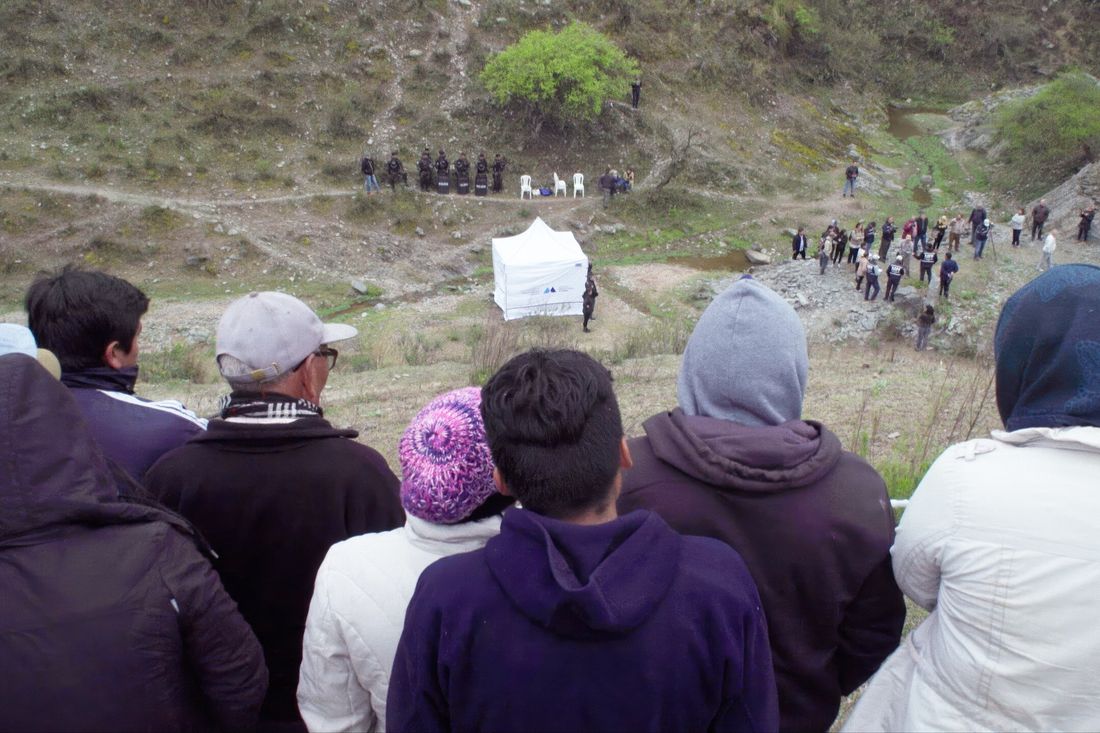
Drone footage is now commonplace, which makes the way it’s used in the new documentary Our Land particularly striking. The film powerfully investigates the murder of Chuschagasta leader Javier Chocobar, who was killed in 2009 while defending his community’s Indigenous land rights against miners. It’s also the first documentary by acclaimed Argentine director Lucrecia Martel, known for her films exploring class and colonial history through a personal lens. Here, she examines power dynamics by revealing how those in control shape historical narratives and accepted truths. The men accused of Chocobar’s murder—who used their connections to claim the Chuschagasta land—present blurry camcorder footage of the incident as proof of their innocence. They also rely on official records that falsely claim the Indigenous population was eliminated, conveniently dismissing their present-day claims.
The Chuschagastans have a long history tied to the land, documented in old photos and family stories. Filmmaker Martel deliberately shows the drones themselves before revealing the footage they capture. Documentarians are drawn to drones because they offer an aerial view previously only possible with expensive helicopters or complex crane setups. However, drone footage can sometimes feel artificial or detached, creating a sense of distance. Martel cleverly uses this impersonal quality to her advantage, framing the drone’s perspective as an all-seeing eye observing a struggle where one side aims to win through endless rules and paperwork. In her film, Our Land, which centers on a 2018 trial, a surveyor claims to be unaware of how close the Chuschagastan settlement was. The camera then shows the site where Chocobar was killed, and eerily pivots mid-air to emphasize just how nearby the house is.
The somewhat artificial look of drone footage – its ability to rise and rotate like a virtual globe – becomes a strength in Martel’s film. It begins with a view from space, zooming in on Tucumán Province as if from a satellite. Our Land also steps back to examine Argentina’s history of exploiting and then ignoring its Indigenous people. This history is so fraught that one family trying to claim ownership of the Chuschagastan land proves its claim by referencing rent they illegally collected from people they simultaneously claim were no longer there. Martel doesn’t hide the fact that drones were used to film this conflict; she often includes the sound of the propellers, even while showing intimate moments in the lives of the Chuschagastans – like a runner’s difficult climb up a hill, or a couple planning their future home, before respectfully pulling back to give them privacy.
Despite their advanced technology, the drones in the film are still guided by the director, Martel, who intentionally maintains her own authorial voice and perspective. The film’s most powerful scene features a drone flying over the contested land, showcasing its beauty while a voice-over recounts how the Indigenous people were deliberately mislabeled to disconnect them from their heritage. Suddenly, a bird strikes the drone, causing it to fall from the sky. This moment emphasizes that no one can have a truly all-seeing viewpoint – the filmmaker is simply using available tools to explore history, acknowledging their limitations.
Read More
- Scientology speedrun trend escalates as viewers map out Hollywood facility
- Where Winds Meet’s new Hexi expansion kicks off with a journey to the Jade Gate Pass in version 1.4
- Vegan nugget startup founder charged with assaulting influencer ex-girlfriend Evelyn Ha
- Makoto Kedouin’s RPG Developer Bakin sample game is now available for free
- NBA 2K26 Season 6 Rewards for MyCAREER & MyTEAM
- How to Get to the Undercoast in Esoteric Ebb
- Insider Trading? Not on Our Watch! Governors Crack Down on Prediction Market Shenanigans
- MrBeast lets fans from every country vote for Beast Games Season 3 contestants
- What Fast Mode is in Bannerlord and how to turn it on
- Noah Beck’s mom suspended from teaching duties after “inappropriate” TikTok with son resurfaces
2026-05-01 21:54