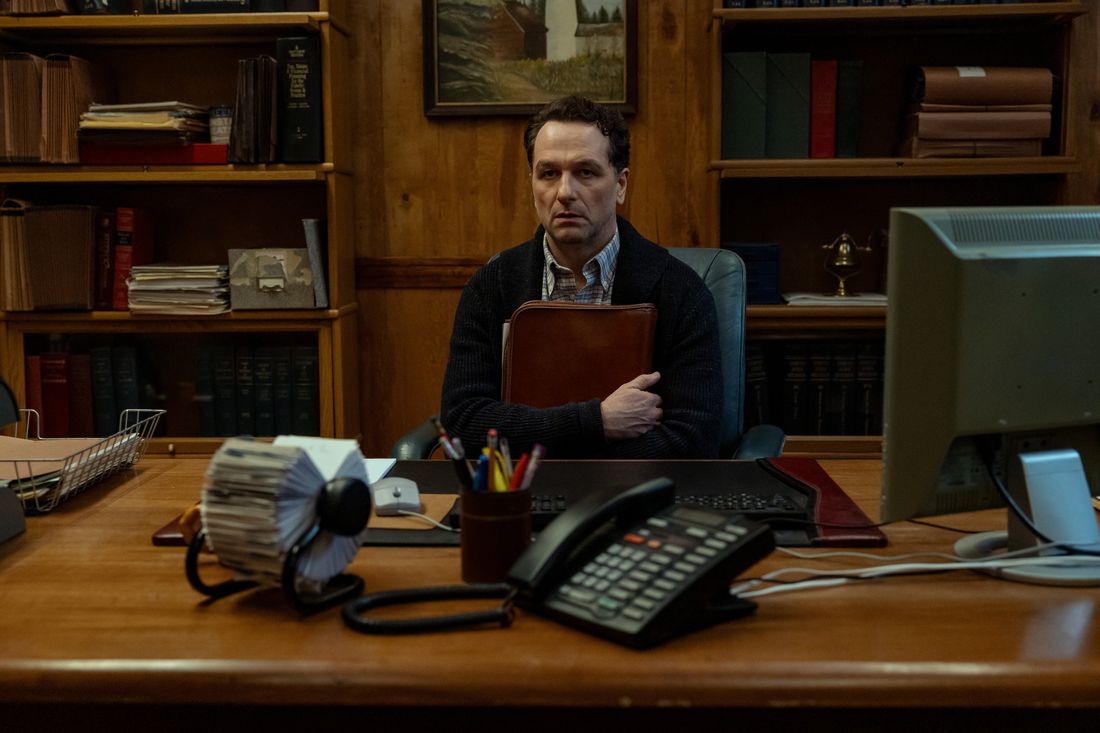
Welcome to Widow’s Bay – both the eerie island off the New England coast and the captivating Apple TV+ series set there. It’s pretty clear something strange is happening in this town, isn’t it? It would be odd to build a show around ghost stories, haunted inns, and creepy killers (the ones dressed as clowns, not targeting them!) if none of it were true. Something is definitely off with Widow’s Bay, and this season’s ten episodes will likely be dedicated to uncovering just what that is.
The series kicks off with two strong episodes, aptly named “Welcome to Widow’s Bay!” and “Lodging.” They do a fantastic job of setting the scene and establishing the unique, funny, and sometimes spooky atmosphere. Created by Katie Dippold – known for her work on Parks and Recreation, as well as writing the movie The Heat and co-writing the 2016 Ghostbusters – the show immediately hints that something strange is happening in Widow’s Bay. The disappearance of Shep, a night watchman on the water, possibly taken by a mysterious fog, is just the first sign.
The story begins with Lonnie, the harbor master, watching a grainy, old episode of Family Feud on a very outdated TV. It’s hard to tell what year it is at first. We soon find out the story is set in the present day, but the town of Widow’s Bay is so isolated—or perhaps magically resistant to technology—that it lacks modern conveniences like Wi-Fi and cell service. The people there rely on landlines and seem to only have access to the oldest TVs imaginable.
Mayor Tom Loftis (played by Matthew Rhys) has big plans to transform this strange town into a tourist spot, but it’s a tough sell. Widow’s Bay has some charm – it’s a bit like the idyllic town of Stars Hollow, with beautiful waterfront views. However, it also carries a distinctly unsettling atmosphere, reminiscent of the town in Stephen King’s It. Despite only having one so-so restaurant, a famously haunted hotel, and residents who aren’t exactly welcoming to visitors, the mayor is convinced people will flock here.
Despite a string of unfortunate events – a missing person, a recent earthquake, frequent power outages, and the unsettling pronouncements of local conspiracy theorist Wyck (Stephen Root) who claims the island is about to face “terror” – Tom remains optimistic. He enthusiastically greets Arthur Lloyd (Bashir Salahuddin, known from Sherman’s Showcase and South Side), a travel writer from the New York Times, hoping Arthur will write a positive article about their little town.
Is Mayor Tom as bad a leader as Larry Vaughn from the movie Jaws, who famously insisted the water was safe despite the shark attacks? This is just one of many horror movie references in Widow’s Bay. Or is Tom just a practical person facing opposition from traditional residents who are afraid of change and trying to scare people into resisting it? We’ll explore this further later.
After two episodes, viewers are still unsure about Tom’s true intentions, but it’s clear he’s not a villain. He genuinely cares for his son, Evan, deeply mourns his late wife, and seems dedicated to the well-being of the town. Plus, he’s played by Rhys, an actor who usually portrays antagonists, adding to the intrigue. Importantly, his plan to revitalize the town is working. Arthur, a writer from the Times, unexpectedly finds himself charmed by Widow’s Bay, commenting that he doesn’t understand why it isn’t as popular as Martha’s Vineyard. This elicits a delighted laugh from Tom, who had been hoping for a comparison to Bar Harbor. Receiving a Martha’s Vineyard comparison – the very location where Jaws was filmed – is a surprisingly pleasant outcome for him.
The story requires Arthur to be charmed by Widow’s Bay and write a positive review, which feels unrealistic considering all the warning signs he encounters during his short visit. He mentions to Tom that a ferry passenger warned him, saying, “Bad things happen here.” Tom tries to dismiss it as typical local folklore, but the Widow’s Bay Historical Society is filled with unsettling news articles – headlines like “Priest Eaten by Whale” and “Man Found Dead by Horse” (leaving you to wonder how the man was found!). When Arthur even asks about cannibalism, Tom immediately denies it, right as the camera pans to an article titled “Cannibalism in God’s House.” This darkly funny, unexpected twist is a perfect example of the show’s signature style.
Arthur starts hearing unsettling rumors from diner customers – things like island natives being unable to leave – and witnesses Tom’s growing panic over the fog. Despite all this, Arthur easily dismisses the talk of death as nonsense. However, as viewers, we aren’t so sure, and Tom himself is finding it harder and harder to remain calm.
Did you notice the echoes of classic horror in the first episode? When Tom hears a scream of “There’s something in the fog!” it’s a direct reference to the tagline from John Carpenter’s 1980 film, The Fog (“Lock your doors. Bolt your windows. There’s something in… The Fog.”). But that’s not the only nod to Carpenter’s work. Patricia shares a story about being haunted by a killer as a teen, saying, “I probably told you about the time in high school when I was home alone the night he came.” This is a clear callback to the tagline for Carpenter’s Halloween: “The night he came home.”
The story “Lodging” is full of references to classic horror films. Tom’s arrival at the inn feels like a scene from Psycho, a New Year’s Eve party echoes The Shining, and a killer clown brings to mind Stephen King’s It. I especially like how the story suggests that all horror stories originate in Widow’s Bay. I’m excited to see kids acting out scenes from Weapons, running around like they do in Naruto.
When Shep wakes up in the hospital as a zombie – something foreshadowed by Wyck’s tale of a soul-stealing fog from 1846 – Tom is understandably disturbed. Despite this, he agrees to spend the night at the inn, partly to silence the superstitious locals who believe it’s haunted and who are already suspicious of him after hearing him insult Wyck. Later, Tom confides in William, another guest (who is secretly a ghost and the clown killer), about his childhood summers visiting his father in Widow’s Bay and how his father criticized him for being too sensitive when he was just six years old. It’s revealed that Tom wasn’t actually calling Wyck names; he was really venting his frustrations at his father.
Tom’s roughly 25-minute stay at the inn is surprisingly more engaging than an entire season of American Horror Story: Hotel. He methodically checks for danger, even repeating the name “Ugly Hortense” three times—a supposed trigger for seeing the ghost of a runaway bride—but nothing happens. Still, the inn feels creepy. A welcome video plays on every channel, showing a man inviting viewers on a tour of Widow’s Bay, then simply walks away from the camera for a very long time. This show shares a lot of similarities with Lost, and the first episode’s ending—a camera pan revealing a basement with an electric chair, accompanied by music straight from the Lost soundtrack—felt so much like that show I half-expected Hugo “Hurley” Reyes to make an appearance.
The games in the inn’s parlor are incredibly strange. One, called Daddy’s Home, has a picture on the lid of a family eating dinner with a father who looks partially like a zombie. Another, simply named Teeth, is just a box containing a pair of pliers – it’s a bit reminiscent of a tense scene from the TV show The Americans. A card game called Run consists of cards that mostly say “Not Yet,” with only one card saying “Run.” Tom avoids playing a board game called She Shouldn’t Have Said That, telling people at the Salty Whale that it gives off a strong sense of misogyny.
Tom is urged on by a mysterious guest named William – who is actually the ghost of a clown killer – and claims to be a structural engineer checking the dock. Despite a warning sign – a card reading “RUN” – Tom bravely enters the crawl space to prove there’s nothing to fear. He’s immediately terrified when William appears, revealing his true identity as the clown killer and rushing towards him… but then Tom wakes up. He’s left wondering if it was just a dream, a drunken illusion, or a terrifying reality.
Kurt, the innkeeper (played by Neil Casey, a standout in a strong cast), discovers black mold in the captain’s suite, potentially explaining the strange events Tom experienced. The security footage actually shows Tom pretending to play with someone—acting out a scene as if with a father—not William as previously thought. Despite Wyck’s concerns, Tom approves the mold removal, hoping to reopen the inn for the tourist season. However, Tom suspects they might need to prepare for something bigger and more dangerous, hinting at the need for increased resources or protection.
Loose Teeth
There are a few interesting hints to explore. Many residents of Widow’s Bay believe people born there can’t leave for the mainland. Also, Evan referred to the town as a “prison,” and the first episode ended with a shot of an electric chair hidden underground. Was Widow’s Bay actually a prison in the past, or is this idea of imprisonment a way to show how stuck the townspeople are in their old ways?
One of the funniest running gags so far involves Kathy, the waitress at the Salty Whale. She clearly doesn’t care about doing her job well, and that’s hilarious. She does things like pour water into people’s drinks, playfully scare customers by tapping their shoulders, and even ignore completed orders to go smoke. The show’s jump scares, especially when Kathy’s involved, are funny because they’re so unexpected and ordinary.
This week brought a lot of genuinely funny moments, often delivered in such a natural way you might not even realize how hilarious they were. Here are a couple of my favorites:
Wyck is describing the stages of soul theft by the fog: first, eyes turn white; then, a loss of the five senses and confusion; finally, loss of physical arousal. Patricia jokingly interrupts to ask who would even try to continue after reaching the second stage, comparing it to the cover of the board game Daddy’s Home.
Tom tries to impress Arthur by telling a story about the first settlers of Widow’s Bay, claiming they found a completely uninhabited island. However, Gerrie, the head of the historical society (played by Nancy Lenehan, recognizable from her role as Jonah’s mom on Veep), quickly points out: “Except for the teeth.” This strange comment is never clarified, but it might explain the name of a game called Teeth played at the local inn.
Read More
- Scientology speedrun trend escalates as viewers map out Hollywood facility
- Where Winds Meet’s new Hexi expansion kicks off with a journey to the Jade Gate Pass in version 1.4
- Makoto Kedouin’s RPG Developer Bakin sample game is now available for free
- NBA 2K26 Season 6 Rewards for MyCAREER & MyTEAM
- Vegan nugget startup founder charged with assaulting influencer ex-girlfriend Evelyn Ha
- How to Get to the Undercoast in Esoteric Ebb
- MrBeast lets fans from every country vote for Beast Games Season 3 contestants
- What Fast Mode is in Bannerlord and how to turn it on
- Ethan Hawke’s $132M Horror Sequel Black Phone 2 Is Officially Heading to Netflix
- Noah Beck’s mom suspended from teaching duties after “inappropriate” TikTok with son resurfaces
2026-05-01 02:56