By Jove, the old Bitcoin exchange reserves have taken a bit of a nosedive, haven’t they? Down to levels last seen when one still had to explain what a “meme” was. Recent on-chain data-the sort of thing one might peruse over a spot of tea-reveals that the amount of BTC lounging about on centralized exchanges has retreated to its 2019 digs. A jolly significant shift, what, in how the chaps and chapesses are stashing their digital treasure.
While the market’s price volatility continues to hog the limelight like a particularly dramatic aunt at a family gathering, the deeper indicators-exchange reserves, old boy-are quietly whispering of supply and liquidity shenanigans. With institutional demand on the up and up, and more investors opting for self-custody (because who trusts a third party these days?), the pool of Bitcoin available for a spot of trading is shrinking faster than a pair of trousers after a spin in the hot wash.
Bitcoin Exchange Reserves: A Multi-Year Dip, Dash, and Disappearance
According to the on-chain sleuths, Bitcoin exchange reserves have dwindled to a mere 2.7 million BTC, the lowest since the halcyon days of 2019. This trend, mind you, has been as gradual as a snail’s progress on a wet leaf, but it picked up pace like a startled hare after the 2022 market kerfuffle. Post-FTX collapse, investors scarpered from exchanges like they were fleeing a particularly persistent door-to-door salesman, moving their Bitcoin into private wallets. In November 2022 alone, over 325,000 BTC made a dash for freedom, one of the largest single-month outflows in Bitcoin’s storied history.
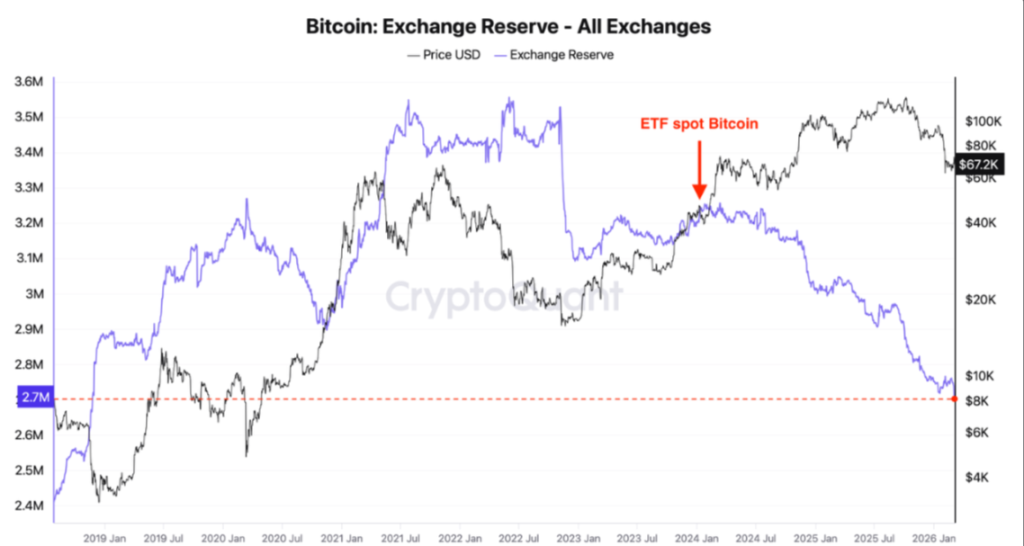
Even now, years after the dust has settled, the downward trend persists, suggesting a long-term shift toward self-custody and the sort of holding strategies that would make a dragon guarding its gold look impulsive.
Among the centralized exchanges, Binance remains the top dog, holding around 20% of all exchange-based BTC reserves. Meanwhile, Coinbase Advanced is sitting pretty with nearly 800,000 BTC, though that’s a cool 200,000 BTC less than their mid-2025 heyday. Steady as she goes, old girl.
Spot Bitcoin ETFs: The New Kids on the Block
Another culprit behind the shrinking exchange reserves is the meteoric rise of spot Bitcoin ETFs. Since their debut in early 2024, institutional investors have been hoovering up Bitcoin like it’s going out of fashion, all through these regulated investment products. When ETFs first strutted onto the scene, exchange reserves were still above 3.2 million BTC. Fast forward to today, and these funds collectively hold roughly 1.3 million BTC, a tidy 6-7% of Bitcoin’s circulating supply.
Because ETF holdings are typically tucked away with custodians rather than exchanges, this Bitcoin is effectively off the market, as liquid as a camel in the desert.
As ETF inflows continue, the amount of Bitcoin available on exchanges may well keep dwindling, leaving traders to scramble like eggs at breakfast.
Corporate Bitcoin Treasuries: The Long Game
Corporate treasury strategies are also playing their part in this grand reserve reduction. Over the past few years, several companies have embraced Bitcoin as a strategic reserve asset, allocating BTC to their balance sheets as a hedge against the sort of macroeconomic uncertainty that would make even the most stoic fellow raise an eyebrow. Collectively, these corporate entities now hold around 1.1 million BTC, a not-insignificant 5% of the total circulating supply.
Unlike the day-traders, who flit about like butterflies in a breeze, these organizations are in it for the long haul, meaning their Bitcoin is about as likely to return to exchanges as a cat is to fetch the newspaper. This further tightens the liquid supply available for active market trading.
What Does This Mean for the Bitcoin Price? A Spot of Supply Shock, Perhaps?
When Bitcoin exchange reserves drop, it’s rather like the last slice of cake at a party-everyone starts to wonder who’s going to grab it next. With more BTC being squirrelled away into long-term storage, ETFs, and corporate treasuries, the number of coins available for immediate trading is shrinking faster than a cheap suit in the rain.
Historically, declining exchange reserves have occasionally preceded supply-driven price expansions, particularly when demand is on the rise. While the impact may not be immediate-one mustn’t get ahead of oneself-analysts believe this ongoing reduction in exchange balances could play a starring role in Bitcoin’s next market cycle. So, keep your wits about you, old sport, and your wallet even closer.
Read More
- Gold Rate Forecast
- Assassin’s Creed is getting a live stage spin-off with parkour and choreographed fights
- Avengers: Doomsday Spoilers & Leaks Addressed By Director Joe Russo: “It’s Over-Policed”
- Crimson Desert Guide – How to Pay Fines, Bounties & Debt
- Apple TV’s Imperfect Women Becomes No. 1 Most-Watched Show Globally
- What is Omoggle? The AI face-rating platform taking over Twitch
- Pragmata: Every Hacking Mode, Ranked
- Blake Lively & Justin Baldoni Settle It Ends With Us Lawsuit 18 Months After Bitter Feud Began
- Man pulls car with his manhood while on fire to raise awareness for prostate cancer
- The 7-Part Dystopian Series Streaming For Free This Month Deserves Its 93% Rotten Tomatoes Score
2026-03-09 12:39