AI Financial Corporation, a publicly traded company linked to World Liberty Financial, reported a net loss of $271.5 million for the first three months of 2026. This loss highlights the instability and underlying weaknesses of this controversial cryptocurrency project in the United States.
The filings with the Securities and Exchange Commission, submitted late Monday, follow increasing concerns about the Trump family’s main cryptocurrency project. These concerns include how decisions are made, potential conflicts of interest, and the project’s dependence on rising token prices during a recent downturn in the crypto market.
The company reported a loss of $2.14 per share this quarter. This significant loss is much larger than the $4.7 million in revenue it earned from its older financial technology businesses. The primary cause of the loss is a $348.3 million decrease in the value of its WLFI governance tokens. These tokens, originally purchased for about $1.46 billion, are now valued at $706 million.
Company management has openly expressed significant concerns about the business’s ability to remain operational for the next year. These concerns stem from a lack of sufficient funds to cover short-term debts, consistently losing money from its core business operations, and having very limited cash on hand.
The company’s financial statements reveal significant concerns about its ability to stay in business for the next year, according to a recent filing.
As a crypto investor, I’m pretty disappointed with how AI Financial (AIFC) turned out. It started in 2025 with a lot of hype, basically as a way for the Trump family to get into crypto. They relaunched it from something called ALT5 Sigma and raised a huge $1.5 billion, hoping it would be a publicly traded way to invest in WLFI. But they locked up most of their WLFI tokens, and on top of that, the company started losing money. Now that the price of WLFI has dropped, AIFC is really feeling the pain – it’s become clear this investment wasn’t as solid as they made it seem.
Treasury Strategy Unravels Amid Token Depreciation
In mid-2025, AI Financial publicly announced it was focusing exclusively on holding WLFI tokens. The company, led in part by Zachary Witkoff—whose father, Steve Witkoff, was a Trump administration envoy to the Middle East and is the CEO of World Liberty Financial—raised funds with the specific goal of acquiring these tokens.
Witkoff is now leading AI Financial’s board. This, along with a $15 million loan from WLFI to AI Financial, highlights how closely the two companies are connected.
Initially, supporters praised the plan as a new approach – “capital with a purpose” – that would let everyday investors participate in a DeFi project connected to the family of the current US president.
WLFI is a platform in the decentralized finance space, aiming to offer services like stablecoins (such as USD1) and digital versions of real-world assets. Documents show that a business linked to the Trump family receives 75% of the profits from token sales, and that Eric Trump, Donald Trump Jr., and other family members are key figures within the project.
The company’s first-quarter financial results clearly show the dangers of relying so heavily on a single asset. AI Financial ended the quarter with just $10.5 million in cash, but spent around $12.3 million during that time. This means the company needs the value of its WLFI holdings to increase, or it will need to secure more funding to stay afloat.
The company’s tokens are still locked up, meaning they can’t be easily sold or used for cash in the near future. Total assets decreased from $1.22 billion to $959.7 million, primarily due to a change in their estimated value.
Experts watching the growing trend of crypto treasuries see similarities to how other companies hold Bitcoin or other cryptocurrencies, but they emphasize a key difference: the political implications. One anonymous crypto fund manager explained, “This isn’t simply about a company’s financial holdings. It’s a sign of trust in the wider WLFI system, which has a strong brand but also carries potential risks to its reputation.”
Political Entanglements Fuel Governance Concerns
AI Financial is facing money troubles at the same time that World Liberty Financial is receiving increased scrutiny, particularly regarding its ties to the president.
WLFI, which started in 2024, has faced criticism for seemingly using Donald Trump’s name to make money. This has also raised concerns about possible conflicts of interest in how the U.S. government makes decisions. Democratic politicians and groups that monitor ethics have repeatedly criticized the situation, highlighting the family’s large share of the profits and the president’s official title as “Chief Crypto Advocate.”
Recent issues have increased concerns about the project. In April 2026, Justin Sun, a blockchain entrepreneur who previously invested a significant amount of money, filed a lawsuit. He claims the project wrongly blocked his access to tokens, removed his ability to vote, and used strong-arm tactics.
WLFI has refuted the allegations, stating they are without merit. Additionally, reports about cryptocurrency sales or collaborations with foreign companies – some of which have previously faced US government concerns – have led to requests from Congress for official investigations.
Some observers are concerned that the arrangement creates a conflict of interest, as a company largely owned by the Trump family could profit from the increasing popularity of cryptocurrencies, especially with the current administration pushing for policies that favor them. Supporters, however, argue that these efforts showcase the United States as a leader in the digital asset space and point out that the Trump family’s involvement in this area began before the presidency.
However, the way things appear isn’t ideal. WLFI’s management structure gives them a lot of freedom in decision-making, and some early investors have expressed concern that they were given preferential treatment compared to others.
These recent developments create more uncertainty for investors in AI Financial. The company’s stock price fell 9.61% on May 18th following the earnings report, suggesting investors are worried a continued downturn in WLFI could worsen the company’s cash flow problems.
As the researcher reviewing the audit, I found that while the auditors didn’t formally state any issues, they strongly indicated the company needs to increase revenue, secure more funding, or see its token price rebound to remain viable. They didn’t issue a negative report, but their concerns were clear.
Market and Regulatory Ripples
This situation highlights ongoing challenges within the cryptocurrency industry under the current government. Although positive statements and clearer rules have improved confidence in some ways, projects connected to influential families have raised concerns about unfair advantages.
WLFI’s plans to create a stablecoin and its applications for a banking license are significant. If successful, they could help establish the digital currency world as trustworthy. However, if WLFI fails, or if any new problems arise, it could harm the reputation of the entire industry.
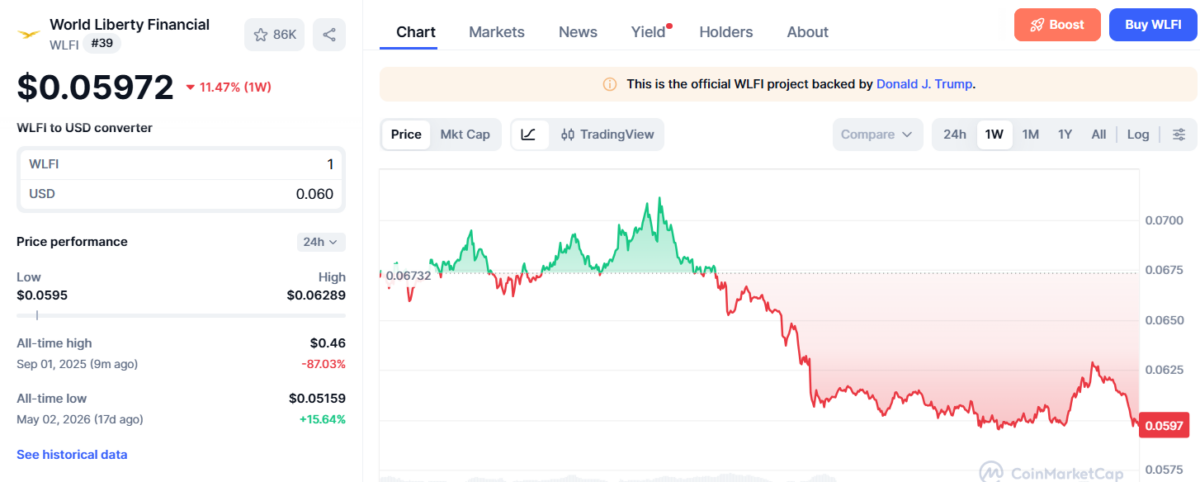
While Bitcoin and Ethereum have remained fairly stable, the wider cryptocurrency market is experiencing mixed results. Some smaller cryptocurrencies, like WLFI, are particularly affected by changes in market sentiment. Currently, WLFI is trading at $0.05975, which is down 11.42% over the last week and 87% from its peak price of $0.46 reached nine months ago on September 1, 2025.
As a crypto investor, I’ve been following AI Financial, and while management *sounds* confident about the long-term potential of their investment in WLFI – they highlight the tech and where it fits in the market – digging into their latest report (the 10-Q) is concerning. It’s light on *actual* plans to address the current issues, beyond hoping the existing loan to WLFI and maybe some future funding rounds will fix things. Frankly, the revenue they’re bringing in right now is tiny compared to the size of their investment, and that’s a red flag.
Outlook: High Stakes for a Politicized Crypto Experiment
AI Financial’s recent struggles highlight the risks of combining family-run businesses, political connections, and the unpredictable world of cryptocurrency.
Investors in the Astana International Financial Centre are hoping WLFI will prove to be a solid investment, providing real and lasting returns, not just temporary excitement. Meanwhile, for those connected to Donald Trump, this situation could serve as a warning: political influence can greatly increase both the potential gains and the risks associated with speculative investments.
It’s unclear if the current downturn is just a temporary dip in the generally positive trend for cryptocurrency, or a sign of more serious, long-term problems. However, the success of AI Financial – and how people view WLFI – will definitely be closely monitored by observers in Washington, on Wall Street, and throughout the cryptocurrency market.
Read More
- Netflix’s Little House On The Prairie Reboot: Release Date, Cast & Everything We Know
- Off Campus Season 1 Soundtrack Guide
- Silver Rate Forecast
- Prime Video’s New R-Rated Spy Thriller Is Officially No.1 On Streaming Despite Poor Reviews
- Gold Rate Forecast
- Brent Oil Forecast
- EUR ZAR PREDICTION
- EUR USD PREDICTION
- KPop Demon Hunters Meets Avatar: The Last Airbender In Netflix’s 3-Part Fantasy Series
- Bulgakov’s Take: Koreans Bet the Farm on Chips, Crypto, and Chaos
2026-05-19 14:16