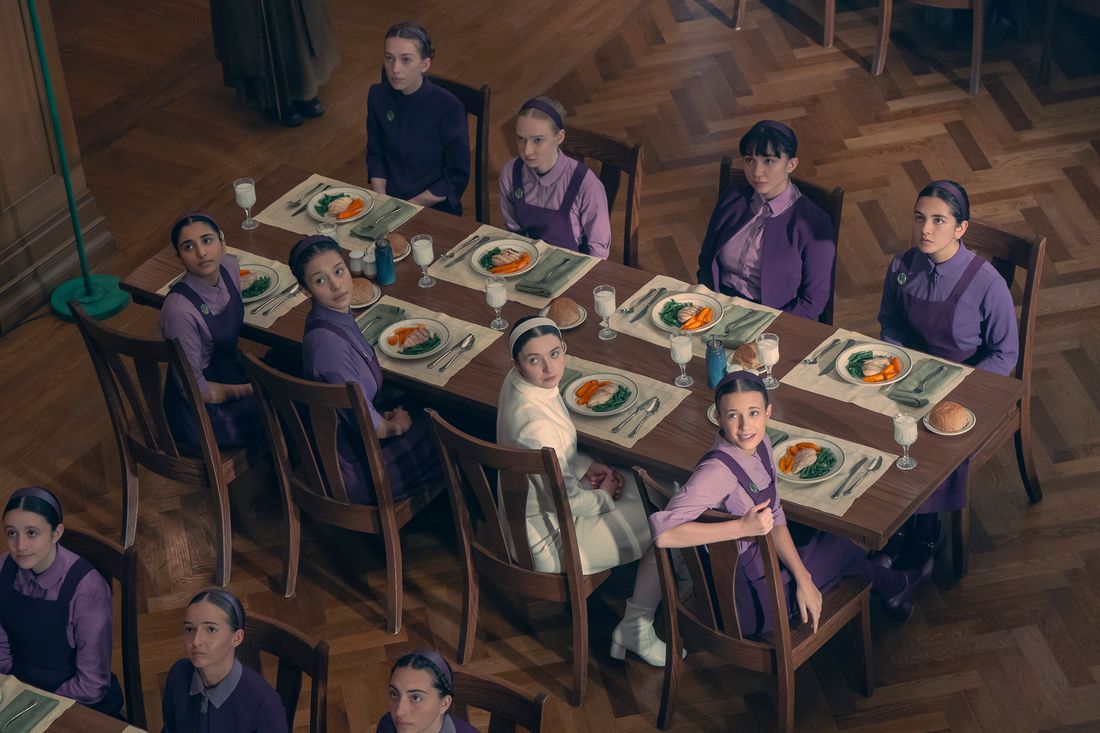
In Gilead, all events related to marriage follow a strict schedule. Aunt Lydia announces engagements in the school cafeteria, treating them like school election results. Some women, like Jehosheba, will marry influential men, while others, like Miriam, are sent to work in agricultural colonies. Hulda is promised to Commander Thomas, who even offers her the possibility of getting a pet dog. Becka is unusually allowed to choose her own husband and wisely selects Garth, despite strong opposition from Agnes. Agnes, however, is betrothed to the intimidating Commander Weston, a man who leads the Eyes and has a history of abuse. The novel suggests that all men in Gilead are controlling and potentially abusive, but some are more overtly so than others.
Shortly after taking engagement photos, future brides begin repairing broken porcelain plates. This tradition involves intentionally breaking the plates, then carefully piecing them back together. It’s also a good time to start thinking about how you’ll care for your future husband (FH).
Okay, so in this bizarre world, young women are rushed into marriage, but there’s one lesson they actually want – a ‘copulation class,’ taught by Aunt Vidala. It’s not what you’d expect, though. Instead of any real explanation, she basically draws a uterus on the board and tells Daisy and Shu they have a ‘vessel’ God will fill with a baby if they’re good girls – which, apparently, they always are. She says their husbands will fill in the rest on their wedding nights, and that’s all they need to know. It’s so unsettling and just… weirdly detached from reality. As a movie lover, I find it fascinating how this scene builds such a strange, controlling atmosphere.
By now, some of the girls likely have some understanding of sex, even if they don’t know the words for it. They may have accidentally seen their parents together or overheard suggestive comments. Some probably realize something happens regularly between their parents and the Handmaid. However, it’s hard to believe such a thing if explained out of the blue. When Daisy attempts to connect with Shu by describing male anatomy and reproduction, Shu dismisses her as naive. Daisy’s explanation – about “secret flesh rods” and swimming liquid – sounds absurd to Shu, and feels as far from spiritual truth as a science fiction story.
Even before the families can celebrate the engagements, these young brides are swept up in intense wedding planning. They’re busy with tasks like choosing seating arrangements, sampling cake flavors, and picking flowers. Though they didn’t choose their husbands, they’re allowed to have some input, like deciding between raspberry and lemon fillings for the cake. When Paula insists on ranunculus flowers instead of calla lilies, Weston skillfully handles the difficult mother-in-law. Agnes manages to smile for the first time since getting engaged.
The episode “Broken” feels a bit underwhelming compared to others in The Testaments, and that’s largely because the story is told again through Agnes’s limited point of view. She’s stuck in her own head, constantly analyzing herself and feeling guilty, which feels a bit slow-paced and frankly, not very engaging. It’s like listening to a friend who’s in the early stages of therapy – we’re waiting for them to work through their issues, but it’s not particularly exciting right now. For instance, when Agnes prompts Hulda to report Dr. Grove’s abuse, the focus shifts to Agnes’s own guilt about her past, rather than staying with the more compelling story of Hulda, where the real drama is happening.
When the young girl reveals Grove abused her, Vidala dismisses it as a misunderstanding. Even after Vidala asks Agnes to help cover up what she calls Hulda’s “confusion” to protect her upcoming marriage, Agnes remains silent about her own experiences. Vidala is clearly shielding Hulda, while Agnes is protecting herself – a fairly simple dynamic. Honestly, I’m more interested in understanding things from Hulda’s perspective, watching her bravely try to make sense of everything she’s just learned.
I’d almost prefer to be inside Daisy’s thoughts right now. She’s deeply shaken by the unexplained vanishing of Thalia, the ‘Pearl Girl,’ who was taken by the Eyes last week, and she sees the situation as much more serious than others do. This leaves her wondering if she’s somehow managed to avoid being noticed, or if she should be even more afraid as this investigation intensifies.
Perhaps it was the change in water, or the constant stress, that finally caused Daisy to start her period – something that hadn’t happened while she was in Canada. Instead of signaling as planned, she quietly washes her bloodstained underwear, desperate to avoid attention. She’s abandoned any desire to be a spy, finding some relief in the safety of a school in suburban Maryland. If even a simple mishap like spilling tea can ruin a woman’s chances of marriage in Gilead, what hope does someone like Pearl – rebellious and with visible tattoos – have of finding a suitable husband?
I’m completely captivated by Shu, and Rowan Blanchard is just phenomenal in the role. It’s amazing how she delivers even the most cutting lines with such dry wit. The show hints at a lot, and I was stunned to finally learn the source of Shu’s tough exterior. Apparently, her little brother was one of the children rescued after that terrible night – the one we saw when June escaped with the plane. It all makes sense now why she feels so much pressure to conform – to get married, have a baby, and just be normal. It’s not about her at all; she’s desperately trying to heal her family’s pain.
The Plums are all facing a difficult time, walking the same path but feeling incredibly distant from each other. Becka and Agnes aren’t speaking, Hulda is withdrawing, and Shu has been completely excluded. Earlier episodes showed the girls happily interacting and playfully teasing each other, but now it takes a special occasion – an engagement party – to even bring them together in the same space.
Everyone is at a party celebrating Garth and Becka Chapin’s upcoming wedding, but the house isn’t really set up for gatherings, so people mostly end up just standing around talking in small groups. Commander Mackenzie, who rarely attends events, looks uncomfortable. He tells his daughter, who seems confused, about the dangers of declining birth rates and tries to defend the practice of child marriage, claiming people need to ‘follow the science.’ He then quickly excuses himself and disappears for the rest of the evening.
The engagement party lets us meet characters we’ve often heard about but haven’t seen. Penny makes a quick appearance, clearly still upset after her recent miscarriage. We also finally meet Commander Chapin Senior, who is unable to move or speak. It’s revealed he was poisoned by Mayday, possibly through one of Rita’s cakes. This new information doesn’t quite match what the girls previously believed—that Chapin was a hero in the Boston battle.
Old Man Chapin is very ill, so Garth tells Daisy she can speak openly around him. She explains she’s started her period and needs tampons. While Garth is educated and knows of Freud, he’s completely unfamiliar with tampons – or even June Osborne. After weeks of trying to calm Daisy, he finally tells her the harsh reality: there’s no way to escape Gilead until the regime itself falls. He suggests that if she’s menstruating, she should find a way to use it to her benefit, as that’s the role she’s now permanently committed to.
Even Lydia, who wasn’t usually invited to parties before the changes, stops by for cake. Agnes, wanting to avoid chatting with Dr. Grove, finds Lydia in the garden and tells her she believes Hulda is telling the truth. Without being able to explain exactly what Grove did, Agnes manages to clearly communicate how she knows Hulda is being honest. Lydia tries to comfort Agnes, promising that wrongdoers will face justice, but her explanation is filled with religious language that’s too complex for a teenager to understand.
The rest of the episode unfolds like a game of telephone, where information gets distorted as it’s shared, making it difficult to know what’s actually true. Agnes is having a drink when Daisy spots her alone, which works out well because Agnes has menstrual pads that Daisy needs. Shu orchestrated this, knowing Daisy needed help and Agnes had what she needed, emphasizing the importance of loyalty: “You don’t turn on your friends, ever,” she tells Daisy, “Not here.” When Daisy points out Agnes seems to be doing just that by skipping Becka’s engagement party, Agnes reveals Dr. Grove assaulted her. Daisy reassures Agnes it wasn’t her fault, especially since Agnes is worried the assault happened because she’d been attracted to Becka’s boyfriend.
As “Broken” concludes, Agnes reflects, hinting she had no idea what Daisy would do next. Considering Daisy is still deeply upset about Thalia’s fate, it seems unlikely she’d simply wait for things to resolve themselves. Agnes likely shared something with Daisy, but it’s possible she didn’t. However, Daisy may have interpreted Agnes’s warning – “You don’t turn on your friends, ever” – as a call to action. And when Garth tells Daisy the only way to escape Gilead is to tear it down, she might have seen it as encouragement to go further. In this world of hushed tones and secrets, information quickly gets distorted – a shared confidence can easily become a reason to act, all within a brief conversation.
Read More
- Netflix’s Little House On The Prairie Reboot: Release Date, Cast & Everything We Know
- Off Campus Season 1 Soundtrack Guide
- YouTuber arrested after viral AI bodycam videos spark real police complaints
- Silver Rate Forecast
- Prime Video’s New R-Rated Spy Thriller Is Officially No.1 On Streaming Despite Poor Reviews
- Brent Oil Forecast
- Gold Rate Forecast
- Peaky Blinders: The Immortal Man’s Tommy Shelby Is a Better Father Than Michael Corleone
- EUR ZAR PREDICTION
- Bulgakov’s Take: Koreans Bet the Farm on Chips, Crypto, and Chaos
2026-05-13 18:00