As a lifelong moviegoer, I’ve always been struck by how Gilead’s idea of justice – and it’s almost a contradiction in terms to call it that – feels rooted in the Old Testament’s ‘an eye for an eye’ philosophy. It’s all about punishment fitting the crime, delivered here by the Aunts, and then, supposedly, eternal damnation on top of that. It’s incredibly harsh and takes us back to a very basic way of thinking – the kind of simple ‘good versus evil’ logic that seems to really appeal to younger characters like Plums. Basically, if you do something wrong, you deserve something bad to happen, and the ‘good’ people are there to make sure it does.
In this week’s episode of “Marat Sade,” Daisy is back working undercover, and it’s clear she’s not up to the task. Throughout the season, it’s been obvious that her grief and tendency to be easily influenced make her a poor choice for this assignment, and this episode confirms those concerns. Daisy arrived in Gilead wanting revenge, and the harsh justice system there has actually appealed to her desire for retribution. Her mother cautioned her that seeking revenge only leads to more suffering, but Daisy now seems to be questioning that very idea.
After Lydia’s inability to keep the Greens safe from Dr. Grove, the Pearl Girl bravely and impulsively confronts him. She finally rings the large bell she’d been ignoring and confidently walks into the schoolyard to expose herself. Daisy struggles to remember the full “Rebecca and Leah” prayer, and abruptly stops, announcing to her excited Aunts, “I got my period.” It’s almost endearing.
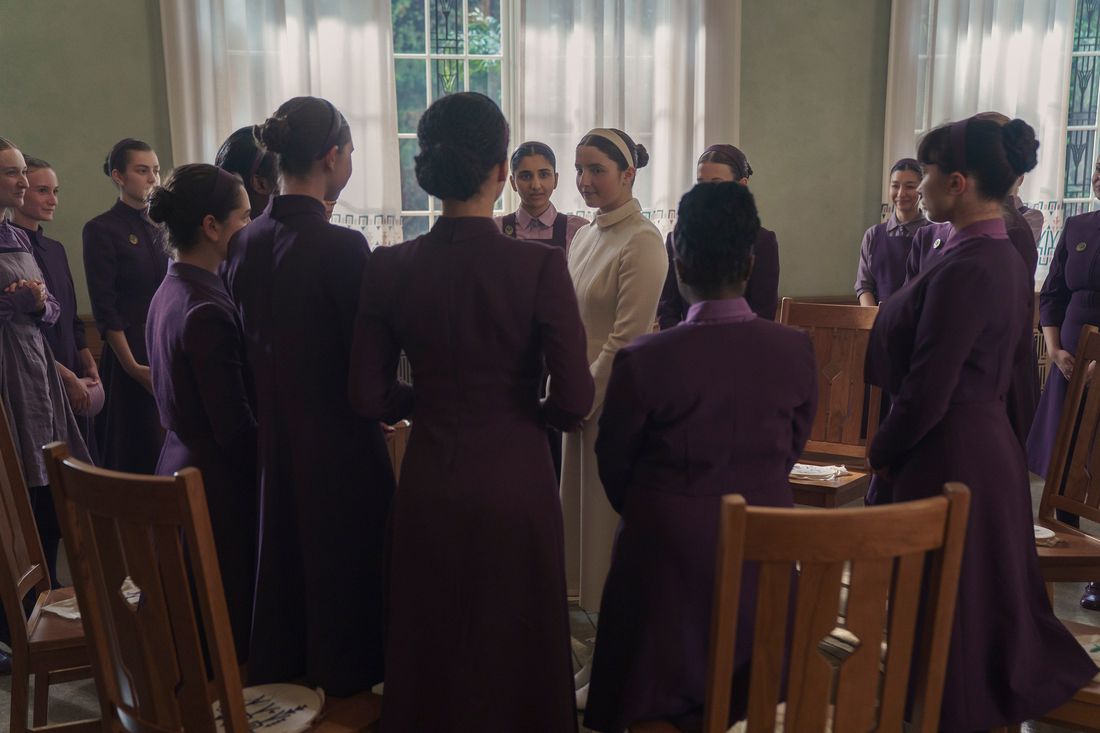
The next day at school, Estee suggests the Plums give Daisy a complete makeover with purple clothing and accessories. Becka, increasingly worried Daisy will take Agnes away from her, deliberately pricks Daisy with a pin – a symbol of Daisy being marriageable, and Becka’s first experience with blood. Estee then announces it’s time for a dental checkup. It seems odd to go from discussing menstruation to getting teeth cleaned on the show Testaments, but Estee presses on. Courageously, Agnes offers to go with the orphaned Daisy back to where she was previously attacked, and the two girls hold pinkies in the waiting room, feeling like an attack is about to happen.
Dr. Grove isn’t fooled by Daisy’s attempt to distract him. Perhaps he’s prejudiced against her – maybe he dislikes her appearance or doesn’t trust outsiders with his secrets. But Daisy, who is secretly a spy, takes matters into her own hands. She tears the strap of her dress and pretends to be frightened, bursting into the waiting room, screaming and begging for help so Agnes, Estee, and the Guardians can witness the scene. Later, when Vidala suggests, as she did with Hulda before, that Daisy might have misunderstood the dentist, Daisy refuses to go back to her place in line.
Daisy claims she’s protecting the Plums after the Aunts let them down, and she talks about stopping a cycle of punishment. However, she clearly misread things if she believed exposing Grove would help her connect with Agnes. The women who come to Gilead – the Pearl Girls – are looking for a stable life: good food, clean water, a husband, and a family. Daisy’s actions have put all of that at risk. It’s hard to see how Agnes can trust someone who doesn’t seem to think things through and protect herself.
The story of “Marat Sade” focuses solely on Dr. Grove, from the false accusations made by Daisy to his tragic death, which he unintentionally brings about. Commander Judd and Aunt Lydia try to postpone Grove’s punishment until Becka marries into the Chapin family, hoping to protect her from his scandal. However, Grove, not realizing Hulda and Agnes have already informed the Aunts, decides to fight back. He returns home and tells his wife and daughter that Daisy is untrustworthy and mentally unstable. The question remains: will Gilead believe a troubled young woman over the man who has faithfully served them?
The following day at school was chaotic. Becka suddenly attacked Daisy, but Agnes quickly intervened, pulling Becka away. The fight drew the attention of the entire school, prompting Shu to make a sarcastic comment: “Someone should draw a picture, it would last longer.” Later, on the school porch, Becka was furious that Agnes seemed to be supporting Daisy instead of her. Both girls were upset as Agnes revealed a painful truth: she wasn’t taking sides because she had actually experienced something similar herself – she understood what Daisy was going through. The power of this scene came from the actors’ performances, particularly the way their faces showed both pain and confusion. That evening at dinner, Becka confronted her father, asking if the rumors were true. His carefully worded response – “I didn’t lay a finger on that Pearl Girl” – didn’t quite convince her.
The episode starts with me and the other women at the Aunt Lydia’s School, scrubbing blood off the floor. It’s clear Gilead’s idea of justice isn’t about simply punishing people – it’s brutal and horrifying. What’s even worse is that we, the women and girls, are the ones expected to carry out these awful sentences – things like cutting off hands or stoning people. We’re supposed to yell and cheer while it happens, as if it’s God’s will. It really makes you think – what’s the difference between cleaning up the mess after something terrible and actually doing it? How much responsibility do we have just by watching, by being a part of it?
That evening, Becka, wearing her nightgown, went upstairs and stabbed her father while he was in the bathtub, confirming the episode’s shocking nature. She acted without hesitation, even stabbing Dr. Grove again when he objected. Earlier, Becka had allowed Agnes to believe she hadn’t been abused by her father, but she quickly accepts the accusations against him, which is unsettling. After the attack, she covered her bloodstained dress with a cloak and took the Martha bus to Agnes’s house. Becka had repeatedly said she’d rather die than get married, and now her life has completely fallen apart.
Agnes, still shocked, gently helped Becka into the bathtub. “He can’t hurt you anymore,” Becka said, looking for reassurance in Agnes’s face. “I did what was right,” she explained, believing she’d delivered the justice Gilead had delayed. Agnes responded softly and cautiously, simply saying, “I know.” When Becka suggested they run away together—anywhere would do—Agnes hesitantly agreed, then sent Zilla to get her father.
Agnes and Becka both betray each other, and their father figure, Daddy, betrays Agnes. He contacts Garth, who deceives a distraught Becka and leads to her capture by the Eyes. We see her desperately clinging to the bars of a window as she’s taken away from everything she knows. It’s unclear what will happen to Becka now – honestly, I don’t think Margaret Atwood’s book offers many clues. Will she face consequences for taking matters into her own hands? Or was she simply collecting something the dentist already owed to Gilead?
I realize that asking about emotional connections is the wrong approach – it’s too focused on feelings for this story. Like The Handmaid’s Tale, The Testaments is driven by ideas and beliefs. The characters aren’t individuals so much as embodiments of political forces. It’s a cycle of retribution – revenge begets more revenge. And if a society is heading towards complete moral collapse, perhaps it doesn’t matter who suffers first.
Read More
- Netflix’s Little House On The Prairie Reboot: Release Date, Cast & Everything We Know
- Off Campus Season 1 Soundtrack Guide
- Silver Rate Forecast
- Prime Video’s New R-Rated Spy Thriller Is Officially No.1 On Streaming Despite Poor Reviews
- Gold Rate Forecast
- Brent Oil Forecast
- EUR ZAR PREDICTION
- YouTuber arrested after viral AI bodycam videos spark real police complaints
- EUR USD PREDICTION
- Inkford Hermitage Chest Locations In HSR (Honkai: Star Rail)
2026-05-20 17:55