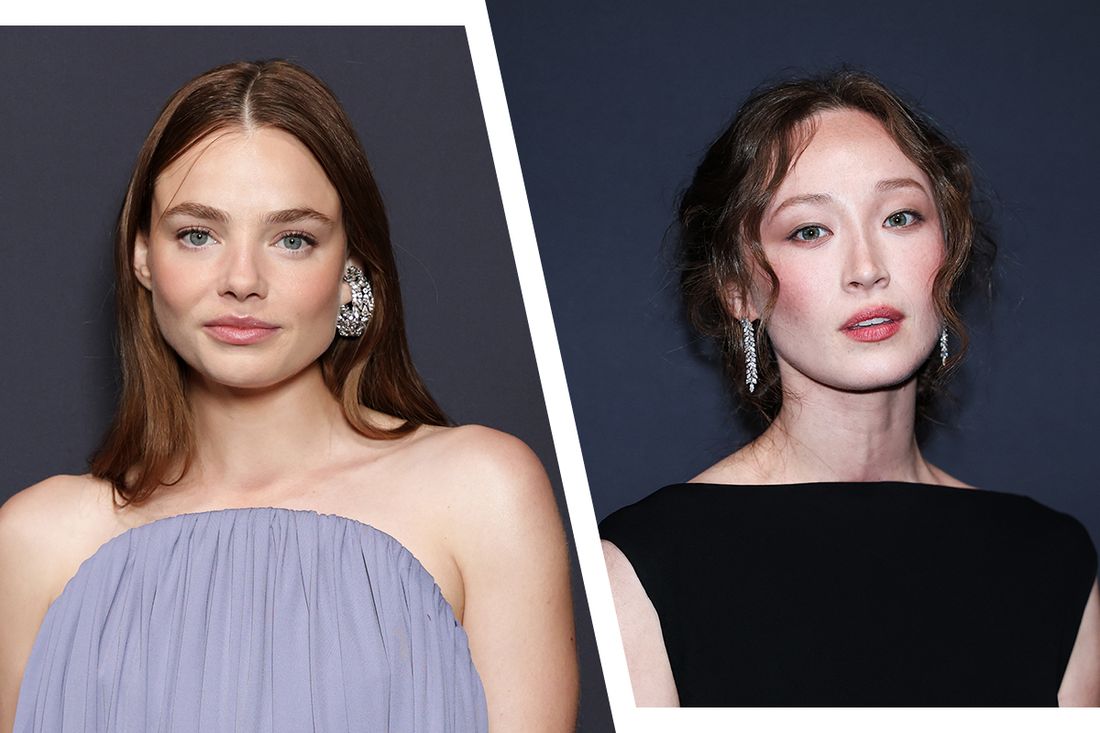
Nicolas Winding Refn returns to Cannes this year with his new horror thriller, Her Private Hell. It’s a difficult film to easily describe. After a decade focused on television work – which he jokingly said was lucrative – Refn experienced a serious health scare, including a 25-minute period where he was clinically dead due to a heart problem. This near-death experience reignited his passion for filmmaking. The result is a mysterious and slightly over-the-top film, both strange and dreamlike, set in a foggy, futuristic city haunted by a brutal serial killer known as Leather Man.
The show Hell centers on Elle (Sophie Thatcher), a troubled actress struggling through the filming of a visually striking, futuristic movie. She’s grappling with a difficult relationship with her father (Dougray Scott) and a complicated connection with her former friend, who is now her stepmother (Havana Rose Liu). Adding to her stress is a relentlessly energetic co-star (Kristine Froseth) who constantly seeks attention. Elle’s path eventually crosses with a determined soldier (Charles Melton) searching for his missing daughter. All of this unfolds against the backdrop of a serial killer on the loose, as Elle and the film crew navigate the chaos of production, relationships, and conflict, all while sporting elaborate costumes and dramatic makeup.
I was so excited to meet with Liu and Froseth – they’re clearly close friends and had amazing chemistry in their recent play, All-Nighter! Watching them in the film was a dream; they moved so gracefully through these beautiful sets and spoke in a way that felt both mysterious and intimate. I chatted with them right before the French premiere of Her Private Hell – they’d just arrived in Cannes and were a little tired, but still hilarious. Liu joked that Cannes is all about looking fantastic while feeling terrible – you’re supposed to be at your absolute best visually, but somehow feel your worst!
So, is this your first time at Cannes for a film? What’s been the most unbelievable experience so far?
Kristine Froseth: I actually attended Cannes for a TV series about seven years ago. But this is my first time here with a film. The best part has been hearing what different people think of the movie and talking to them about it. It’s also wonderful to see Nic again – he seems really happy. It’s all a bit overwhelming, and I think it will take me a while to fully take it all in.
I first saw the stunning gowns at a Celine dinner in Cannes about three years ago. It feels like the ideal place to launch this film – the atmosphere here, with the ocean, the glamorous dresses, and the lights, creates a surreal, dreamlike quality that really mirrors the feeling of our movie.
It’s amazing to hear how people are reacting to the film! What I find really cool is that the filmmakers intentionally left it open to interpretation. They didn’t have a rigid script; instead, they followed the actors and their characters wherever they led, almost like an open-world video game. It felt like everyone was on their own personal journey with their character. But beyond that, we were all exploring deeper themes – what the story meant symbolically, the archetypes at play, and what it was saying about things like masculinity, femininity, heroes, villains, and even victimhood. It’s not just a story, it’s a conversation!
I didn’t receive a formal pitch for the project. I just had a brief, five-minute conversation with Nic on Zoom. I had some books about trauma and human behavior visible in the background, and he seemed really interested in that topic – though my approach to it differs from my character’s. He then sent me some sample scenes, and I did a screen test with Havana, who had already been cast. After that, he explained his motivation for making the film, which stemmed from his own experience of a near-death experience – he said it lasted a few minutes, or maybe just seconds.
During a screening, he mentioned being clinically dead for 25 minutes. I don’t recall the exact time he stated, but he explained he felt compelled to return for his daughter. He was remarkably candid, admitting he wasn’t sure what the future held, and he repeated that sentiment throughout filming. He recently told me he’d only just understood what happened, figuring it out about three days ago, which I found incredibly moving. He never seemed certain about anything. He always wore a heated blanket on set and would share vivid, ever-changing dreams he’d had. Interestingly, he never formally explained any of this to me beforehand.
He basically said, “I’ve faced death, let’s create something from it.” KF explained that the story is fundamentally about the Leather Man’s search for his daughter, exploring themes of family, loss, love, and abandonment. His driving motivation is reconnecting with his youngest daughter, which is the core of both Private K’s and the Leather Man’s journeys.
Okay, so we met with this guy, and honestly, it was pretty intense. He was so keen for us to read his script that he actually had someone hand-deliver it – it took about three hours to get to us! We tore through it as quickly as possible, trying to be respectful and definitely not wanting to get caught taking pictures. Believe me, I really wanted a quick snap of the cover, but we didn’t risk it.
KF: I was scared if I did it that they’d somehow know.
The script explored many of the same ideas as the final movie, particularly its central themes. While the ending and my character changed significantly between drafts, and even between the first and second time I read it, the core story remained consistent. It always revolved around a daughter with a difficult relationship with her father, set in a futuristic, unreal world. The story also featured a father from the past searching for his daughter, all connected by a serial killer.
We had some input into how our characters developed, and we could share our ideas and concerns. However, the showrunner ultimately made the decisions – sometimes he agreed with us, and sometimes he didn’t. We weren’t completely in control of the creative direction, but we weren’t left out either. He provided a basic framework and allowed us to explore within it, often focusing on refining the story by removing unnecessary elements. It was a process of seeing how much we could streamline things.
I find your movements and speech really captivating. What kind of guidance were you given?
HRL: My favorite thing he used to say was, “Nothing is everything.” He repeated that to us constantly.
What does that mean?HRL: What a great question!
I always thought of him as the Riddle Man. I’d constantly ask him questions, throwing out ideas and challenges, and he’d respond with these beautifully worded answers that were completely baffling. They just didn’t add up.
HRL described feeling like things were constantly being simplified or slowed down, almost to the point of entering a trance or meditative state. They shared this experience with another person, and it was particularly challenging for both of them during the first week.
KF: Yes. Because we just came from a play that was so high intensity.
Yes, I did see it, and the contrast in style was striking. KF explained they were instructed to speak extremely fast, and the presentation was much more expansive. Afterwards, they transitioned to a performance where they portrayed dolls.
It was incredibly difficult. The first week felt like a personal nightmare.
What were you discussing privately with each other?
HRL: It was mostly just expressing our struggles and doubts – feeling overwhelmed and unsure how to approach the project. But eventually, we found the right tone. Once we accepted that this was meant to reflect the fast-paced nature of modern life – almost like a slow-motion film – we let the story unfold naturally, relying on the audience’s intuition. Honestly, though, it was incredibly challenging.
I was the first to start filming. We all lived in the same apartment building, and I was bouncing ideas off of her, running through lines and trying things out – it felt like we were intensely studying for a big test. There was a scene that didn’t make the final cut where my character arrived at a hotel, only to find his room wasn’t available and his luggage was missing. The director would constantly ask for another take – “Just one more time” – and we ended up doing about sixty! He also did something I’d never seen before: he’d stand right next to the camera while you were acting and watch you. He’d also show you the monitor so you could see how you looked in the scene, which I wasn’t used to. At first, it was a bit of a shock, but I started to get used to his rhythm. He was always telling me to “Slow down. Calm down.”
Coming from the play?
KF: From any set. It was completely different. Every single part of it.
The production felt very similar to the Danish tradition of alternating between hot and cold – like saunas. It was a constant shift from intense, energetic performance to quiet, static moments. We were meant to feel like dolls or objects, completely still, and the costumes reinforced that feeling of being in a dark, shadowy place. But then, after each day of that intensity, we’d step out into the beautiful Copenhagen summer and immediately go swimming. It was a daily contrast.
How was your friendship in Copenhagen different from the one you had in New York?
KF: I really connected with Havana right away. She’s been a huge support for me – my rock, really. I used to pop in and chat with her even when she was rehearsing, and we’d always share snacks. Looking back, it might have been a little too close!
Spending six months working with Havana-Kristine was a really special experience. We supported each other through some tough moments, and that was a definite highlight. It was great to have someone who understood what I was going through and could offer encouragement – someone to say, “I see you, and you’re doing great.” We really leaned on each other during the most challenging parts of the play and film, offering encouragement and making sure the other was okay. She was always there, quietly cheering me on, and we always took care of each other.
KF: We help each other get out of spirals.
How do you help each other when one of you is stuck in a negative thought pattern?
KF: By checking the facts. When I start spiraling, I tend to jump to the worst possible conclusion. My partner helps bring me back down to earth by reminding me what’s actually happening.
HRL said she found a lot of support from this person, especially because she tends to be hard on herself. This person was incredibly encouraging, like a true teammate. For example, after her first day, she received flowers as a gesture of encouragement – a way of saying, “You can do this!” They were very close, like partners in life.
I really connected with the film’s depiction of couples experiencing similar struggles. The lead actress described how, when they both felt overwhelmed at the same time, they’d actually create some space for themselves. It was a surprisingly relatable moment, and her little laugh afterward felt so genuine – like a shared understanding of what it’s like to navigate those tough times.
KF: That’s actually so true. And you didn’t like my tough-love phase.
HRL: Kristine had a crazy tough-love phase. But we got through that.
I spent almost all my time at the gym, constantly motivating myself and others. I kept saying, “We have to keep showing up and pushing ourselves.” My goal was simple: to get stronger by lifting weights.
About two weeks later, she apologized, saying she hadn’t been doing well. I jokingly replied that I had missed her, using a playful insult.
What was the strangest or most challenging moment in the movie? There are a lot of bizarre things happening.
I really struggled with the final, most intense scene. We typically filmed scenes many times, but after just one take of this one, I started breathing heavily and shaking uncontrollably. I was overwhelmed by the character’s pain and longing for connection. She was trapped in a terrible situation and desperately needed a breakthrough. Because we were filming late in the production and in order of the story, I felt very connected to the character and it all felt incredibly real. I told the director I could only do one take – I just couldn’t handle going through that again.
HRL: I remember you feeling nauseous.
After filming a difficult scene, I was really shaken up. Thankfully, the crew was amazing and helped me calm down with breathing exercises. Even the director, Nic, was patient and supportive, even though he probably wanted to film more takes. Honestly, that collaborative spirit – everyone working together to solve problems – was the best part of the whole experience. Each day felt like we were figuring things out as a team.
Stepping onto the set for the first scene was incredibly intimidating. It felt like a huge responsibility to establish everything right away. My most emotional scene was especially difficult – I think I filmed it around 85 times! By the end of the day, I was completely drained, feeling empty and lost. I’d cried so much throughout the process that I had nothing left. We used a lot of mist for that scene, and when I asked if they’d gotten the shot, they told me they couldn’t even see me. I just broke down.
The process was incredibly demanding. As someone who already tends to overthink things, it was strange to constantly revisit and refine my work without ever feeling completely satisfied. I was pushed to my absolute limit, and the outcome was always uncertain. I had to completely let go and trust the process, which was a completely new experience for me.
“How many takes did it take to film the scene where you and I barked at each other like dogs?”
HRL: “Eighty-five times! It took the entire day. We essentially filmed only one scene each day.”
Did you change the dog sounds?
HRL: Absolutely. Perhaps a hyena this time? Or a Chihuahua? Even a wolf would work! We just use whatever sounds best!
Read More
- Netflix’s Little House On The Prairie Reboot: Release Date, Cast & Everything We Know
- Off Campus Season 1 Soundtrack Guide
- YouTuber arrested after viral AI bodycam videos spark real police complaints
- Silver Rate Forecast
- Prime Video’s New R-Rated Spy Thriller Is Officially No.1 On Streaming Despite Poor Reviews
- Gold Rate Forecast
- Brent Oil Forecast
- Peaky Blinders: The Immortal Man’s Tommy Shelby Is a Better Father Than Michael Corleone
- EUR ZAR PREDICTION
- Bulgakov’s Take: Koreans Bet the Farm on Chips, Crypto, and Chaos
2026-05-19 01:57