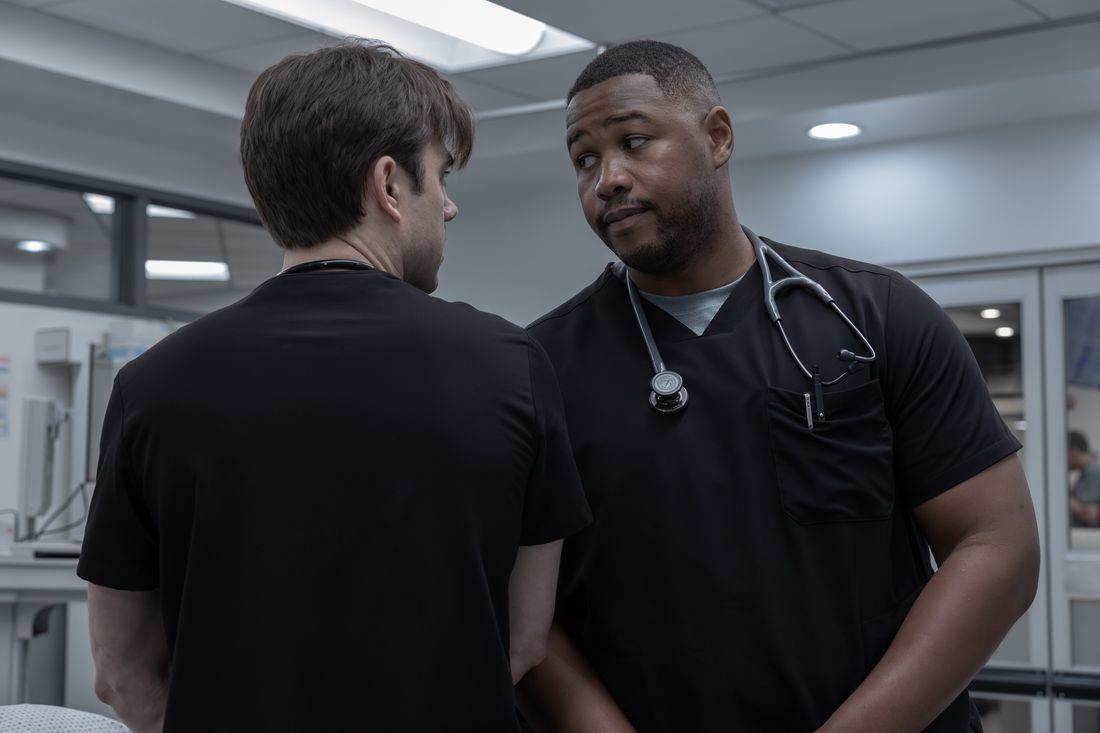
Despite appearing in just a handful of episodes of The Pitt, resident Crus Henderson quickly stands out. He’s even more calm and collected than the other night-shift doctors, handling patients with a comforting smile. Many viewers will recognize the actor, Luke Tennie, as Sean from Shrinking, where he’s been a main character since the first season. He also recently played Dom, a teacher with ADHD, in a recurring role on Abbott Elementary, and his character was involved in a memorable storyline.
All three TV shows are filmed on the same studio lot in Los Angeles, and Tennie found something unique in each role. However, he prioritizes being a flexible supporting actor. He explains his approach to The Pitt: “On a procedural show, the story itself is the star.” Tennie sees himself as a team player, much like his days as an offensive lineman in high school. “I’m good at delivering technical dialogue,” he says, “and that’s what I excel at as an actor.”
I was already a big fan of the show when I auditioned for the role of Crus Henderson. My wife and I were devoted viewers. By the time the audition came around, I had a clear idea of how to impress them. Instead of trying to stand out, I focused on fitting in—on appearing as if I’d always been part of the show, just another doctor with a stethoscope. I practiced my approach with my wife. During the Zoom audition, the directors told me he should be ‘cool, calm, and collected.’ Initially, I was playing him as someone always on the go, but they clarified that he’s never rushed, which really shaped how I portrayed the character.
I learned the medical terms by first understanding their definitions, then practicing how to pronounce them correctly. Finally, I drill them relentlessly – I’m a bit obsessed with memorization! But instead of just trying to remember the words, I focus on the physical feeling of saying them. For example, if I had a complicated phrase like “hemolytic anemia, elevated liver enzymes, and low platelets,” I wouldn’t break it down word by word. I’d repeat the tricky parts – like “lytica-nemia, lytica-nemia” – to build a muscle memory in my mouth. This way, when I say the terms on camera, it sounds natural, like I’ve said them many times before. It’s a combination of knowing the meaning and physically practicing the pronunciation.
You’re starting to repeat the phrase as often as Henderson likely did. Just by saying it repeatedly, you create a sense of recognition. While he might have said it 8,000 times, I can say it 100 times in just a couple of days and give the impression I’ve said it that many times too.
Have you had to learn specialized language for roles before? Nothing quite like medical terms, but I did a show a couple of years ago called Players. I think that’s why I got the part on Shrinking – it was my first comedy. Players involved some video game terminology, so you had to talk about the game like you were a player. Luckily, some of my friends play League of Legends. A friend of mine, Esteban, was actually on that show, and he helped me prepare. I really needed to understand the world of League of Legends. Throughout the season, my character learns about it, but at first, neither he nor I knew anything about it. That meant I could mess up the jargon, which felt authentic to the character.
In The Pitt, the character was already established and adapted to the environment. With Crus, especially as a doctor people are meant to trust, he needs to quickly demonstrate competence and build rapport through his words and actions. He doesn’t have the benefit of already being familiar with the setting, so he needs to establish himself immediately.
It’s interesting how composed the night-shift doctors appear, particularly Crus. I wonder what they’re like when they finish their shifts. Do they feel the same level of stress as the day doctors, or do they just hide it better? I suspect people who choose to work nights are different – it takes a certain type of person to do that. Day shifts seem to attract more conventional individuals. Plus, night shifts usually come with extra pay, so maybe that benefit is enough to balance out the challenges for those who choose them.
Before the final showdown, the group has a rallying cry led by Abbot, who declares they handle the strangest situations because they are the strangest people around, finishing with a “Hoo-ah!” This shared acknowledgment of their unusual nature seems to unite them. Generally, they remain level-headed – except for a moment in the first season when Robby talked Abbot down from a dangerous situation. It was unclear if Robby was being genuine, and I think that was intentional. Shawn Hatosy, the actor who plays Robby, often delivers lines in a way that makes it hard to tell if he’s joking or being serious.
It was interesting seeing how people reacted to the show, but I jumped right into another job with a friend, Fred Hechinger, so I didn’t get to see much of the feedback directly. My friends have been sharing memes with me, which is how I’ve been keeping up. Honestly, I’m surprised people find my character, Crus, handsome or charming! I think he’s way cooler than me. I only have eyes for my wife, and she’s the only one I’m trying to impress. My friends keep telling me people think he’s smooth or has kind eyes. It’s funny because it’s the same actor who plays other characters, but no one ever comments on those roles.
People seem really drawn to my character, Crus. A lot of friends have pointed out it might be the medical uniform, the stethoscope, or even the way he talks – especially that line, ‘Let’s get you home real fast.’ Honestly, I’ve never thought of myself as someone who gets roles because of how I look. I believe I’m hired because I’m a capable and reliable actor. This whole ‘sex symbol’ thing with The Pitt’s fans was a surprise! I’m just a pretty average-looking guy – I don’t have a six-pack or anything. But put me in scrubs, give me a stethoscope, and have me wink, and apparently, it’s a hit!
Robby’s behavior this season might be off-putting to some, especially when he’s constantly yelling. Last season, he was open and vulnerable, reacting emotionally to a really difficult day. Now, he’s trying to leave, and people aren’t understanding that. I think it’s important to remember that even heroes are human and deserve some understanding. Robby definitely makes mistakes, particularly in how he speaks to women. However, I believe nobody could handle his job as well as he does, and having a bad day doesn’t negate all the good he’s doing. He’s still saving lives, after all.
Everyone’s been asking about my possible return for season three, and honestly, I don’t have much information! I overheard something from Noah, one of the show’s people, and it gave me a little hope. I was telling the hair and makeup team how much I enjoyed working with them, and I said I really wanted to come back. Noah chimed in and said something about Crus being on the night shift. He basically explained that if the show features scenes with the night shift again, then my character will likely be in them too. So, it all hinges on whether they decide to switch things up and show the night shift – if they do, fingers crossed you’ll see me again!
I recently spoke with Bill Lawrence, which was good – he enjoys The Pitt, and that’s a plus. My contracts clearly state that Shrinking is my main focus, and honestly, I’m committed to it. However, if the timing works out, I’d be happy to also play Sean and Crus around the same time.
I read that the three shows you shoot are on the same lot.
The same lot and likely the same time.
Originally, Shrinking was only going to have three seasons, but now it’s been renewed for a fourth. I’m not sure where Sean’s storyline will go from here. I had a feeling Sean’s arc would end with him moving out – that happened around episode three, and it felt like a natural conclusion. Honestly, I don’t know what the writers have planned, and I suspect they’re still figuring it out. Rick Remender, who wrote the comic Deadly Class and was the showrunner on a show we both worked on, gave me some great advice: don’t hold back the best material. As a writer myself, I realized I shouldn’t save the good stuff for later seasons. Instead, we should just write and try to top ourselves. That’s exactly what Bill Lawrence and the team did. We could have stretched out Sean’s move and Jimmy’s healing process over more seasons, or we could stick to our original plan and see if we could deliver something amazing, even if it was challenging.
The real test is figuring out how to surpass something that’s already proven successful, and that’s incredibly motivating. I’m really curious to see what happens next. I’m especially hoping we get to see how Sean and Jimmy navigate their friendship now that therapy has ended. I’d love to see them just hanging out – Jimmy at the gym with Sean, or Sean playing pickleball with Jimmy and Brian. And honestly, Jason is surprisingly athletic for his size, so it would be entertaining to see him throw a few punches.
You’re currently working on three very different shows – a medical drama, a sitcom filmed like a documentary, and a heartwarming but realistic dramedy. How has each role challenged and fulfilled you as an actor?
I always thought I’d be good at shows like The Pitt – ones with a lot of specialized language. CSI, Law & Order, those procedural dramas… I figured I’d excel at playing a part within a larger story, rather than being the central focus. As part of a procedural show, you have to understand that the story itself is the main character. The Pitt is all about the hospital. I used to be an offensive lineman, so I’m a team player, and that’s what I do best. Working on that show confirmed I could handle that kind of role really well. I think my strength as an actor is being able to deliver technical dialogue convincingly.
Playing my role in Shrinking was really difficult. It was a comedy, but my character was meant to be dramatic, so I had to learn how to be the ‘straight man’ – the one who reacts seriously to all the funny stuff. Basically, Jason Segel’s character was intentionally trying to get a rise out of mine, and I needed to stay focused and grounded. I aimed for a performance where my character’s inability to laugh would be sad, rather than amusing. If I couldn’t manage that, it just wouldn’t work.
Working on Abbott Elementary has been a dream come true – it’s the type of show I’ve always wanted to be a part of. Growing up, I loved sitcoms like Fresh Prince, Martin, Full House, and George Lopez, and Abbott feels like a modern take on those classics. The filming process is different from what I’m used to, though. There aren’t a lot of pre-planned blocking marks, so you have to be incredibly prepared, but also willing to let go of your preparation and react to whatever happens. It’s about finding the flow of the scene with the director of photography and your fellow actors. It’s a blast, and it’s great to play a comedic role instead of always being the ‘straight man.’ The ‘GayDHD’ episode was honestly one of the most fun experiences of my career. It lets me tap into the joy I felt as a kid watching those shows. My daughter even calls Abbott ‘Papa’s show,’ which is cute, even though I’m only in a few episodes so far! I tell her not to expect too much, but hopefully I’ll get to be in more later.
You’ve had the chance to work with well-known creators like Quinta Brunson, Jason Segel, and Noah Wyle. What were those experiences like? Jason Segel, in particular, has been a real mentor to me. I often hesitate to ask for help, worried about bothering people or taking up their time. But Jason is incredibly generous with his knowledge and support, especially when it comes to writing. He’s been writing his own material for years, and he’s shown me what I should aim for in my own career. I want to be able to pay that forward and mentor others in the same way he’s helped me when I’m further along in my career, maybe in ten or fifteen years.
I just love working with Quinta! Every single time we start a new episode, she always makes time – seriously, a good ten minutes – to just chat with me. It’s not just a quick ‘hello,’ either. She always asks about my kids, wants to see more pictures, and genuinely checks in. Then I end up asking her about things before someone calls her away to get back to being Quinta Brunson! She always goes above and beyond with her time, which is so kind. And get this – she’s in charge of wardrobe approvals! So when I’m getting photos taken for my Dom fittings, she’s the one signing off on everything. That means she does that for the whole cast, and still manages to spend seven minutes talking to me about my little girl. What a genuinely lovely person!
Noah is exceptional at setting a positive and comfortable atmosphere on set, especially considering the challenging role of the actors playing patients on The Pitt. While the production team has plenty of time to develop storylines, these actors need to deliver authentic performances immediately. Noah always makes a point of personally welcoming them, explaining the process, and most importantly, outlining a safe word system they can use if they feel overwhelmed. He’s incredibly kind and approachable when he does this. What’s amazing is how he seamlessly balances being personable with staying focused on the work. He might be in the middle of a conversation, then instantly switch into professional mode when filming starts, using precise medical terminology. As soon as the scene is finished, he’s right back to finishing his thought! It’s like he can instantly shift between different roles. It reminds me of Doctor Octopus in Spider-Man 2 – he manages so many things at once. Noah is the same way on set, quietly ensuring everything runs smoothly and creating a warm, supportive environment for everyone on The Pitt.
I’m eager to create films for families, though I’ve been advised not to call them “kids’ movies.” I’ve already written a script for one, and I’m hoping for the chance to direct it. If that doesn’t happen, I’d love to be involved in other family-friendly projects. I grew up loving movies like The Pacifier, Daddy Day Care, and Spy Kids, and I want to make films that my own children can enjoy. Ultimately, I want to create a body of work that positively impacts and inspires kids – that’s really important to me.
Read More
- Netflix’s Little House On The Prairie Reboot: Release Date, Cast & Everything We Know
- Off Campus Season 1 Soundtrack Guide
- YouTuber arrested after viral AI bodycam videos spark real police complaints
- Silver Rate Forecast
- Prime Video’s New R-Rated Spy Thriller Is Officially No.1 On Streaming Despite Poor Reviews
- Brent Oil Forecast
- Gold Rate Forecast
- Peaky Blinders: The Immortal Man’s Tommy Shelby Is a Better Father Than Michael Corleone
- EUR ZAR PREDICTION
- Bulgakov’s Take: Koreans Bet the Farm on Chips, Crypto, and Chaos
2026-04-22 23:58