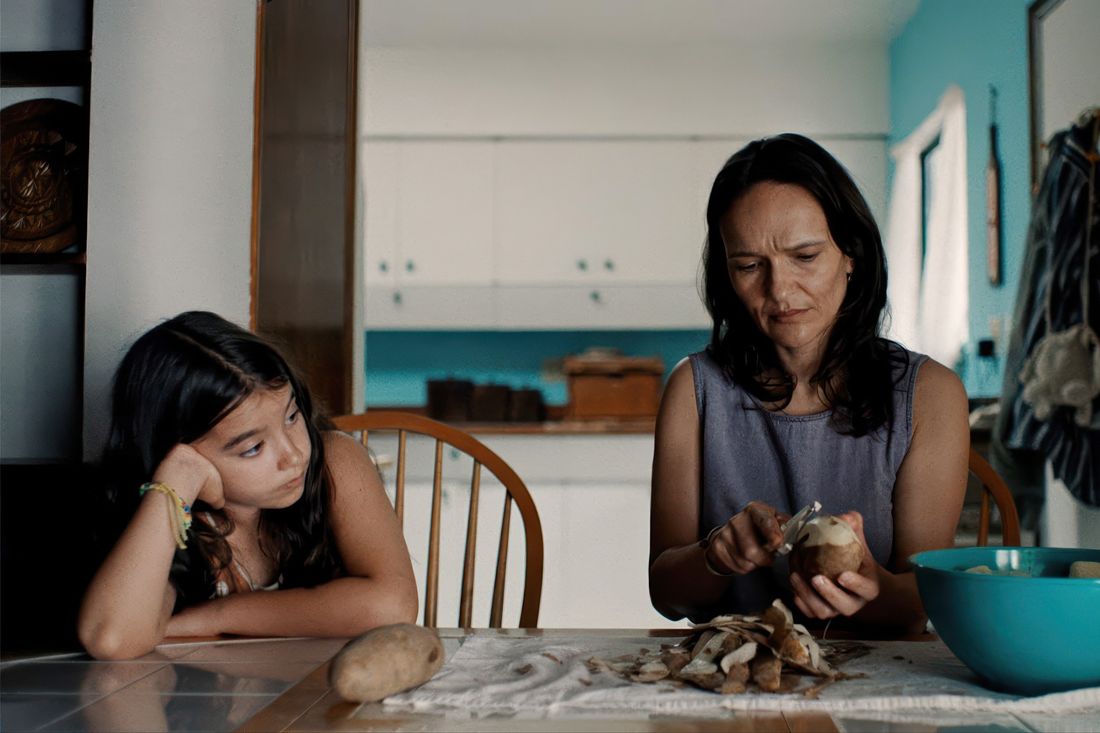
Blue Heron is a deeply personal film, drawn from director Sophy Romvari’s own childhood experiences when her Hungarian immigrant parents moved their family to Vancouver Island. It feels less like watching a story and more like a conversation with the past, an attempt to understand things her younger self couldn’t. The film is both gentle and heartbreaking, blurring the lines between documentary and fiction. This allows Romvari to uncover a deeper truth by recreating past events. Similarly, Asmae El Moudir used miniature models in The Mother of All Lies to reveal hidden details about her family’s history during a difficult period in Morocco. And in The Act of Killing, Joshua Oppenheimer had perpetrators of violence reenact their actions, seemingly forcing them to confront the gravity of their deeds.
In her first feature film, Romvari used actors to portray her family, including her younger and adult self, to explore childhood memories leading up to her troubled half-brother, Jeremy, being sent away. This approach allowed her to consider whether any amount of understanding could truly bring peace. As the adult Sasha, played by Amy Zimmer, explains in a voiceover, “The more I get older, the more I realize I never really knew him. The image I have of him now feels incomplete.” While we don’t have a basis for comparison, this doesn’t fully capture the vivid and immersive depiction of a 1990s Canadian summer that Romvari creates, a time experienced through the endless days of a child’s perspective.
Young Sophy, known as Sasha in the movie, quickly fits in with the other girls in her neighborhood. We see her mother applying sunscreen to her at the beach, and a sweet scene of her and her father, an amateur photographer, watching her brothers, Felix and Henry, play with origami boats in the kitchen sink while Jeremy playfully sprinkles powdered sugar like snow. Initially, Jeremy seems like a typical moody teenager, part of the family but wanting to express himself. However, subtle signs hint at deeper issues – like when he dramatically collapses on the doorstep or disappears during an outing, causing his mother to frantically search for him in the rain before finding him at a gas station. At one point, his mother asks Sasha what she thinks of Jeremy’s behavior, and the little girl, lost in thought as she plays with her hair, simply replies, “I don’t know.”
I keep thinking about Sasha’s mom, and the worry she must have felt, noticing her son was changing and struggling, even before things really came to a head – the shoplifting, the self-harm, even him ending up on the roof. You can tell she’s spent so much time trying to understand what was happening, talking to doctors and specialists, hoping for a diagnosis that could help him. What really struck me about Blue Heron is how vividly it portrays both the small, real moments – like filling water balloons or cooking with family – and the things Sasha couldn’t have known. The author clearly imagined conversations and filled in gaps, and it feels so authentic, like looking at a collection of memories, both remembered and reconstructed.
Certain parts of the film are subtle and might be lost on a child, particularly the complicated relationship between the parents – the father constantly working on his computer, and the mother primarily responsible for childcare and housework. However, the movie truly shines when it jumps to the present day and shows Sasha, now a filmmaker, presenting her father’s case files to social workers, asking them how they would have handled things differently. This isn’t just an attempt to figure out if a better outcome was possible; it’s a powerful imagining of revisiting the past and recognizing what was missed at the time.
Read More
- Off Campus Season 1 Soundtrack Guide
- Chainsaw Man Volume 24’s Cover Art Reveals a Brand-New Denji
- X-Men ’97 Finally Gave Gambit the Hero Moment He Deserved
- 46 Years Later, The Mandalorian & Grogu Answers A Major Empire Strikes Back Question
- HoI4 fans harsh reactions to the announcement of another DLC pack
- 10 Worst End-Game Couples In Sitcom History
- Emily Henry Says to ‘Trust the Vision’ For Beach Read Adaptation
- DoorDash responds after customer uses AI to make food look bad and get a refund
- Hatsune Miku cosplayer goes viral selling $15 cups of “foot juice” to thirsty anime fans
- Gold Rate Forecast
2026-04-17 21:54