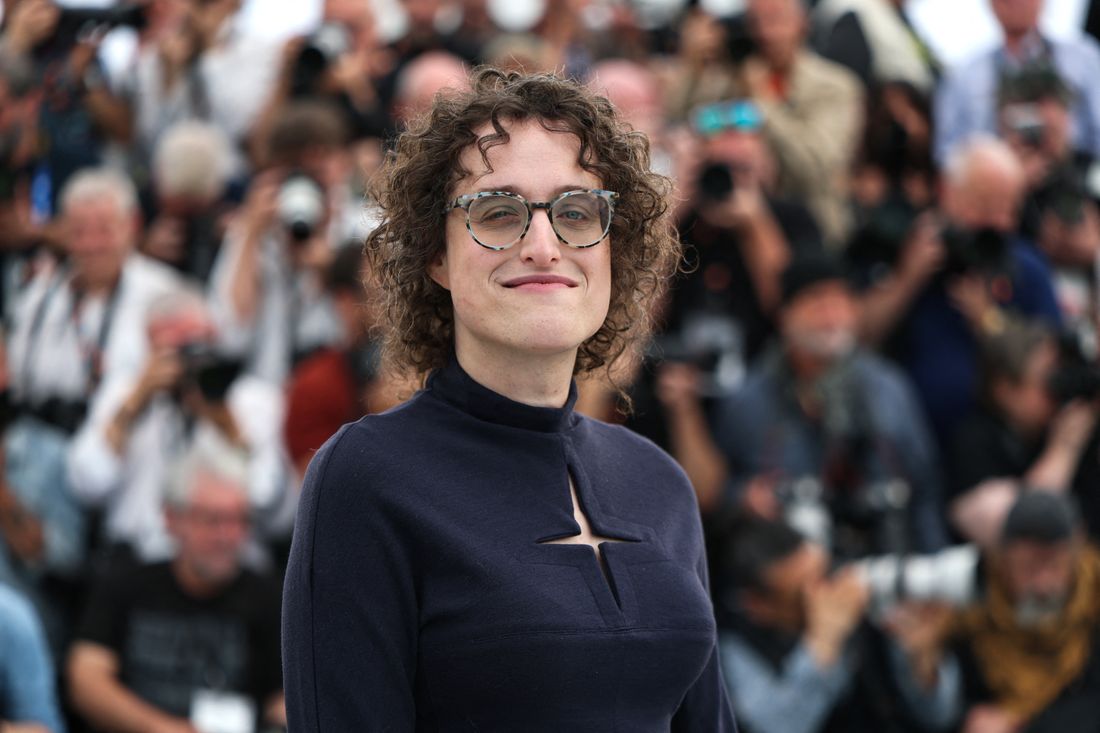
Jane Schoenbrun kicked off Cannes’ Un Certain Regard section last night with their new film, Teenage Sex and Death at Camp Miasma, which many are already calling the best film of the festival. This is Schoenbrun’s third feature exploring themes of identity, sexuality, memory, and change, following the unsettling We’re All Going to the World’s Fair (2021) and the intense horror film I Saw the TV Glow (2024).
The series Miasma features Hannah Einbinder as Kris, a young director trying to bring back the popular but outdated horror franchise Camp Miasma. The original films, created by the show’s creator and inspired by classic slashers like Sleepaway Camp, Halloween, and Nightmare on Elm Street, were once hits. However, Miasma’s reputation declined due to poor sequels and modern criticism of its problematic portrayal of women and transgender people. Kris, a queer woman struggling with anxiety and self-repression, believes the key to a successful, updated reboot lies in meeting Billy (Gillian Anderson), the original film’s survivor.
I recently saw Miasma, and it’s a film that’s really stuck with me. It centers around Billy, who’s essentially living off the grid – he’s retreated to the very summer camp where they filmed, indulging in junk food and, yes, a lot of marijuana. He meets a woman, and their connection is… complicated. They’re both clearly searching for something, a deep release, both sexually and emotionally. What really sets this film apart are the sex scenes. They aren’t exploitative at all; they’re incredibly honest, vulnerable, and even playful. There are these extended close-ups on actress Anna Einbinder’s face during intimacy, and they’re breathtaking – you really feel her struggle to stay present and connect. The director, Daniel Schoenbrun, has said this is their most personal work, and after the premiere, I had the chance to talk with them about exactly that – sex, death, and everything in between.
You mentioned Drake’s lyric, “Started from the bottom, now we’re here,” at the premiere last night. What did ‘the bottom’ look like for you? It was making my first film – a very low-budget project, really. I made it with ten people in the woods for just $100,000. It meant a lot that the people who funded that first movie were in the audience last night. When I directed We’re All Going to the World’s Fair, I hadn’t yet started hormone therapy. About half the crew knew I was transgender, and the other half didn’t, because I hadn’t publicly come out. I directed the film while feeling disconnected from who I was, and honestly, I didn’t expect it to get much attention. I’d been working in independent film for a while and knew how challenging it is for movies like that to find an audience.
I’ve hit my lowest point, and looking back, the biggest change is that I’ve finally found peace and gratitude for who I am and the life I’m living. I feel connected to my true self and what I’m meant to do. Of course, my ultimate dream is to see one of my films premiere at Cannes, feeling completely authentic while I’m there.
You’ve been here before for work, haven’t you? What brought you then? I hesitate to say, because I’ve joked about it in the past. If you’re curious, you can probably find information online. I visited twice using a company card, attending industry events and meetings – once in 2015 and again in 2016. I remember being incredibly excited in 2015, thinking, ‘Wow, I’m at Cannes, and everything is perfect!’ I was enjoying the food and someone else was covering the expenses. But the second time, the excitement had faded. I realized I was actually feeling depressed, unhappy with my body and my job. Even being in Cannes didn’t make me happy. I understood then that my unhappiness wasn’t about the place or the festival itself, but about my own situation and how I was experiencing it. I wanted to be there, but I wasn’t approaching it the right way.
It’s funny, looking back at last night’s premiere compared to how I felt leading up to it. Hannah and I were actually talking about how quickly it felt like a memory while it was happening. She pointed out, as we were walking to the red carpet, that it already felt like something we’d be reminiscing about. Those kinds of nights can be a lot to handle, honestly. I’ve been practicing meditation to help me stay grounded and appreciate the good things, like being surrounded by people I love, which is exactly what last night was. It was incredibly emotional to finally share the film with an audience, and seeing their positive reaction – both in the theater and online – was deeply overwhelming, in the best way.
I consistently find myself deeply connecting with your films – they feel incredibly personal, like they were made just for me. It means a lot when people share that they feel the same way.
Several people at the after-premiere party mentioned the same thing, and I’m curious about it, especially knowing how personal this movie is to you and based on your own life. While I believe personal stories can connect with everyone, what do you think about that connection in this case? Do you think the film is resonating because a lot of people feel suppressed sexually?
Many people, however, don’t reduce my work to that simple description. Some focus on what they perceive as explicit acts, which is frustrating – I’m actually exploring themes of sexual violence and the suppression of desire. My work comes from my own experiences as a queer and trans person, and from observing the experiences of those around me, who share similar identities. I aim to bring visibility to stories that have been deliberately ignored, and to present them in a way that is both beautiful and acknowledges the power of romance and desire.
The film contains difficult content, and I’ll illustrate with one example: it depicts a sexual assault. When I explained it to the crew, many of them didn’t realize that’s what I meant, highlighting how sensitive the topic was and perhaps how subtly it was portrayed.
You thought it was obvious? Actually, a lot of people don’t see it that way. This is intentional – it’s a way of testing the waters. The confusing area around consent is something many young women experience in school. It’s that feeling of being pressured, even subtly, into something they’re not sure they want. Our society often normalizes harmful ideas about sex and gender, and anything that challenges those ideas is considered unacceptable or rude. We’re discouraged from discussing these issues in art and media. I’m trying to bring these hidden experiences into the light and give them a voice. That’s what I aim to do with my films.
I’d love to discuss the intimacy scenes because they felt really unique. Could you share your process for writing them and what inspired them? They really stemmed from a period of self-discovery for me. Transitioning later in life, in my 30s, and finally starting to feel a sense of wholeness – something many people experience naturally during their teenage years – allowed me to have experiences I hadn’t before. And honestly, some of those experiences were difficult. It finally clicked – I understood why people often struggle with figuring things out in their 20s!
I developed this approach while making films like World’s Fair and TV Glow. Instead of trying to explain experiences from a distance, I aimed to bring audiences into my own journey of discovery. This latest movie grew out of a period where I was exploring my sexuality and learning how to have healthy, present sexual experiences after past trauma. That meant establishing firm boundaries around consent, which often involved a lot of comfort food – gummy candy, specifically! It also required a playful attitude, the freedom to start and stop, and the ability to navigate the experience comfortably. I had to actively unlearn traditional ideas about sex – the notion that it always follows a specific path leading to a male climax. I was very sexually active at the time and considered it a form of research, which, in a way, it was. Ultimately, I arrived at a much healthier and more liberated place, and that has made me a happier and more complete person.
It seems like older generations often criticize millennials and Gen Z for being less interested in sex. But the reason is pretty clear: the world can be a harsh place, and our attitudes towards sex are often unhealthy. It’s no surprise people are having less sex when the topic itself feels so complicated and even frightening. Just looking at online pornography reveals how distorted our views of sex have become. The way we think about sex, both in America and globally, is deeply troubled and needs serious examination and healing.
I was so struck by the intimacy and almost restorative quality of the sex scenes, especially those close-ups of Hannah. It felt incredibly vulnerable and powerful, and I was curious about the direction given to her. The director explained that in an early version of the script, there was a very direct visual element – a symbolic, phallic object. But his partner, Melissa, wisely pointed out that it risked making the scene about that object, centering the male gaze when the focus should be entirely on Hannah’s experience. He completely agreed, realizing it was much more effective to suggest that power dynamically rather than explicitly show it, allowing the intimacy to breathe and remain centered on her pleasure and healing.
This film focuses on emotional intimacy, with the most powerful scenes happening during moments of physical connection. I always envisioned the final intimate scene as the emotional climax of the movie – a moment as impactful and resonant as Owen’s experience in the birthday room from TV Glow.
Absolutely! There’s a line Hannah says to Gillian, followed by the song “Pain Is the Heart of Love,” and these moments subtly suggest a hidden pain connected to intimacy. While not the only clues—the film contains other hints about the complexities of sexuality—they create a powerful emotional release. When sex allows you to be truly present and vulnerable, instead of disconnected or performing, it’s like seeing each other at your most innocent and fragile. I found the ending particularly moving and unexpected. It’s presented with humor, and it is funny, but that moment inherently demands vulnerability. It’s impossible for it not to be deeply personal.
It was incredible watching Hannah perform. She has a rare ability – something I definitely don’t possess – to truly connect with her emotions. She was so immersed in the role that she couldn’t stop crying between takes. Gillian asked her if she knew how to calm down, and Hannah admitted she didn’t. We both ended up having a cigarette afterward – my first in six years! She said she needed it after such an intense experience. The best compliment I ever received was when I asked her how she does it, and she replied that she felt safe on set, which allowed her to fully express herself.
Someone asked if Gillian shared any advice on managing emotions. It made me realize actors must learn how to do that, and I’m starting to really get into the technical side of acting. It’s amazing to work with other people on set, helping them fully become a character. I’m discovering the difference between simply performing and truly being present. Some actors meticulously craft their roles, while others learn to let go and fully inhabit the character – and both aspects often blend together in truly great performances. The acting that really stays with you feels like a complete surrender to the role, but from a place of security.
That’s exactly what Gillian meant. I don’t believe Hannah had ever fully let go and allowed herself to feel so deeply before. It’s something all truly talented actors learn – how to access those intense emotions without letting them overwhelm them.
In an interview, you mentioned wanting the film’s sex scenes to be approached with the same cultural consideration as those in Blue Velvet – I seem to have misremembered the film you referenced. Could you explain what you meant by that, and do you see the scenes as potentially controversial?
Honestly, I don’t think our scenes are very similar to the ones in Blue Is the Warmest Colour. But the film is intended to be provocative. We wanted to present sex on screen in a way that makes people ask themselves, “Do I find this sexy? And if so, why?” We explore many different kinds of intimacy. The first scene depicts sexual assault. The second initially resembles typical movie sex, but something feels off. They then share a moment of connection making s’mores and eating candy before resuming, but this time it’s positive – a shared fantasy that brings them closer instead of pushing them apart. Finally, there’s a painful but ultimately cathartic experience.
This film explores aspects of sexuality I haven’t encountered before. It acknowledges that everyone’s experience with sex – good, bad, or none at all – is unique, regardless of their identity. The core message is about having open and honest conversations about sex in all its complexities, including experiences that might be difficult or unconventional. Ultimately, it aims to help us understand and heal the societal issues surrounding sex and sexuality.
The film aims to spark discussion, and I anticipate the sex scenes will be surprisingly unsettling for many viewers, particularly men, potentially challenging conventional ideas of what’s considered ‘sexy.’ I’m eager to see how people react and the conversations it generates, as the movie is intentionally raw and vulnerable, and I believe it will push us to address important topics we often avoid.
Read More
- Netflix’s Little House On The Prairie Reboot: Release Date, Cast & Everything We Know
- Off Campus Season 1 Soundtrack Guide
- Silver Rate Forecast
- Prime Video’s New R-Rated Spy Thriller Is Officially No.1 On Streaming Despite Poor Reviews
- Gold Rate Forecast
- Brent Oil Forecast
- EUR ZAR PREDICTION
- Amazon Primes new GenAI cartoon looks like K-Pop Demon Hunters with aliens
- KPop Demon Hunters Meets Avatar: The Last Airbender In Netflix’s 3-Part Fantasy Series
- EUR USD PREDICTION
2026-05-14 22:57