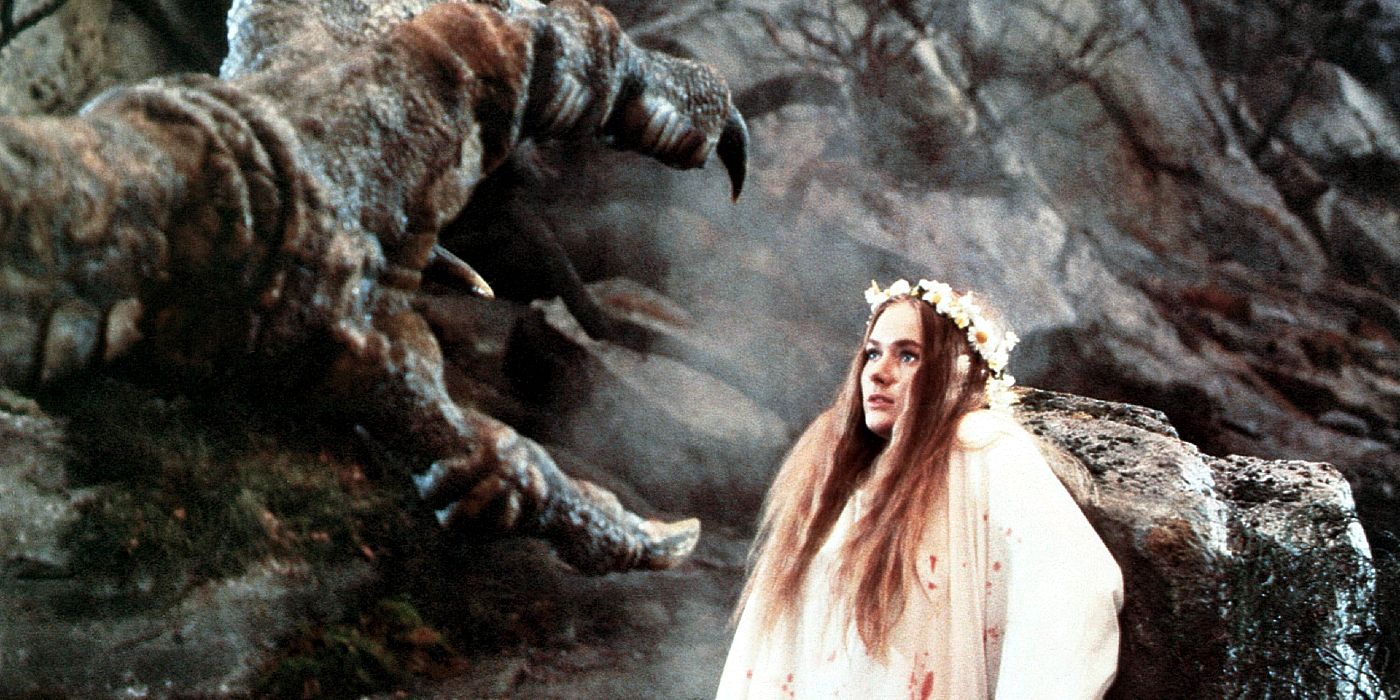
The 1980s produced some of the most enjoyable and visually stunning films ever made. Because animation wasn’t as advanced and more money went into creating detailed worlds, amazing creatures, and elaborate costumes, fantasy movies could really shine with their impressive sets, monsters, and action sequences, instead of relying heavily on famous actors or computer effects. While films like Willow, The Princess Bride, and Labyrinth are often remembered as the best ‘80s fantasy has to offer, Matthew Robbins’ 1981 film, Dragonslayer, is arguably the most overlooked – and boasts some of the most impressive creature design of its time.
The movie Dragonslayer tells the story of Galen Bradwarden, a wizard’s apprentice chosen by a magical amulet to save a kingdom from a fearsome dragon named Vermithrax Pejorative. This ancient dragon, 400 years old, is terrorizing the land and demanding sacrifices of young women. Despite receiving two Academy Award nominations and earning a high 84% rating on Rotten Tomatoes, Dragonslayer didn’t perform well at the box office, failing to recoup its $18 million production cost. This was an unusual setback for both Disney and Paramount, who jointly produced the film.
Dragonslayer’sVermithrax Pejorative Is Still the Best-Looking Dragon Ever Put to Screen
These days, it’s rare to see truly realistic dragon effects in movies and TV shows. While the dragons in the live-action How to Train Your Dragon look impressive, they’re clearly computer-generated and don’t have the same believable quality as effects created with animatronics and physical builds. A great example of this is Vermithrax Pejorative from Dragonslayer, a massive 40-foot dragon brought to life using animatronics and a team of 16 puppeteers, allowing it to flap its wings, move convincingly, and even breathe fire.
Phil Tippett, known for his work on creature effects in films like The Empire Strikes Back and later Jurassic Park, invented a technique called “Go-Motion.” This improved stop-motion animation by adding motion blur during filming, making the creatures’ movements appear smoother and more realistic.
To bring the dragon to life in the film, Tippett led a team of 80 special effects artists from Industrial Light & Magic. They used a combination of techniques: a massive 16-foot robotic head for detailed close-ups and smaller, stop-motion models for distant flying scenes. While David Bunnet originally designed the dragon, Tippett refined the look to make it more believable, including adding large, bat-like wings.
The film truly showcased ILM’s skill with a stunning fantasy sequence: the dramatic emergence of Vermithrax Pejorative from the water and flames, fully revealing her immense size and wings, leading into an unforgettable battle. This scene alone was worthy of the film’s Academy Award nomination for Best Visual Effects. However, it competed against Raiders of the Lost Ark, widely considered one of the greatest adventure films ever made.
Dragonslayer Was Much More Influential to the Fantasy Genre Than It Seems
While Phil Tippett didn’t begin his effects career with Dragonslayer, it was an important early project for him. Receiving an Oscar nomination for his work on it was a significant achievement and helped launch his most famous projects. Without Dragonslayer, we might not have seen such visually impressive films like Return of the Jedi (particularly the Rancor creature), Starship Troopers, and the popular 1990s fantasy film, Dragonheart.
Matthew Robbins’ career flourished after this success. He went on to direct another film, Batteries Not Included, and secretly contributed to the writing of Steven Spielberg’s blockbuster, E.T. the Extra-Terrestrial. Their collaboration began earlier, with Robbins writing The Sugarland Express and providing uncredited writing assistance on two of Spielberg’s most famous films, Jaws and Close Encounters of the Third Kind.
In the 1990s, Robbins began working with acclaimed director Guillermo del Toro on the film Mimic, a story about giant, monstrous cockroaches infesting the New York City subway system. He continued to collaborate with del Toro as a writer on several of his most popular movies, including Crimson Peak (2015) and a film nominated for Best Animated Feature in 2022.
You know, as a movie fan, I’ve always thought about how certain films really change things. And while Dragonslayer might not be a household name, I honestly believe it’s hugely important. The special effects in that movie were groundbreaking – they really paved the way for a lot of the filmmakers I admire and some of the most iconic movies ever made. It’s a bit of a hidden gem, but its impact is undeniable.
Read More
- Netflix’s Little House On The Prairie Reboot: Release Date, Cast & Everything We Know
- Off Campus Season 1 Soundtrack Guide
- YouTuber arrested after viral AI bodycam videos spark real police complaints
- Silver Rate Forecast
- Prime Video’s New R-Rated Spy Thriller Is Officially No.1 On Streaming Despite Poor Reviews
- Brent Oil Forecast
- Peaky Blinders: The Immortal Man’s Tommy Shelby Is a Better Father Than Michael Corleone
- EUR ZAR PREDICTION
- Gold Rate Forecast
- Bulgakov’s Take: Koreans Bet the Farm on Chips, Crypto, and Chaos
2026-04-24 03:39