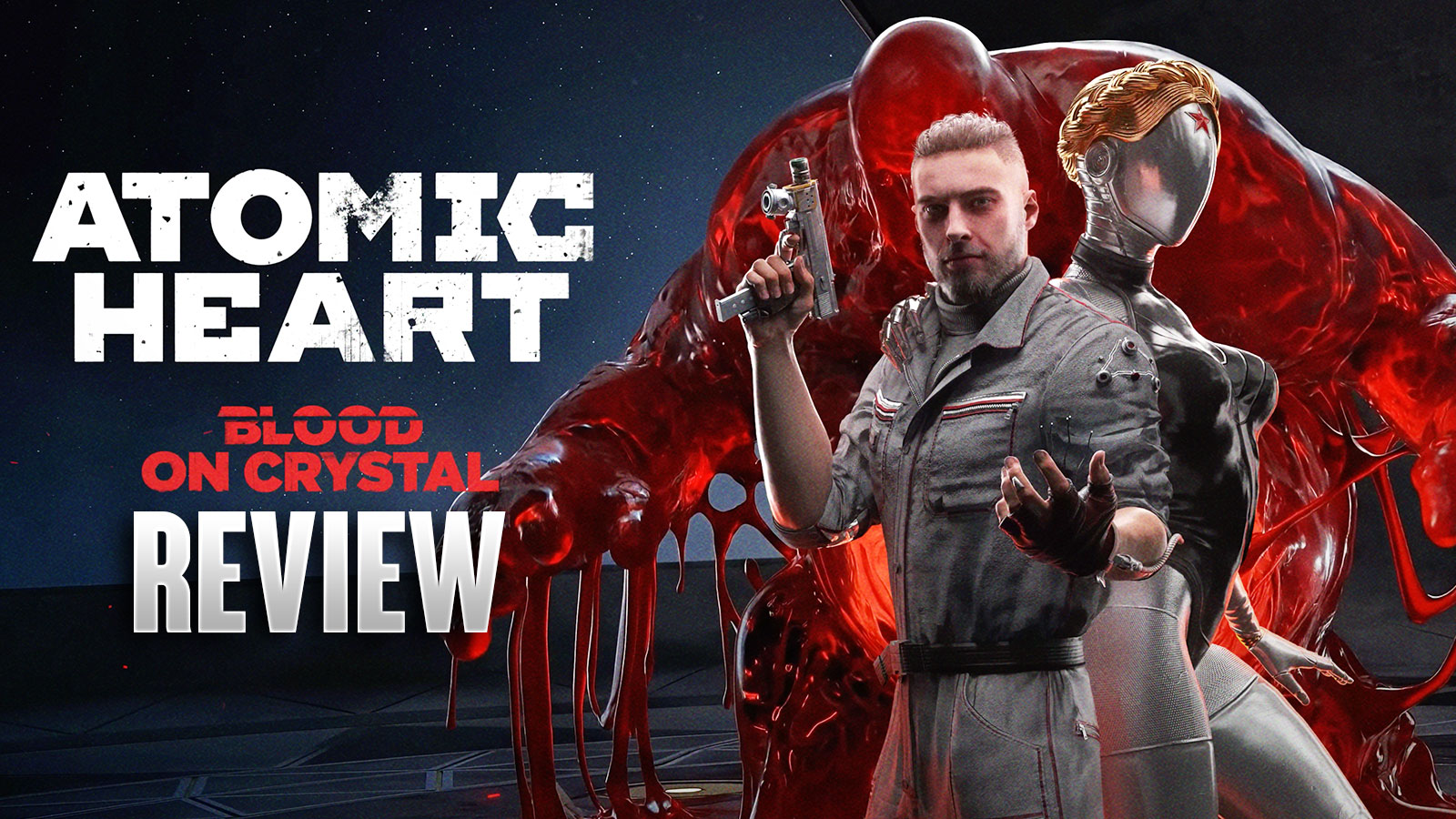
Our review of Atomic Heart’s Blood on Crystal DLC 4 covers the final chapter of the game’s initial story. This expansion wraps up the events of the original Atomic Heart and hints at what’s to come in the series. It introduces fresh enemies, locations, and character upgrades, aiming to combine the best elements from the game and its previous DLCs. But is it worth playing?
Atomic Heart Blood on Crystal DLC Review – What is DLC 4?
Blood on Crystal is the last downloadable content (DLC) story for Atomic Heart. You can buy it for $9.99, or get it as part of the Atomic Pass, which costs $39.99. If you purchased the Gold or Ultimate Edition of the game, the Atomic Pass is already included. It’s available on PlayStation 5, PlayStation 4, Xbox Series X|S, Xbox One, and PC through Steam.
WARNING: Spoilers Ahead!
Story – Atomic Heart Blood on Crystal DLC 4 Review
Another spoiler warning for anyone who hasn’t finished the downloadable content yet.
The fourth DLC for Atomic Heart continues the story from the game’s extended ending. While the ‘Blood on Crystal’ DLC starts with a story recap, we’ll also give you a quick refresher on everything that’s happened so far.
After finishing the main story of Atomic Heart, P-3 learns the real reason behind the Atomic Heart Project and battles Dr. Dmitry Sechenov with the help of CHAR-les. Though P-3 defeats the Twins and seemingly defeats his boss, he’s then shocked to discover CHAR-les is the true villain. CHAR-les merges with a being known as the “Jelly-Man” and banishes P-3 to Limbo.
In the second downloadable content, “Trapped in Limbo,” P-3 is reunited with his wife, Ekaterina Blesna. They then work together to escape Limbo and join forces with Granny Zina (Ekaterina’s mother) in the third DLC, “Enchantment Under the Sea.” It’s during this adventure that P-3…
- Explores a destroyed Chelomey, as well as the Neptune Complex
- Meets new allies – Nikolai, The Hunter, Nastya, and Samodelkin
- Recovers the Beta Connectors
- Recovers Blesna’s body
Having finished the last challenge in the third expansion and returned to the main world, P-3 feels ready to face CHAR-les. This also means briefly explaining the events that led to the ‘Blood on Crystal’ situation.
The latest story expansion continues directly after the events of ‘Enchantment Under the Sea’. P-3 and his friends are suddenly attacked by a huge wave of robots on the beach, but luckily, Granny Zina shows up to rescue them.
The team meets up again at Professor Lebedev’s Orb lab – the same place from the first downloadable content. While P-3 recharges, they devise a plan to face CHAR-les, which involves getting inside the Wave Platform. Before they can start, though, P-3 is paired with a new companion for their Glove – NORA.
Okay, so you know that repair vendor who was also the boss in DLC 1? Well, she actually joins your team in this DLC, but it’s a little weird – she doesn’t really do anything until you get to the Crystal Complex. While you’re exploring Wave, P-3 mostly chats with the rest of the crew. But as you dig deeper into the Platform, you find out about this totally secret place called Crystal, and that’s when things really start to happen!
P-3, Nora, Nastya, Nikolai, and The Hunter snuck into the Crystal Complex, while Blesna, disguised as a Twin, created a diversion from above.
I really loved that the new DLC gave us two totally different places to check out – it kept the gameplay from getting stale. The ‘Wave’ area was especially cool because it mixed outdoor and indoor environments, and it was awesome to battle some brand new enemies with P-3. It really added to the experience!
Now you’ll face Burlaks, enemies already in the original game, along with a brand new robotic opponent called the RACCOON. These enemies are different because you need to damage a specific part of them before you can use your glove to pull out the Candle inside. There are several types of RACCOON, and one even appears as a boss fight early in the game.
The robot enemies were fun to battle, but I’m still hoping for a fight with a Burav. Hopefully, we’ll get that opportunity in the next Atomic Heart game.
I enjoyed exploring the Wave Platform. It was a good transition between the earlier, more lighthearted areas and the grimmer Crystal Complex. What I particularly liked about Atomic Heart is that I took the time to read all the information on the PEAR devices – it really helped me understand what each part of the facility did, and it’s rare for me to do that in games.
Atomic Heart truly embraces its science fiction roots, with a detailed explanation of how everything within the game functions – that’s what initially drew me in. Combined with the thoughtful and imaginative designs of Art Director Artem Galeev, the game boasts a compelling backstory and a world that feels intentionally crafted.
The story really shines once you get to the Crystal Complex, and it’s a surprisingly large area to explore. The entire DLC took me about six to eight hours to finish, and everything felt well-developed and unhurried. The Crystal Complex is actually comparable in size to the Vavilov Complex from the main game, which is known for being the biggest location.
I recently learned about something incredible hidden inside the Crystal Complex – it’s where Dr. Sechenov is conducting his most groundbreaking work! Apparently, he’s figured out how to turn people into what he calls ‘Polymorphs.’ These aren’t just regular humans anymore; they’re basically upgraded! They can withstand really tough environments, live much longer, and don’t need to eat or drink as much. It’s a slow process of transformation, but the results are amazing!
The original game showed us hints of creatures made of a polymer, but those were just animal tests – they never truly transformed into fully shapeshifting beings. CHAR-les is a unique intelligence that can change form, appearing as the jelly-like figure at the game’s end. However, in Crystal, we encounter ordinary people who have completed the full transformation process.
The Polymorphs were designed to build stronger, more adaptable bodies for humans, allowing them to explore the universe. With these new forms, humans could accomplish incredible feats – from transforming planets like Mars to discovering the secrets hidden deep within the oceans – and learn far more about the world than ever before.
Polymorphs live much longer than humans, can withstand harsh environments, and can even control elemental powers. Originally, the first Polymorphs were people who…
- Had disabilities or life-threatening diseases OR
- Former soldiers who lost appendages
Eventually, the research grew to include wealthy and influential people hoping to extend their lives. But transforming into a Polymorph has significant and dangerous drawbacks.
I won’t go into a lot of detail, but I really appreciate how the story illustrates the effects of polymerization.
If a person replaces their body with a synthetic, polymer-based one, what changes occur? Interestingly, animals created with these polymers can even link their minds together, forming a collective intelligence. One report details a synthetic wolf curiously licking a synthetic sheep instead of attacking it. Though this shared intelligence is currently limited, it expands as more polymer-based animals join the network.
It’s incredibly interesting to talk with some of the Polymorphic beings. It’s not just about fighting them; you can actually have conversations and learn about what still connects them to their human side, as well as what they’re losing. Becoming immortal, it turns out, comes at a significant cost.
Throughout the downloadable content, you’ll encounter tasks from these unique beings, the Polymorphs, and learn about their perspectives. They see humans as ‘Bygones,’ and some believe they are superior. These interactions will make you question the facility’s purpose, its experiments, and the origins of CHAR-les.
While exploring deeper into the P-3 complex, you uncover more about what the facility is for and what CHAR-les is really up to. I don’t want to give away the ending or discuss major plot points, but I can say I found it satisfying.
I didn’t enjoy the conversations with Blesna in DLC 3 as much as I did with CHAR-les in the main game. Thankfully, Blesna appears less frequently in this DLC, and we get to see a lot more of CHAR-les.
One of the coolest parts of Atomic Heart is getting to chat with the other characters. I especially enjoyed the scenes with Nastya and Kolya – they’re in a lot of the game. The Hunter is still pretty enigmatic, but you definitely uncover more about his backstory. And even though Lebedev doesn’t show up too often, it’s always great to hear his voice. Honestly, I’m really loving all the characters in this game!
Okay, I have to talk about CHAR-les, the big bad in the DLC. Seriously, he’s the coolest character in Atomic Heart, hands down. I saw some people complaining about the English voice acting, but I totally disagree. Eric Meyers absolutely killed it as CHAR-les – he perfectly captured that mix of brilliant mind and terrifying monster.
Throughout the story, P-3 repeatedly crosses paths with his old friend, Charles. These encounters are incredibly well-done. Charles’s dialogue and performance are captivating, and he’s one of the most nuanced and compelling villains I’ve experienced in a video game.
Throughout the game and all its downloadable content, the player never quite understands what CHAR-les is trying to achieve. It isn’t until the very end of the fourth DLC that his plans start to become clear. Without giving away any spoilers, everything builds towards a large and impressive story.
Throughout the downloadable content, you’ll also encounter several smaller characters. One standout is Validol, a unique robot who keeps track of the Polymorphs. You’ll need to complete a small task for him to unlock the path forward. He’s a funny, well-designed character and a pleasure to interact with.
Many of the Polymorphs feature engaging and unique dialogue. It truly feels like you’re conversing with a different entity, opening up exciting possibilities for more original interactions in Atomic Heart 2.
I really enjoyed reading Blood on Crystal; it kept me engaged from start to finish. I first learned about Atomic Heart back in 2018 when the developers, Mundfish, released the initial trailer. There was a lot of uncertainty about whether the game would ever come out, and after five years, it finally did. However, fans then had to wait another three years to see how the story concluded.
There were only a few things I think could’ve been done better in the story.
Okay, huge spoiler alert! I was really excited for DLC 1 thinking it would continue the story from the ‘short’ ending, but it turned out to be… a simulation created by Professor Lebedev. Honestly, it felt a little like the developers were saying, “Never mind about that ending!” Now that I know it wasn’t actually real, it kind of makes playing the DLC feel pointless, you know? It’s a bit disappointing.
I also felt the ending was a little hurried. It was disappointing that we didn’t get any dialogue with the final boss after defeating him. Plus, the joke at the very end felt out of place. I generally prefer Atomic Heart to maintain a more serious tone, although I appreciate the moments of humor when they fit well – like with the Validol or the VDNH Tereshkova.
Don’t let this put you off trying the final DLC – you won’t be disappointed with the story. It’s the best story content Atomic Heart has released so far.
Gameplay – Atomic Heart Blood on Crystal DLC 4 Review
Blood on Crystal plays much like the original game, but it also introduces some key changes and new features.
You can no longer use neuropolymers to upgrade your character’s abilities like Shok, Blaze, or Whip. Any neuropolymers you find from enemies won’t be usable for upgrades. Instead, you’ll need to find 11 hidden upgrades within the Crystal environment to improve your character. These upgrades offer various enhancements.
- Increase your Maximum HP
- Increase HP Recovery when outside of combat
- & more
I generally like to work with neuropolymers, and I understand their reasoning. They’ve explained why the usual upgrade process isn’t possible anymore.
Getting new abilities works differently now. Instead of simply buying them from a repair shop, you’ll need to find special capsules called CHANCE capsules. These are hidden around the facility and are often necessary to get through certain areas.
As a player, I found some of the puzzle rooms really pushed you towards using specific abilities like Blaze or the Whip. Sometimes, the game hinted at using a Polymeric Shield, but honestly, it wasn’t always needed. My biggest problem with how they designed these puzzles was that it just felt a little clunky and forced, rather than natural.
Certain enemies, such as the Polymorphs, can transform during battle. They might cover themselves in fire or freeze themselves in ice. This means you may need to quickly change the type of Chance Capsules you’re using to defeat them effectively. It can be particularly challenging to do this on harder difficulties, especially when facing multiple enemies at once.
As a fan, one of the things I really appreciate about Blood on Crystal is how many different kinds of enemies there are! The new Polymorph enemies are a blast to fight if you’ve built your character right. I also had a lot of fun taking on the mechanical enemies like the Burlaks and RACCOONs. It’s cool they even brought back some enemies from DLC 1 and 3, too – it really feels like a connected world!
The selection of weapons isn’t very impressive. It’s disappointing that the Zvezdochka isn’t included. We only have the two melee weapons from the previous DLC packs, and for ranged options, you’re limited to the Secateur, Shotgun, Assault Rifle, and Pistol.
The new DLC only includes around six or seven weapons, which is a bit of a letdown. I also really miss the Mass Telekinesis power – even though it was a little too strong, it was enjoyable. It also feels like a mistake to remove the ability to upgrade powers.
While I enjoyed the fighting in Atomic Heart’s Blood on Crystal, I definitely preferred how combat felt in the original game. I understand the developers’ intentions with this expansion, but it wasn’t a good fit for me personally.
The combat still felt enjoyable, and thankfully, you weren’t constantly overwhelmed by large groups of enemies. The game struck a much better balance between fighting, solving puzzles, and exploring the world. It would have been even better, though, if there had been more weapons and greater flexibility in how you could customize your abilities and upgrades.
I definitely prefer the Polymorph boss over the crab boss from the third DLC. Overall, the boss fights in this game are a big improvement. The MO-R4Y boss from the DLC was just frustrating and not enjoyable. In contrast, Blood on Crystal’s boss battles are challenging but feel much fairer, and the final boss was especially fun to fight.
Beyond the battles, the main focus of DLC 4 is exploring the Crystal Complex. The new puzzles you encounter inside are both challenging and enjoyable. The complex is also rich with backstory and intriguing details, encouraging players to discover everything it has to offer.
I’m really happy that Atomic Heart has automatic sprinting. A lot of games make you constantly hold down a button to run, which can get tiring. It’s a small detail, but I hope the developers keep this feature in their future games.
Despite a few drawbacks, I really enjoyed playing Blood on Crystal. While I’d like to see more weapon variety and I’m not a fan of the CHANCE Capsules, the game is still fun and I’d definitely play it again. The boss fights are exciting, the shooting mechanics feel good even with some limitations, and the different enemy types keep the gameplay interesting.
Sound – Atomic Heart Blood on Crystal DLC 4 Review
Atomic Heart boasts a fantastic audio experience, with both its music and sound effects being particularly well-done. Surprisingly, I found myself enjoying the more understated tracks – like the themes for the PEAR devices and the Repair Vendor shop – even more than the music during the action sequences. These subtle sounds really enhance the game’s atmosphere.
I really enjoy the sounds of the labs and machines too. They create a truly immersive experience as you explore a facility with a distinctive design, unlike anything else in gaming. From the flowing sounds of the strange liquids to the whirring and beeping of the equipment, the sound design is fantastic.
I’ve been having a blast playing Atomic Heart, and I’ve discovered something really cool – it sounds amazing with classical music! The developers, Mundfish, did such a great job weaving classic tunes into the game’s retro-futuristic world, which is set in a Soviet Russia vibe. Honestly, you really can’t go wrong with the audio experience in this game – it’s fantastic!
Graphics – Atomic Heart Blood on Crystal DLC 4 Review
Atomic Heart is a stunning game, visually. Its indoor environments are particularly beautiful and well-designed, largely thanks to the incredible artistic vision of Artem Galeev. I truly believe he’s one of the most talented and imaginative artists I’ve ever encountered.
Artem Galeev’s work stands out because of his thoughtful design and meticulous detail. His robots aren’t just visually impressive; every aspect of their design serves a specific purpose. Learning about these machines, and the new Polymorph enemies, reveals even more about their capabilities.
The Crystal Complex has a unique style, combining retrofuturistic elements with the aesthetic of ancient Egypt to create something truly original. While Wave was enjoyable to navigate, I found Crystal much more captivating.
Polymorph designs are visually appealing, especially the animal forms. Their transparent shells allow you to see fascinating internal details. The game’s environments and enemies are further enhanced with details like propaganda posters and distinctive buildings.
I could talk all day about how great Atomic Heart looks, but simply put, you won’t be disappointed by the game’s visuals.
Verdict: Is Blood on Crystal Worth Your Time & Money?
Atomic Heart’s DLC, Blood on Crystal, is definitely worth playing, especially if you enjoyed the main game. If you have the Atomic Pass, you absolutely should check out this last story expansion.
This DLC has the strongest story of all the expansions and does a great job of setting up what could happen next in the Atomic Universe. Even if future installments, like Atomic Heart 2 or The Cube, aren’t well-received, we’ll still have the original Atomic Heart to enjoy. If the series doesn’t continue successfully, ‘Blood on Crystal’ could feel like a satisfying conclusion.
I doubt that will be the case. Mundfish clearly excels at building captivating worlds and narratives, as we’ve seen in the latest DLC. We’re really excited to see what they have planned for the future of the game.
My main criticisms of the DLC are that it doesn’t have enough weapon variety and the ending feels a bit hurried. However, it’s still enjoyable thanks to its fresh enemies and challenging boss fights, plus a compelling story and interesting new location to explore.
I’m a huge fan of Atomic Heart – it’s rare for a game to truly captivate me, but this one did. The team at Mundfish faced a lot of challenges during development, but they successfully brought their vision to life. Even with some controversy and unfair criticism, Mundfish looks poised to do great things with the Atomic Universe in the future.
A new chapter is beginning in the AH Universe, and we’re excited to see what happens next.
Score: 9.5/10
Read More
- Netflix’s Little House On The Prairie Reboot: Release Date, Cast & Everything We Know
- Off Campus Season 1 Soundtrack Guide
- YouTuber arrested after viral AI bodycam videos spark real police complaints
- Silver Rate Forecast
- Prime Video’s New R-Rated Spy Thriller Is Officially No.1 On Streaming Despite Poor Reviews
- Brent Oil Forecast
- Peaky Blinders: The Immortal Man’s Tommy Shelby Is a Better Father Than Michael Corleone
- Gold Rate Forecast
- EUR ZAR PREDICTION
- Bulgakov’s Take: Koreans Bet the Farm on Chips, Crypto, and Chaos
2026-04-24 18:29