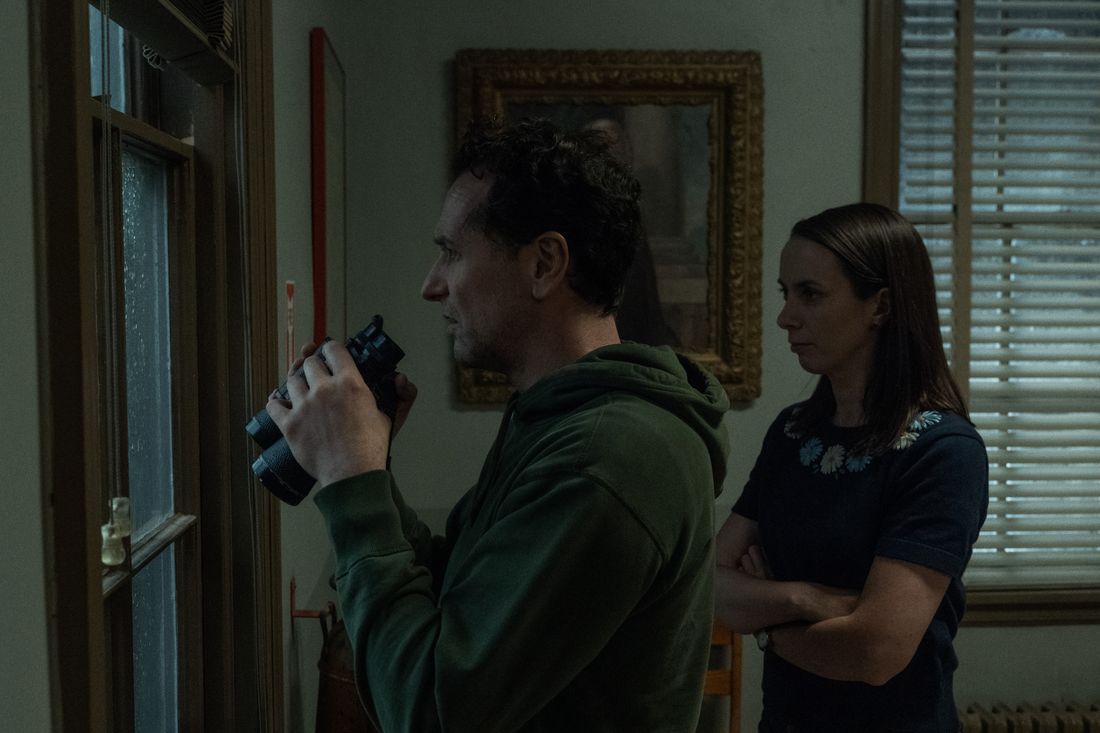
Getting to Widow’s Bay isn’t difficult. Ferries regularly travel to the quiet island town, which is about 40 miles from the New England coast—as long as the weather is good. But where did the idea for Widow’s Bay come from? The show’s sixth episode, “Our History,” offers some explanations within the show’s story, but the real origins lie with Katie Dippold, the show’s creator. Years ago, Dippold wrote a funny, slightly spooky script as part of her audition for Parks and Recreation. She got the job, but instead of discarding the script, she saved it for later. Eventually, she revisited and revised it, which allowed her to create the story of an island that people outside the community accurately describe as a place where “bad things” happen.
Dippold often discusses what influenced the show’s scary elements. While films like Jaws, and the work of Stephen King and John Carpenter are clear inspirations, Widow’s Bay doesn’t usually directly copy them. Instead, the series captures the feeling of those works, blending and re-imagining the things a lifelong horror fan loves. Below is a look at those inspirations, and a list of recommendations for what to enjoy after you finish watching.
Stephen King
There’s a hint that the show draws inspiration from Stephen King. In the fourth episode, “Beach Reads,” Patricia (Kate O’Flynn) adds books to her mobile library, the Pattiwagon. One is a self-help book called Your Turn, which causes trouble later in the episode. The other is a Stephen King novel – we only see part of the cover, but it’s clearly a copy of The Shining (this particular edition).
This isn’t so much a surprising discovery as a confirmation of how much Stephen King’s work has impacted popular culture. The series Widow’s Bay already showed its appreciation for The Shining in its second episode, “Lodging,” where Tom (Matthew Rhys) stays overnight in the allegedly haunted Breakwater Inn. Like other references in Widow’s Bay, it doesn’t directly copy The Shining, but uses it as inspiration. During his stay, Tom encounters a frightening clown—reminiscent of Pennywise from It—and a particularly haunted room, which alludes to Room 217 from the novel The Shining and King’s short story “1408.” The fact that King himself has described “1408” as part of a broader tradition of ghost stories set in haunted rooms shows he was also inspired by a long history of similar tales.
Stephen King’s influences are abundant throughout the series. In the episode “Beach Reads,” Patricia, who has been ostracized for years, is motivated by a character named Your Turn to throw a memorable party where she initially experiences connection and belonging, only to have it all fall apart. While the party isn’t a direct copy of Carrie, it’s clearly inspired by that story. One viewer noted a specific scene with Tom and Wyck mirroring a moment from Brian De Palma’s 1976 film adaptation of Carrie. As the season progresses, it also strongly recalls King’s 1999 miniseries, Storm of the Century, which was based on his original screenplay.
Even if Widow’s Bay didn’t directly reference specific works by Stephen King, his influence is still clear. The story’s New England location, the tough characters who live there, and the rich details all show his impact. In a recent interview with Polygon, author Dippold explained, “He’s such a skilled storyteller. It’s about capturing a feeling of nostalgia, creating a strong atmosphere, and being as precise as possible. You try to learn from that, and hope some of it rubs off.”
Twin Peaks
Stephen King isn’t the only storyteller who creates eerie small towns populated by quirky characters. The TV series Twin Peaks, created by David Lynch and Mark Frost, is another major influence on Widow’s Bay, and it’s about more than just the setting. Like Widow’s Bay, Twin Peaks blends intense fear with lighter scenes and takes place in a place that feels… different. Early in the series, Sheriff Harry S. Truman warns Agent Dale Cooper about a strange evil lurking in the woods – a warning that could easily apply to Widow’s Bay. Just as Lynch and Frost did with Twin Peaks, the author has built her town around a mysterious and fascinating background, with room for ghosts, strange illnesses, and even slasher killers. It makes you wonder if there’s a connection to the Black Lodge somewhere on the island – and at this point, anything seems possible.
Lost
Like Lost, this show builds a mysterious and captivating backstory. You see hints of it early on with the strange, old-fashioned welcome video Tom finds – it feels similar to the instructional films from Lost. There’s also an unsettling chair near a hidden underground entrance, and the island’s secrets seem connected to another well-like opening in the woods, reminiscent of those surprising discoveries in Lost. This connection seems to have driven Reverend Bryce to suicide. Ultimately, both shows center around groups of people forced to cooperate because they are trapped on an inescapable island.
The Wicker Man
The mystery surrounding the founding of Widow’s Bay involves a strange deal made with an unknown, possibly sinister power. This has strong echoes of classic folk horror films like The Wicker Man, which features a policeman investigating a remote island community practicing ancient pagan rituals. Similar vibes appear in Patricia’s impulsive beach party and the growing sense that an old, powerful force governs the island – one that existed even before European settlers arrived to find it seemingly uninhabited… except for those unsettling teeth. The island’s atmosphere and the story of the Puritan settlers trying to establish themselves also recall Robert Eggers’ The Witch, another well-known example of folk horror.
John Carpenter
The horror series Widow’s Bay owes the most to the filmmaking style of John Carpenter. The very first episode opens with a dense, unsettling fog, a clear nod to Carpenter’s 1980 film, The Fog. Carpenter’s work is particularly influential because his hit Halloween didn’t create the slasher genre, but it really defined and popularized it—establishing the trope of an unstoppable masked killer hunting victims. Widow’s Bay features its own version of this killer, the Boogeyman, who combines elements of Michael Myers from Halloween and Jason Voorhees from Friday the 13th (a series that likely wouldn’t exist without Halloween’s success). Like Jason, the Boogeyman wields a machete, and like Michael Myers, he initially targets teenage girls—possibly including a younger Patricia. However, this time around, the Boogeyman seems to be expanding his range of victims.
Atlanta and Parks and Recreation
As a huge fan of good TV, I’ve been really impressed with the direction on this new show. Hiro Murai – you might know his work from shows like Barry, Station Eleven, and even Mr. & Mrs. Smith – actually directed half of the first season’s episodes, including the crucial first three. But honestly, what really caught my attention is that he also did a ton of directing on Atlanta. That show was amazing because it constantly surprised you, sometimes even within a single episode! It wasn’t exactly horror-comedy like this new series, but its unique style and world-building were just incredible. The creator told Inverse they specifically wanted Murai because of his knack for unpredictable storytelling – they literally couldn’t guess what he’d do next with an episode, and that’s a huge compliment!
It seems like both the setup for Widow’s Bay and the creator’s previous work are strong. The town’s museum in Widow’s Bay especially feels reminiscent of Parks and Recreation, revealing a quirky history that echoes the strange stories from Pawnee, Indiana, but with a darker edge. While Tom Loftis isn’t quite as relentlessly optimistic as Leslie Knope, he’s equally dedicated to improving his town—and, naturally, to one-upping its rival, Martha’s Vineyard.
Popeye
The third episode of the series, “Inaugural Swim,” features Tom battling the Sea Hag, a frightening monster reminiscent of New England folklore. While stories of cursed women connected to the sea have existed for centuries, the modern image of a “Sea Hag” actually comes from E.C. Segar’s comic strip Thimble Theatre, which also introduced Popeye. In the comic, the Sea Hag is a witch and pirate with a crew of henchmen. However, the Sea Hag in Widow’s Bay appears to be a solitary creature. Unlike Popeye, who refused to fight a woman due to his principles, Tom doesn’t seem to have the same restraint – he just struggles to defend himself effectively.
Jaws
The creators of Widow’s Bay aimed for a town that felt welcoming but subtly unsettling, much like Amity Island in Jaws. Similar to Amity, the town’s mayor initially prioritizes tourism even when danger arises. However, unlike the mayor in Jaws, Tom quickly becomes dedicated to protecting everyone after experiencing the supernatural threat firsthand. This makes him more like Chief Brody. In fact, the show’s three main characters strongly mirror the heroes of Jaws: Wyck embodies Quint, the experienced, tough sailor who’s willing to risk everything. And Patricia, with her research skills and bravery, is similar to Matt Hooper, the oceanographer who proves to be surprisingly resilient. Even an episode of Widow’s Bay called “Seasickness” deliberately draws inspiration from Jaws.
The Babadook
Obviously.
Read More
- Off Campus Season 1 Soundtrack Guide
- Netflix’s Little House On The Prairie Reboot: Release Date, Cast & Everything We Know
- Infinity Nikki Candlelight Reverie Challenge and Rewards Guide
- Gold Rate Forecast
- Brent Oil Forecast
- Silver Rate Forecast
- Prime Video’s New R-Rated Spy Thriller Is Officially No.1 On Streaming Despite Poor Reviews
- KPop Demon Hunters Meets Avatar: The Last Airbender In Netflix’s 3-Part Fantasy Series
- EUR ZAR PREDICTION
- The Hunting Wives Star Teases “Wild” Major Character Death in Season 2
2026-06-15 17:59