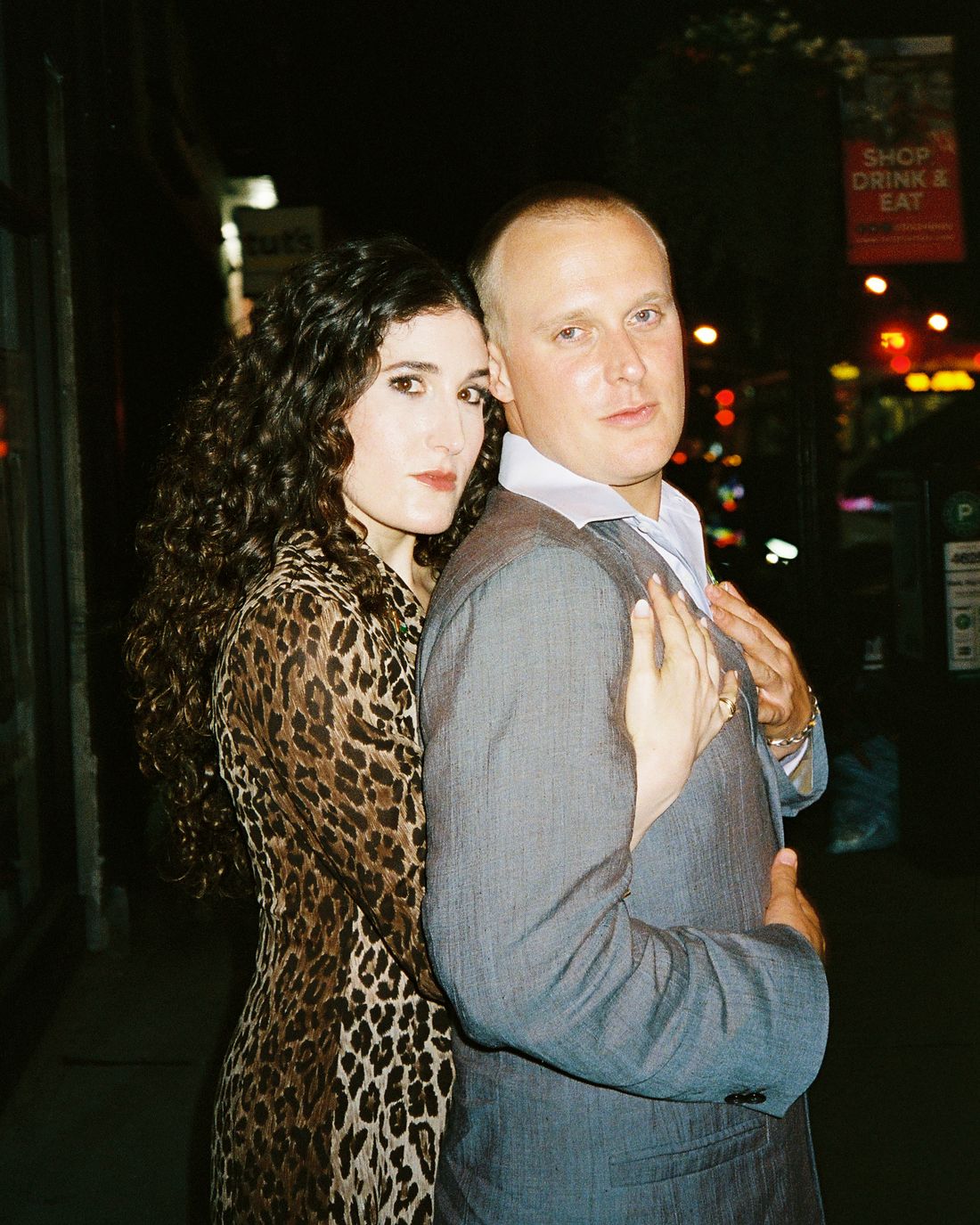
John Early and Kate Berlant are in Early’s East Village apartment, a colorful, older space he’s been renting while performing in a play. Early is quickly gathering his things before they leave, while Berlant examines his bookshelves, quizzing him about the books he brought from Los Angeles. She asks about titles like Light Years – “I read half of it a long time ago,” he replies, looking for his laptop. She continues, asking about Remains of the Day. “Never read it,” says Early, now searching for his phone, wallet, and keys. Berlant insists he should, saying she wants to reread it herself. She then announces she’s starting to read again tomorrow, explaining that she had been doing well with reading at the beginning of the year until she got back on Instagram, which she says disrupted her life.
With a small bag safely stowed, Early checked the time and suggested we walk to a nearby park and sit at a picnic table under a tree. He was clearly pleased, saying, “This is exactly like Maddie.” He meant the main character of his first film, Maddie’s Secret, which he wrote, directed, and stars in. Maddie is a food influencer gaining popularity at a media company similar to Bon Appétit. She seems to have it all – a loving husband (Eric Rahill), a supportive best friend (Berlant) who may have feelings for her, and even a fantastic Super Bowl recipe. However, she’s secretly battling bulimia, a struggle that began in her childhood and could ruin her growing success. The film had a very enthusiastic premiere at Lincoln Center just a few days before our conversation, and even louder reactions in Los Angeles. Berlant recalled, “There was one woman who just screamed from the back of the theater—it was incredible!”
“Maddie’s Secret” is a tricky show to define – it’s funny, dramatic, and sharply criticizes the world of online content, but it also takes itself very seriously. The cast, featuring actors like Vanessa Bayer, Conner O’Malley, Claudia O’Doherty, and Kristen Johnson, fully commits to the sincerity of the story. Creator Brett Early wrote it rapidly, drawing inspiration from classic Lifetime movies, the films of Douglas Sirk, the soundtrack to “Shaft,” and the work of John Waters. He describes it as intentionally aiming for a “cult classic” vibe, something unpredictable and ever-changing. The show brings together themes that Early and his longtime friend and collaborator Zach Kanin have explored for years, including elaborate dance numbers, playful attempts at seduction, and a satirical look at a specific side of Los Angeles. They discussed how the show, and their many previous projects, came to be.
You two met in New York and fell in love with each other right away, but can you tell me specifically what struck you first about each other?
KB: We actually met on Facebook. How I remember is that you messaged me and then I looked you up and saw Skindergarten and was like, “Oh, he’s really funny.”
JE: I had seen “Lampshade Susan.” I was really shocked by her videos, and then I was shocked to know that she had looked me up and seen one of my videos, which by the way, it was a short film I made in which I play a woman with a really nice lace-front wig.
So, was that the first time you’d tried that kind of thing?
Yes. I’d previously approached comedy like Cheri Oteri – big, broad characters, like a sketch show. She’s incredibly versatile, and I want to be clear, she has depths I don’t think I’ll ever reach. But Skindergarten was the first time I really wanted to create something intimate, cinematic, and realistic. I was surprised Kate even took me seriously, because she was already a well-respected comedian – kind of the queen of alternative comedy. People a little older than her – like Eugene Mirman and Reggie Watts – all really admired Kate. I was just starting out, fresh from drama school with not much experience, and a lot of ambition.
Who friended whom on Facebook?
JE: I probably friended you.
KB: I think you friended me and messaged me. And then we met and we were like, “We should hang out or something.” Then we happened to be on the same lineup for Brooke Bundy’s show at Jimmy Number …
JE: Jimmy’s 43.
KB: I did a set, and I had to go to do another set — I was really pounding the pavement — and it was the thing where I felt someone grab my arm. I looked up, and it was John. I remember we had this moment where it was like, We’re going to do this, but I’m leaving right now.
JE: We knew there was something there.
It started with a simple connection – we just found each other funny. Then, almost immediately after that, we ended up working together on a short film called The Greggs.
This is what, 2012?
KB: Yeah. I remember it so viscerally because there was a little room with the snacks, and John and I were in there, and we were immediately screaming-laughing, and just having so much fun. I remember only wanting to hang out with him, and other people would come in the room naturally to get snacks, and I’d be like, “Get the fuck out.”
JE: This quality has been perverted and exaggerated in Maddie’s Secret.
That night, we took the train home from Grand Central Station, each of us heading back to our own apartments.
The experience felt like something out of a movie.
KB: It was around 2 a.m., and I recall taking the train home. Then, John texted me, saying he would harm himself if he didn’t see me. Honestly, we met up either the next day or the day after that.
JE: When have you ever said, “Let’s hang out,” and you mean immediately? You’re actually hoping the other person forgets it.
KB: It really was the falling-in-love thing of like, we were just inseparable. There wasn’t dating, there wasn’t any coitus. It was very lesbian. John quite literally would sleep over at my apartment. I had a roommate of course, and John would be sleeping in bed with me for many nights of the week.
What size bed?KB: Full.
JE: It was not even a queen.
Were you cuddling?
JE: It was a full-size bed and then there was a foot of space around the bed to create the room.
It wasn’t much space, but we didn’t need to cuddle. We had enough room to comfortably talk until we fell asleep, and we always slept soundly right next to each other.
JE: You had these jersey sheets.
KB: I had cotton Target jersey sheets. We would do what we had to do in the day and we would just rejoin up at night. The iconic thing is that John would buy packs of Hanes underwear from CVS so he didn’t have to go home.
Did you two immediately decide to collaborate, or did it take time and start as just a friendship?
KB: It happened right away.
JE: It was instant.
KB: The friendship was founded in this creative way, like, “Oh, we’re supposed to be together.”
Just a month after becoming friends, we traveled to Wilmington, North Carolina, where popular shows like Dawson’s Creek and movies like Cape Fear were filmed, along with many other well-known productions. We were there to see the amazing—
KB: Sammy Birch.
JE: And Jackie Birch, her mother, who’s a brilliant casting director. She helped us cast the kids for “Family Dinner.” These local children in North Carolina.
https://youtube.com/watch?v=watch?v=ghDbHTiOWeM
The very first project you collaborated on was called “Family Dinner.” As Jenna Elfman explained, it started with a simple idea: to improvise scenes as if you were parents and the other actors were your children.
Those kids are incredible. How are they not in tears?
JB: They’re amazing.
KB briefly paused the interview and pointed to a child playing in the park. She expressed concern, wondering where the child’s caregiver was. Then, she noted that someone was waving, presumably the caregiver.
JE: Yeah. And she’s smiling.
KB: Sorry. It’s that maternal instinct. She has curly hair, so it was like …
So she’s yours, yeah.KB: Yes.
Oh yeah, I remember filming that short! We stayed at our friend’s mom’s house again and shared the same bed, and we were just really excited and happy. Does that ring a bell for you?
KB: I do remember that.
We were both incredibly excited and felt like we’d stumbled onto something special. There was a natural connection and comfort between us, and we weren’t afraid to show our true selves or let our talents shine.
KB: We were like, “See you on IFC.”
JE: We kept saying that. We thought that IFC was the holy grail.
KB: It was just like, “Naturally we’ll have a show.” And please let it be printed that we have not had a show. We made a gorgeous pilot. We were in preproduction for another pilot literally when COVID hit. But we’re not worried. Divine timing. We always knew we would take off in our 40s.
We’re finding new ways to work together as things evolve. This film is a good example – it wasn’t even something I originally planned.
You didn’t intend it to be for the two of you?
JE: When I was writing it I was obviously just like, “I want to make a movie.” I wasn’t thinking of it being a John-and-Kate vehicle.
KB: No. It doesn’t feel like that to me.
I was initially concerned the film would feel too focused on me, since I’m in every scene, and it felt overwhelming. But after watching it last night, I realized it actually works really well as a story about John and Kate, even though it’s also about other things.
KB: Ensemble. It’s totally ensemble.
It’s a really lively set with lots of people. The dynamic between Deena and Maddie developed very organically – we both really enjoy and connect with that kind of intense, psychological, and sensual thriller vibe, and it’s a lot of fun to play those scenes together.
https://youtube.com/watch?v=watch?v=IjfX8l5XrF8
Are you different around each other versus when you are both with other people?
JE: I often feel sort of brain-dead when we hang out, in a really relaxing way. Like when Kate’s driving and I’m in the front seat, I always find myself dancing unconsciously and just being like, Look at that. I feel like a stoner.
KB: We have a relaxed intimacy. We end up singing and making up rhymes, but unconsciously. It is very childlike. But we also are laughing so much.
JE: Yes. And quite earnest with each other. Obviously friendship should be a sacred space where you can be totally sincere, but I think people for some reason assume that we’re like …
KB: That we’re like fashion police and being like, “Ugh,” or whatever. And it’s like, no.
JE: We’re not doing bits.
Never?
JE: No. I mean, we make each other laugh all the time but it never feels—
KB: Front-facing.
Absolutely. Being around comedians, especially backstage, can be surprisingly draining because they’re constantly performing little jokes and routines. It often feels like an involuntary reaction, almost like they’re trying to fill awkward silences. I definitely struggle with using humor as a way to cope with anxiety, and I think you do too, if you don’t mind me saying.
KB: Of course.
JE: But in our friendship, privately, the bits are actually … I hate saying “bits.”
KB: I know.
JE: We just make each other laugh. Then we slip into really—
KB: —full characters.
JE: We slip into, I’m really Laura Dern and enlightened.
We often joke about Kate playfully flirting with me. It’s a running gag that’s become a bit of a classic between us, and it’s even referenced in the movie. It might not be our longest running joke, but it’s definitely one we come back to often, usually with Kate suggesting we ‘fool around’.
Do you handle that sort of thing in private? It’s like, ‘Let’s have some fun.’
JE: Exactly. Yes. She’d say something like, ‘Come on, I just need to relax.’
KB: Where was that video? Was that like early Instagram?
JE: We were in a hotel.
You also use the phrase, “Let’s blow off some steam,” which is featured in your special, Would It Kill You to Laugh.
JE: That saying originated during a show we were doing, I believe it was in San Francisco.
KB: We were staying in a friend’s basement.
JE: We were killing time before a show and Kate’s like, “Let’s blow off some steam.” And it killed me. We also sometimes slip into a duo of that girl and her vacant gay best friend. Which is like, it is. I am in some ways, when I’m like,“Amazing.”
KB: We both look like normal girls. We both love being like normal girls.
So when you were writing Deena, you wrote it for Kate like, “I’m going to escalate further the ‘you wanting to fuck me’ joke”? How exactly did you pitch it?
JE: I think I texted you.
I recall you mentioning you were planning to write a movie, either while we were talking on the phone or when I was visiting you and we were sitting on your couch. I think I was walking around the reservoir at the time – maybe with you, or maybe just while we were on the phone.
JE: And I was listening to the Shaft album.
I was going through a phase of really enjoying Isaac Hayes’s music while writing the movie. The sound just felt right—it matched the style I often used when creating music with fictional bandmates. Michael Hesslein, who composed the score, and I both love that energetic, Burt Bacharach-inspired sound. It felt perfect for the film because it’s an exploitation movie, reminiscent of a 1970s women’s picture with that genre’s particular style.
So I was listening to that a lot, and I didn’t have a role for Kate yet. The story wasn’t totally mapped out, but I knew there would have to be something. And there’s this one song called “Do Your Thing” from the Shaft album where it’s like 19 minutes, and it’s really dark and hypnotic, really sexy. And it birthed an entire other element of the movie, which was your character. I wanted to write this weird dance class where my innocent little fairy princess could get pulled into the dark—
KB: Underworld?
Absolutely. I was picturing Kate as the one introducing me to that hidden, unconventional side of things.
You often include dance sequences in your work. You’ve done a lot of choreographed dance scenes. What draws you to that?
JE: I really enjoy dancing! There’s something playful and reminiscent of sleepovers about learning choreography. It reminds me of a funny moment in Janet Jackson’s Pleasure Principle where she simply walks into a studio, turns on the lights, drinks water, and puts it back down – it always makes me laugh. You see similar scenes in movies like Showgirls and Flashdance – the newcomer being thrown into a dance class and struggling to learn the steps. I think there’s something inherently funny and relatable about the vulnerability of not knowing the choreography.
Who struggles more when learning dance routines? KB says it’s her. She explains that she has trouble with spatial awareness and tends to freeze up, making it really difficult for her.
JE: Kate is a real natural dancer—
KB: Thank you.
JE: —but there is kind of … I think that you have an idea about yourself.
KB: Yeah, you’re right. It’s more of an idea.
JE: I see the kind of math-class panic.
Could you guys do it right now, the dance from the movie? Is it in there forever?KB: No.
Another trope that you guys return to a lot is one where you’re meeting up again after years of not speaking and you’re one-upping each other. Do you have any of that actual anxiety, like, Maybe someday, something would split us apart and that could be a future?
JE: I think it probably comes from a real place.
KB: The idea of us having some kind of breakup. Because we don’t fight. And it’s just funny to imagine, What could break us apart? Then there’s just a very funny idea of us being polite with each other. Because we are so obsessed with social nicety, the performance of social nicety. So, the idea of us actually having to do that with each other is really hard.
JE: I think that would be so heartbreaking. To actually go from an easy intimacy—
KB: To like, “How are you?” Oh my God.
It’s mostly about imagining how that situation would feel. We both work in entertainment, and naturally, we each have our own goals and what we want to achieve. It’s amusing to picture one of us joining the Marvel Cinematic Universe while the other continues to focus on theater.
You mentioned avoiding conflict, but have you ever felt a distance growing between you, or worried about drifting apart?
KB: We decided early on that if we ever felt a problem brewing, we’d go to therapy. It’s something creative partners often do – address issues before they escalate.
JE: It’s more and more popular.
KB: So, we would do that before we would just be like, “Fuck you,” and end it.
JE: I agree. I promise.
KE: We have an anniversary. Cinco de Mayo. Why did we pick that again?
JE: No, that’s literally when it was. We looked up the day.
How have you observed each other’s growth as performers?
KB: With Maddie’s Secret, John really blossomed as a filmmaker – something he’s been working towards for a long time. This feels like his official debut.
I was deeply affected by Kate Berlant’s one-person show, Kate, directed by Bo Burnham at the Connelly Theater. Our generation was led to believe that creating a lot of short online content would lead to success – that someone like Steven Soderbergh would discover us and build a project around us. But that simply doesn’t happen. I think both Kate and I really needed to work on something longer and more developed. Kate was a brilliant showcase of the self-aware humor Kate is known for, but it was much more polished and carefully constructed than her usual improvisational work. I found it incredibly masterful, and it evoked a strong emotional response – I both cried and laughed hysterically.
Personally, I think it’s closely linked to our artistic work, which isn’t surprising. When we work on longer projects, we both prioritize making things clear, thoughtful, and giving the audience something genuinely rewarding. I believe that kind of approach can only happen if we’re also striving for directness, honesty, and clarity in our own lives.
KB: It’s too much of a simplification to say grown up, but it is just kind of like …
As we’ve gotten older, it’s become simpler to be direct and say what we intend. I believe this change is visible in our work. Our earlier pieces were more experimental and energetic—we were trying everything, and that’s exactly what we should have been doing at that stage.
Do you ever get jealous of each other’s other collaborators? In a Deena way?
KB: No, because it’s like we have our own thing. It’s also, even just selfishly, our collaborations are only bolstered by individual success. Us learning skills elsewhere and having other experiences only helps to nurture the stuff that we make together.
JE: We’re very poly in that way.
KB: It’s the only way that polyamory can work.
Have you guys ever watched the other one flop onstage, or do something that they weren’t proud of? And what do you say to the other one in that situation?
JE: I have. Yes.
KB: I feel like we’ve seen each other in different moments of everything.
JE: God, yeah. We’ve done enough shows together where we’re both on the same lineup and where we’ve …
KB: It’s just like—
JE: Quiet. I’ve seen both of us in those situations—
KB: —get hostile.
Hostile at the audience?JE: Yeah.
KB: Kind of shut down and be like, “Fine.”
Are you honest with each other after? Like, “That sucked”?
KB: It’s never been a situation of one of us is crying and the other one has to talk them down. It’s just kind of like, “Ugh.”
Sometimes Kate asks for my opinion on her stand-up, but we don’t regularly bounce ideas off each other like some comedians do. I’ve had other comics suggest jokes or taglines to me, even in the green room, and honestly, I just don’t care. It’s not about being proud; I’m perfectly okay with my own material being imperfect or a little strange. I’m comfortable with it even if it’s not great.
I don’t want to sound resentful, but it bothers me that I tried to perform stand-up on Conan so many times and was always rejected. I’d offer my seven-minute set, and they’d say it was just too strange. That’s where all that feedback – like, “make this more…” – comes from. It’s based on what other people thought.
JE: Accessible or traditional.
Have you ever wondered how different your lives and personalities might be if you hadn’t met each other?
KB: I actually haven’t considered that. What’s strange about John and me is that even if we hadn’t met, we probably would have crossed paths eventually. We have a lot in common, almost like we’re related. I guess if I had ended up being a stay-at-home mom instead…
JE: Or if I had done Doctors Without Borders, which I almost did.
KB: Oh my God.
JE: No, I’m kidding.
I just completely trust whatever he says. But honestly, I think it was always meant to happen. We were bound to cross paths eventually; it felt unavoidable.
JE: But in a world where we didn’t. In a freak world where we hadn’t met.
KB: I would be much sadder. I would be much more lonely.
Regarding Maddie’s Secret, how soon did you start hearing about the story from Kate?
KB: He wasn’t actually sharing pages with me, he was just telling me about it. He’d mention things like, “I just wrote a really funny scene.”
JE: And then did you read it for the first time in the group when we read it at my house?
KB: Yeah.
Kate, you said John wrote this very fast. How fast?KB: I would say really fast.
I was drawn to this style—a deliberately flashy and exaggerated tone, similar to the movie Showgirls, with very direct language. The word people always use to describe Showgirls‘ dialogue is ‘overripe,’ and I think it perfectly captures what I was aiming for. It reminds me of the writing style of Tennessee Williams, which also felt very rich and full.
Part of why I wanted to be in that mode is because I was like, “I want to write something that will actually benefit from me writing quickly.” I thought if I made something fast and outrageous that I would have a kind of blindness to it. There has to be some sort of blindness so that you can allow yourself as the person who’s pushing the fucking boulder up the hill to actually lose yourself in it and let your unconscious mind speak.
I guess what I’m saying too, is it’s like an adolescent style.
KB: Camp. But like, going to camp.
JE: Summer camp.
I also really missed the fun of creating things with my friends, like when we used to sketch together.
It’s a good start, honestly. It’s the best approach. I recently saw a video about the 555 timer, and I was really impressed.
JE: Oh my God.
KB: I’m like, “Hello?” I was watching the aliens one. It also has that spirit of very limited resources. We were writing scenes the night before we were shooting them. It just makes you commit. The hunger, the desire. There was a time where anyone could get a show. Except us. And now it’s like, those days are done. There has to be this return to the handmade personal stuff.
JE: Just making things for the hell of it. When I watched Polyester for the first time in my early 20s, I had a very intense emotional response to that movie. I’ve always dreamt of taking this sketch-comedy instinct in me but making it more cinematic and more emotional, and that’s what Polyester is. I have wanted to play an ingénue since my early 20s. I remember Kate, you had an idea about a flight attendant who is anorexic.
What other projects do you have that you’ve abandoned?JE: I had an idea about a girl in high school who was cast in Steel Magnolias but she’s anorexic, and she’s cast as the Dolly Parton role, the brassiest one, but she’s so frail.
That’s the role I played – Truvy. Do you recall? I also wrote a screenplay for us, one that never got read. It was about John and me as Christian twins, very conservative and planning to harm an abortion doctor. In the story, John, who was secretly gay, went to buy guns and ended up falling for people at the gun range. I went undercover at the hospital to get close to the doctor, but I fell in love with him instead. The ending had us parked outside his house, but we ultimately didn’t go through with it.
Why didn’t it get made?KB: No, no. I never let anyone read it.
Not even John?KB: I never let a soul read it. I should find it.
Why not?
KB: Well, this is what I’m healing now. My fear that I’m not a writer.
JE: There’s part of me that still believes that this movie is an evasion of writing something more serious. It’s like I chose a kind of genre and a campy tone so that I didn’t have to. And yet, to me, that’s the beauty of the movie. It was almost consciously an evasion. I was actually trying to write something else when I abandoned ship and wrote this. And as I was writing it, literally by page 12 I was weeping.
What was making you cry?JE: I just think I’m tapping into something. Like, Maddie is me.
It seemed like you realized, ‘I’m actually writing about my own life.’ And surprisingly, especially with stand-up comedy, which is all about sharing personal stories, embracing the emotions actually frees you. The wig, or whatever persona you create, lets you be more authentically yourself because it’s not you personally on display.
What aspect of Maddie feels personal to you?
JE: Being a good girl.
Okay, so at first, watching Maddie felt… strange. It was like she wasn’t fully there, not a real person on screen. But then, something shifted. As the movie progressed, she started to feel incredibly real, and not just a stereotype. I initially pegged her as the ‘funny gay friend’ or the ‘nice guy from Nashville,’ but the film quickly reveals so much more. She’s a deeply complex, emotional, and genuinely brilliant character, and underneath it all, she’s angry. It’s a really powerful transformation to watch.
JE: There’s this fantasy of self-destruction. Exactly. There’s a lot of rage in this movie, and there’s a lot of rage in Maddie that she has to bury, and then it comes out in these cagey ways. Her rage doesn’t get fully expressed in the movie, her rage actually comes out through the way she lies to her husband, and then with Deena.
That’s one thing I love about the movie actually, is that Maddie at the end is really not a saint. I love the end. I love the last scene with Jake, which I really struggled with writing because I was like, I know that I could boil this down to some pithy, perfect little bow, thematically. But I was really drawn to them having just two lines, basically.
What does the ending mean to both of you? What do you think happens?
JE: Well, I personally think that Maddie is telling the truth. That’s how I played it. I played it that she was telling the truth and that Maddie has actually grown up so much through this process of self-destruction.
And what happens to Deena?
KB: I think she becomes a therapist.
JE: Yeah, a queer therapist. A somatic therapist.
KB: She probably would have a very fruitful career.
JE: In Ridgewood.
I noticed a couple of amusing running gags in the movie, and one that keeps coming up is this therapy app.
JE: Oh right, BetterHelp.
Oh, is it supposed to be BetterHelp?JE: Essentially, yeah.
And all of these millennial-coded things—
JE: Yeah, Fly by Jing.
Can you talk a little bit about coming up with what you were going to skewer, specifically, about millennial culture?
JE: I needed there to be some sort of chatter for when she was in the bathroom waiting for them to leave. And it just really made me laugh, the idea of the thing that we overhear is two people talking about a therapy app, especially because I wanted the end of the movie to have this old-school, hysterical ’50s melodrama, Freudian, Marnie thing. There’s a literal scene in Marnie where Sean Connery is yelling words at Tippi Hedren, and she’s free-associating. He says, “Red.” And she’s like, “Ahh!” I wanted there to be in some ways this representation of a deeper, more costly, intense version of therapy as we used to see it in the movies, up against this like paper-thin app-based, total Ponzi-scheme therapy. Just empty, hollow bullshit.
KB: Well, it’s also genius that in a meta way it sounds like an ad in the movie.
JE: That’s actually something that I hilariously did not notice till last night.
You know, we see product placement all the time, and I just blurted out this silly example – like, “If you have a sore throat, this thing is amazing!” But obviously, I wouldn’t actually put that in an article. I was just speaking my mind, and honestly, I don’t even have a sore throat! I just… [I instinctively grabbed my throat spray and gave it a quick spritz] there. It’s a habit, I guess.
JE: That is what modern life feels like. Advertising has gotten so insidious. It’s not on a billboard. You’re suddenly like, “Yeah, I love Fly by Jing!” You’re like, “What am I doing? I’m hawking Fly by Jing for no reason.”
I targeted specific companies like Hulu, FX, and Condé Nast, but it wasn’t about being critical, just playfully poking fun at them. I decided how to approach it – sometimes by changing names, like calling a certain company ‘The Boar’ instead of ‘The Bear’. Other times, using the real name was actually funnier. For example, when I tested out a name for Condé Nast, the audience laughed when I just said ‘Condé Nast’. And the joke about ‘premiering on FX tonight’ is something Kate’s been doing for years.
KB: It was hardly a joke.
JE: It’s not, but some things just sound funny in the mouth.
It’s interesting you haven’t done a show, particularly on any of the major networks – it’s almost like you’ve intentionally avoided that whole system. KB: And thank goodness for that! It can really be a destructive cycle.
What are your upcoming plans as a team? Are you currently developing any new projects?
JE: We’re hoping to expand into theater, and we also have ideas for both a movie and a stage production.
We briefly discussed developing a TV show, but it didn’t really come together. And honestly, this whole situation feels strange.
As a longtime film and TV fan, I recently asked someone with a lot of experience in the industry if it’s become tougher to get a show on the air. Their answer was pretty blunt – they said it’s night and day compared to when they started. Basically, they feel like it’s incredibly difficult to get a show made these days.
JE: I really wanted to in my early 20s because it seemed like that’s where the hot young things went. Because you had the Girls, you had the Broad City. We’ve gotten older, and so our desires don’t necessarily align in the same way with the culture maybe.
No more TV?JE: Maybe one day.
KB: No, don’t say that we don’t want a TV show!
Read More
- Netflix’s Little House On The Prairie Reboot: Release Date, Cast & Everything We Know
- Off Campus Season 1 Soundtrack Guide
- YouTuber arrested after viral AI bodycam videos spark real police complaints
- Silver Rate Forecast
- Gold Rate Forecast
- EUR ZAR PREDICTION
- Bulgakov’s Take: Koreans Bet the Farm on Chips, Crypto, and Chaos
- Prime Video’s New R-Rated Spy Thriller Is Officially No.1 On Streaming Despite Poor Reviews
- Emily Henry Says to ‘Trust the Vision’ For Beach Read Adaptation
- 10 Indie Games that Really Felt Like the Start of a New Era
2026-06-11 20:59