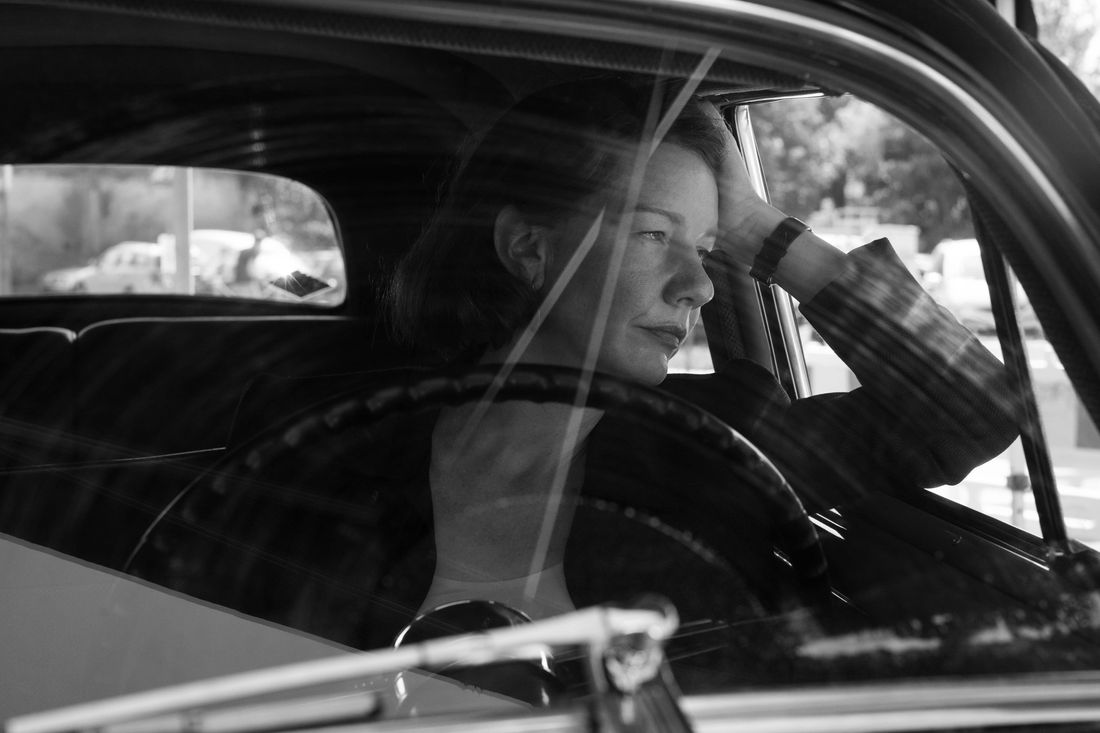
Paweł Pawlikowski is unique among modern filmmakers for his stunning use of black-and-white cinematography. His latest film, Fatherland, like his previous works Cold War and Ida, features a beautiful monochrome palette that emphasizes light and shadow, giving his actors, particularly Sandra Hüller, a radiant quality. (The film’s visually striking look is thanks to cinematographer Łukasz Żal, known for his work on Hamnet and The Zone of Interest.) For over a decade, Pawlikowski has focused on the post-WWII era, and Fatherland, which recently premiered at Cannes, takes place in 1949, depicting a war-torn Germany divided into two. The film follows the renowned novelist Thomas Mann (Hanns Zischler) and his daughter Erika (Hüller) on a journey across the country. Mann, who fled Germany in 1933 and had his citizenship revoked by the Nazis, is returning to receive the Goethe Prize – actually two awards, one from West Germany in Frankfurt and another from East Germany in Weimar – with Erika acting as his assistant, driver, editor, and even barber.
A filmmaker could approach the story of Thomas Mann’s life – or that of his wife, Erika, a fascinating figure who was an actress, war reporter, and writer in a marriage of convenience with poet W.H. Auden – from many different angles. However, Pawlikowski’s film, Fatherland, focuses on a very specific and limited timeframe, compressing events even further by placing the recent suicide of Erika’s brother, Klaus, within the narrative of a single journey. Pawlikowski is known for concise filmmaking, and at just 82 minutes, Fatherland is strikingly short and impactful. This narrow focus isn’t a mistake; it’s a deliberate choice that highlights the disorientation and unreality of trying to rebuild life after a world-shattering event. The war has left everything broken, and people are desperately trying to piece things back together into something resembling normal society. In Eastern Europe, this means erasing the recent past and starting over with communist ideals, all under increasing Soviet control. In the West, it means denying any connection to Nazism and moving forward as if nothing happened, a process subtly guided by the CIA.
At a gala in Frankfurt, Thomas meets two young men who reveal they are grandsons of Richard Wagner. They ask for his help in repairing their grandfather’s image and the Bayreuth opera house, which have been damaged by Hitler’s well-known admiration for the composer. (Thomas bluntly tells them his mother should be put on trial and the opera house destroyed.) Elsewhere, Erika confronts her ex-husband, actor Gustaf Gründgens, who insists Hermann Göring actively sought him out, unlike Erika, who had the luxury of refusing to cooperate because she didn’t need to work. (She responds by slapping him.) In Weimar, children sing a new anthem while a Soviet colonel tries to engage Thomas in a discussion about complex political philosophy. A man who visits Thomas’s hotel to discuss Buchenwald’s transformation into a political prison is suddenly taken away by unseen forces. Thomas, portrayed as aloof and intellectual, is determined not to be used by either side. He remains committed to delivering high-minded speeches about Goethe, lofty ideals, and his vision for a better Germany, refusing to be drawn into practical concerns.
Erika isn’t trying to preserve a great work of literature for future generations, and she struggles to simply go along with things. Historically, it was Thomas Mann’s wife, Katia, who joined him on a trip in 1949, but the film’s choice to feature Erika instead is compelling. While Thomas had a difficult relationship with his brother Klaus, only planning to attend the funeral after receiving an award, Erika and Klaus were close. The movie even begins with a conversation between them where Klaus confesses he’s lost his faith. Erika feels despair and anger more intensely; she’s shown publicly confronting drunk men, calling them out as “fascist scum,” and she’s more disturbed by their shock than by their initial behavior. Sandra Hüller is having an exceptional year, earning a Silver Bear for her role in Rose and appearing in the popular Project Hail Mary. However, in Fatherland, she seems to be the only one burdened by the memories of the past fifteen years, which others have readily forgotten. She delivers a quietly powerful and unforgettable performance, perfectly suited to this subtle and impressive film.
Read More
- Netflix’s Little House On The Prairie Reboot: Release Date, Cast & Everything We Know
- Off Campus Season 1 Soundtrack Guide
- YouTuber arrested after viral AI bodycam videos spark real police complaints
- Silver Rate Forecast
- Prime Video’s New R-Rated Spy Thriller Is Officially No.1 On Streaming Despite Poor Reviews
- Brent Oil Forecast
- Bulgakov’s Take: Koreans Bet the Farm on Chips, Crypto, and Chaos
- EUR ZAR PREDICTION
- Peaky Blinders: The Immortal Man’s Tommy Shelby Is a Better Father Than Michael Corleone
- Gold Rate Forecast
2026-05-16 01:54