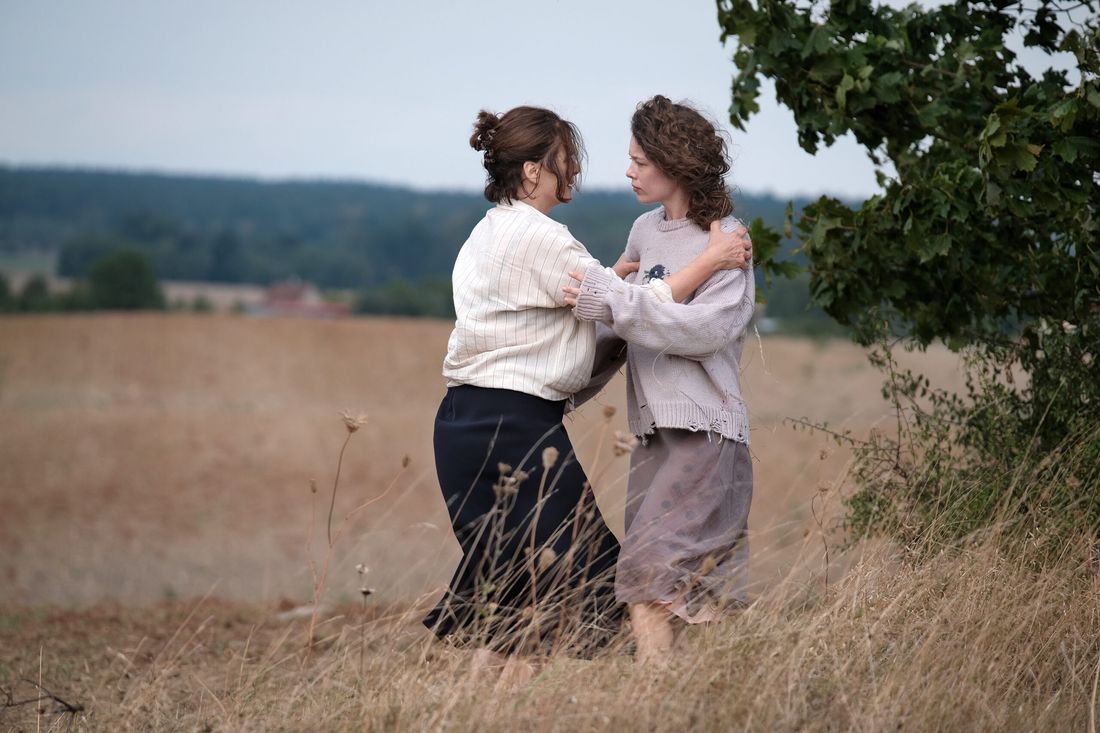
Christian Petzold’s new film, Miroirs No. 3, isn’t a horror film, but it begins with two unsettling events. The film opens with Laura, a music student played by Paula Beer, walking sadly by a canal when she sees a paddleboarder dressed entirely in black who silently turns toward her—a strange, almost casual image of death. Soon after, while driving with her boyfriend, Jakob, and friends, she makes eye contact with a woman standing by the road, also dressed in dark clothing. These moments foreshadow something bad, and shortly after, the couple is in a car accident that kills Jakob. Laura survives with surprisingly few injuries, even though their car flips over. This reminds viewers of the classic low-budget film Carnival of Souls, where the main character also miraculously survives a crash, only to later be revealed as having actually died in it.
Petzold’s new film doesn’t follow a typical thriller formula, but it does have a surprising reveal that shatters the unusual world its characters build. This secret feels increasingly likely as the story progresses, yet no one directly addresses it. The film’s dreamlike atmosphere begins after a car crash, when a woman named Betty (Barbara Auer) offers help. It’s strange that the injured woman, Laura, immediately asks to stay at Betty’s house instead of going to the hospital, and even more surprising that Betty readily agrees, preparing a room and leaving out refreshments. Laura’s confusion could be explained by the trauma of the accident or her pre-existing sadness. However, Betty’s behavior is even more peculiar. She watches Laura sleep with a mixture of shock and wonder, accidentally calling her by a different name, ‘Yelena,’ and later offering clothes that belonged to her daughter.
Even before we meet Betty’s husband, Richard, and son, Max, it’s clear her family is grieving a major loss. What’s captivating about Miroirs No. 3 – a small, but deeply affecting film – is how it portrays the comfort characters find in pretending everything is okay. Laura isn’t Betty’s daughter, but she quickly fits into the family as if finding a safe, cozy space. She’s cared for and comforted, waking up to the soothing sound of rain and bright sunshine. While tending to a wound on Laura’s back, Betty tells her a story about Tom Sawyer, behaving like a mother reading a bedtime story. This fairytale atmosphere continues as Betty shows Laura her garden, offering her a flower to taste. Betty doesn’t seem like a magical figure, but she’s discovered something special, and when she introduces Laura to Richard and Max at dinner, they’re as surprised as if they’d seen someone come back to life.
While not as impactful as Petzold’s brilliant post-war film Phoenix, Miroirs No. 3 is still captivating. What makes it so strangely compelling is its clever approach to discomfort: the film only acknowledges something is disturbing if a character explicitly points it out. Before that moment, the characters – Laura, Betty, Richard, and Max – are engaged in a kind of therapeutic role-playing, addressing Laura’s sadness alongside the family’s grief. Laura isn’t directly fixing things, but by temporarily stepping into the life of Yelena, a life that seems idyllic with its cakes and bike rides, she encourages Yelena’s family to begin healing. By the end, they all seem genuinely improved.
Read More
- Gold Rate Forecast
- What is Omoggle? The AI face-rating platform taking over Twitch
- Man pulls car with his manhood while on fire to raise awareness for prostate cancer
- Bithumb’s Dance with Fate: Court Halts Ban, But BTC Blunder Looms
- Elden Ring Is Back With A New Free Game, Thanks To The Fans
- Wartales Curse of Rigel DLC Guide – Best Tips, POIs & More
- Beyond Traditional Risk Metrics: Forecasting Market Volatility with Bayesian Networks
- Audible opens first ‘bookless bookstore’ in New York
- How To Grow Money Trees In Animal Crossing: New Horizons
- Apple TV’s Imperfect Women Becomes No. 1 Most-Watched Show Globally
2026-03-23 22:54