
As a big fan of Monster Hunter Stories 3: Twisted Reflection, I’ve learned that building a really strong team takes some effort! You can’t just pick any monsties – you really have to search for ones with the best stats to make a truly amazing squad.
It’s simple to talk about creating strong monsters, but actually doing it is challenging. Just having good starting materials isn’t enough – you’ll need to understand and utilize a monster’s genes to truly succeed.
Table of contents
- How do genes work in Monster Hunter Stories 3: Twisted Reflection
- How does Rite of Channeling and Bingo work in Monster Hunter Stories 3: Twisted Reflection
- How do Excursions work in Monster Hunter Stories 3: Twisted Reflection
How do genes work in Monster Hunter Stories 3: Twisted Reflection
Each monstie possesses unique Active and Passive skills. These skills, and how many a monstie has, are determined by its genes. As you can see in the image below, a young Rathalos is available to all players at the beginning of the game.
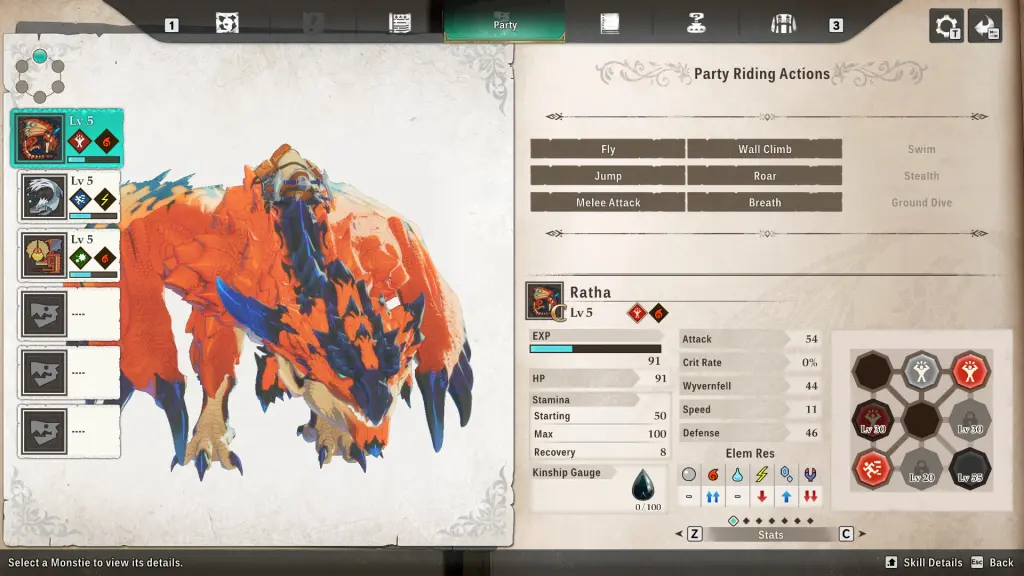
Look at the bottom right corner – you’ll see a 3×3 grid with nine spaces. Every monstie has this grid when it hatches. Some spaces will already be filled in, while others will be empty. To create the strongest monstie, you need to fill all the empty spaces, completing the entire grid and giving it the best possible skills.
You can gain extra traits from other creatures, even if you don’t have space for them right away. To get these traits, you’ll need to learn about Bingo and Rite of Channeling.
How does Rite of Channeling and Bingo work in Monster Hunter Stories 3: Twisted Reflection
The Rite of Channeling lets you transfer genes between different monsties. There are various methods for doing this.
- Directly swap the genes from one monstie to another.
- Manually select which gene/genes you want to swap.
- Select the monsties and the genes you want to swap.
After swapping genes, you can keep customizing your monstie’s abilities by filling all nine gene slots. But randomly filling those slots isn’t the best way to build a strong monstie.
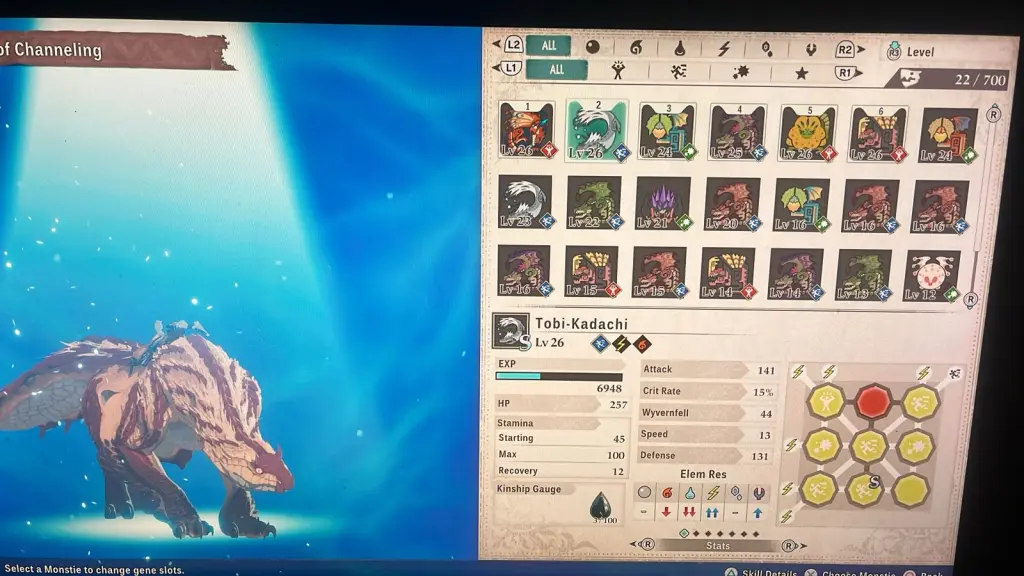
To get the biggest benefit from Rite of Channeling, try to connect matching genes. If you successfully do, your monstie will deal 5% more damage with all Power attacks. Specifically, you need to connect three Power genes in a row – they can be lined up horizontally, vertically, or diagonally.
You’ll receive the bonus damage from a Bingo even if your element and attack type aren’t a perfect match. But if they do match, you can potentially earn multiple Bingos on the same line.
To build up your perfect monstie, Excursions are important as well.
How do Excursions work in Monster Hunter Stories 3: Twisted Reflection
Send your monstie on an Excursion to help it improve its stats and learn new Environment Skills. You’ll need Training Talismans for this, which you can buy at the Melynx Emporium. These talismans are quite costly, so use them wisely! Also, remember that only one monstie can be sent on an Excursion at a time.
To teach your monsties new abilities, consider where you found them. If a monstie lives in a habitat and then goes on an excursion in that same area, they can learn skills tied to their Environment Rank.
As a dedicated rider, I’ve learned that the real goal is to get three S-rank Environment Skills going on your monstie at the same time. That’s the absolute max any monstie can handle! But here’s the catch: if you send them to a region they’ve never been to before, they’ll only pick up the basic stat boosts, not those awesome S-rank skills. So, make sure they’ve explored a region before you really rely on those skills!
Environment Skills have three levels – B, A, and S – for each area. Your monstie can learn a skill if its Ecosystem Rank is at or above the area’s level. You can also unlock skills by giving your monstie the necessary genes.
Read More
- Off Campus Season 1 Soundtrack Guide
- Euphoria Season 3’s New R-Rated Sydney Sweeney Scene Proves The Show Is Trolling Us
- What is Omoggle? The AI face-rating platform taking over Twitch
- Man pulls car with his manhood while on fire to raise awareness for prostate cancer
- Gold Rate Forecast
- Why is there no Jujutsu Kaisen this week? Missing Season 3 Episode 8 explained
- Crimson Desert Guide – How to Pay Fines, Bounties & Debt
- Jailbreak codes (April 2026)
- Lord Of The Flies Review: Near-Perfect Adaptation Is A Reminder Of Classic Novel’s Haunting Power
- Popeye Slasher Horror Film Officially Kicks Off Production on ‘Bigger & Bloodier’ Sequel
2026-03-14 02:18