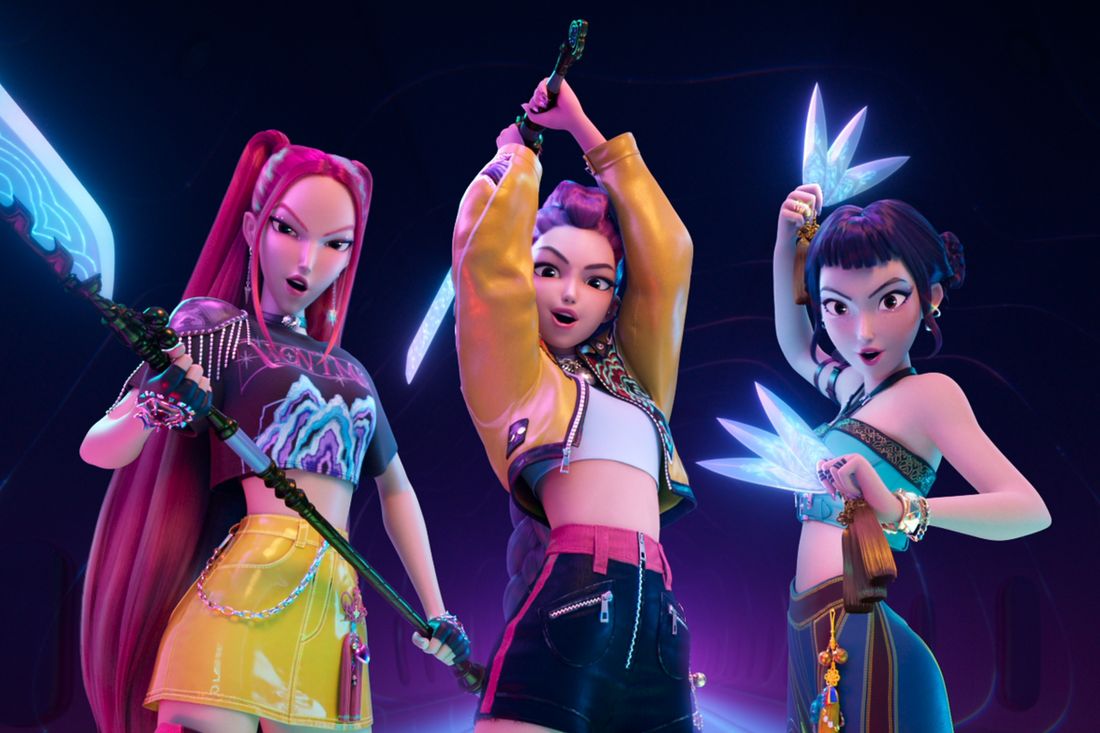
The peak popularity of KPop Demon Hunters has passed. Last summer and fall, the movie was a huge hit, with four songs charting on the Billboard Hot 100, Huntr/x becoming the first K-pop girl group to reach No. 1, and Netflix earning $24 million in box office revenue despite the film already being available for streaming. It even became a widespread Halloween costume trend, with many elementary school students dressing up as the character Rumi.
The movie is finishing a hugely successful run, solidifying its place as a major cultural event of 2025. This weekend’s Oscars are the final step, and it’s expected to win both Best Animated Feature and Best Song for “Golden” – a track that already made history as the first K-pop song to win a Grammy in February. This recognition is well-earned, as the film’s music has proven to be incredibly popular and enduring. Last year, on our podcast Switched on Pop, hosts Charlie Harding and Nate Sloan analyzed what makes five songs from the movie so effective. Before this weekend’s ceremony – which will include a performance of “Golden” by EJAE, Audrey Nuna, and Rei Ami – here’s a look at their discussion.
“How It’s Done”
Nate Sloan: Let’s begin by introducing the characters. They’re three incredibly popular K-pop stars who feature in this animated movie, but they’re also…
Charlie Harding: … demon hunters.
The movie’s title is pretty straightforward, which was intentional. The team behind it hopes this will be a big hit and establish them as a successful group. They also want the featured song to be a standout K-pop track that can succeed independently.
This song feels very Blackpink-inspired. It features powerful 808 bass, skilled rapping, and a beautiful blend of English and Korean vocals right before the chorus.
The song should also tell us more about the main characters. We have Mira, who’s the tough, rebellious type, Zoey, who’s sweet and endearing, and Rumi, who’s the strong leader. While we first meet Rumi as an incredibly talented singer, there’s more to her story – she’s secretly part demon, and we’ll discover that throughout the song.
The line “That sound ringing in your mind” suggests these songs have a powerful effect. They aren’t simply enjoyable tunes—they represent a conflict between opposing forces like good versus evil and life versus death, and the outcome matters a great deal.
According to them, music’s purpose is to inspire us, connect people, and overcome negativity.
Interestingly, the team also drew inspiration from the song “Jet Song” from West Side Story when creating this introductory piece. While the musical similarities might not be obvious, the feeling of strong camaraderie present in “Jet Song” – particularly the line about being together “From your first cigarette to your last dying day” – really comes through in “How It’s Done.”
“Golden”
This is Demon Hunters’ biggest hit in the pop music scene, and it’s easy to understand why. The song really grows on you, starting with lower vocal tones and steadily building to a powerful, soaring climax.
As the song heads towards the chorus, there’s an interesting musical effect. Zoey sings about living a double life, and the music mirrors that feeling. The main melody focuses on the note A, but it’s supported by a C-major chord, creating a slight tension. It’s as if the melody and the chords aren’t quite in agreement, reinforcing the idea of two separate worlds.
The singers don’t just hit high notes – they continually climb higher and higher throughout the chorus. The song is a gradual and exciting build-up, reaching what feels like the absolute peak, but then surprisingly continues to ascend even further.
While watching the movie, I was inspired to learn to play the piano. I went straight to my piano and tried, but it was harder than I expected. The chords were easy enough, but the melody was complex. I decided I needed to find the sheet music, but when I did, it was frustratingly difficult to read – the notes started very low on the page. It was written that way because the melody gradually builds to a very high note and covers a wide range of pitches.
EJAE, who wrote and performs as Rumi, jokingly admitted she pushed her vocal range to its limits while writing the song, and then immediately worried about actually being able to sing all those high and low notes!
This song is a standout track because it’s the main theme of the film – truly the movie’s biggest hit.
N.S.: It’s the “I want” song.
This song really makes the initially strange idea work. I originally thought, ‘A K-pop band secretly fighting demons and saving the world through their music?’ sounded crazy. But the show pulls it off. It cleverly presents demons as the embodiment of our hidden shame and pain—the more we bury those feelings, the stronger and more destructive they become.
Our main character is struggling with a big question: should she bury her difficult feelings, or find a way to accept both her strengths and flaws? This is the central conflict of the film, and the ending shows her bringing these two sides of herself together. This acceptance expands the world of the story, taking us into both a fantastical demon world and a protective golden barrier, bridging everything in between.
N.S.: It’s a tall order for a three-minute pop song, and yet “Golden” pulls it off.
“Soda Pop”
The Saja Boys are a K-Pop group that fits the typical mold, and they burst onto the scene with the incredibly catchy song “Soda Pop.” The song is deliberately designed to be light and bubbly, like empty calories from soda, drawing listeners in with its pleasant sound. However, beneath the surface, there’s a more unsettling truth.
These villains are attempting to gain followers among Huntr/x fans. If they succeed in winning over the fanbase, they plan to spread their negativity throughout the universe and steal everyone’s souls. This conflict centers around the passionate fandom of K-pop idols and is deeply connected to the overall story.
I really like how openly commercial the song is. The title, “Soda Pop,” is perfect – it’s bubbly and instantly marketable. The way they’ve included the sound of a fizzing soda can is really satisfying. But it also subtly hints at the group’s true nature. The lyrics, “We’re gonna drink you up,” seem harmless at first, until you realize these seemingly sweet boy band members are actually demons.
Okay, so there’s this line in the song, “Ooh, we’re gonna suck up your soul,” and honestly, it’s brilliant! What I really appreciate about this whole movie is how knowingly it plays with K-Pop tropes. It doesn’t shy away from being, well, a product. And that’s totally fine! There are tons of super-commercial K-Pop songs out there – think of something like “Soda Pop” in the film. They’re not exactly high art, but they’re incredibly catchy and fun. It’s like a sugary drink – you know it’s not the best for you, but it just hits.
“Your Idol”
While “Soda Pop” hints at something darker underneath, “Your Idol” fully embraces it. This song is essentially about stealing souls. It begins with a choir singing the “Dies irae,” an ancient Gregorian chant about death, creating a very intense and dramatic opening. It’s clear we’ve moved beyond typical pop music here.
The song works on two levels. On the surface, it’s about a demon stealing souls, but it can also be seen as a critique of the K-pop industry. It highlights how intense fan devotion can be both positive and damaging, comparing it to giving everything to someone who only takes from you – whether that’s money or something deeper, like your spirit. The lyrics, like ‘Anytime it hurts, play another verse / I could be your sanctuary,’ suggest a dangerous reliance on someone who doesn’t truly care in return.
C.H.: It’s literally idol worship.
The performance is flawless. As it progresses, the characters shed their disguises and the song becomes increasingly ominous. The final lines are particularly powerful—until that point, the lyrics had a double meaning, but they end with a stark, unambiguous message: “No one’s coming to save you.” It’s a completely direct and unsettling statement.
To add to the intensity, the song is in E-minor. This is the darker counterpart to G-major, the key of “Golden,” creating a stark contrast to our upbeat, popular song.
“What It Sounds Like”
This scene marks the peak of both the movie and the music. It’s a moment of realization – accepting who you are, flaws and all, and facing your deepest regrets. The film asks us: who are the real monsters? The answer is, it’s all of us. And it’s only by acknowledging that truth that we can truly find peace. The final song reflects this, with a raw and honest vocal performance that’s different from the polished sound of the earlier numbers.
Pop music, and particularly groups created by companies, often struggles with the idea of authenticity. Performers are expected to both perform and present their genuine selves, creating a constant push and pull between the two.
I’m no expert on K-pop history, but it seems like each new generation of groups expands the limits of what’s considered acceptable in pop music. Earlier K-pop artists had to be more cautious about expressing themselves, especially regarding personal identity and sexuality. Maybe that kind of restraint is what fuels negative energy. It appears that the most impactful music comes from connecting with people who feel shame or struggle with difficult emotions, and helping them embrace those feelings. Over time, successful K-pop groups have consistently challenged cultural norms, acknowledged their own vulnerabilities, and driven cultural progress.
Towards the end of the song, and the film, a melody from the very beginning returns. It’s the same tune sung by the demon hunters’ ancestors in the opening scenes. This is a quiet but powerful moment, suggesting that music itself is a key theme. While KPop Demon Hunters is about fame, fans, and the battle between good and evil, music arguably takes center stage. The film asks whether a song truly has the power to save the world, and hopes the answer is yes.
This movie is crafted like a catchy pop song – it’s not meant to be deeply thought-provoking or groundbreaking. It’s not an experimental art film; think more along the lines of pure, polished entertainment. While the story isn’t innovative, the film is incredibly well-made, with meticulous attention to every detail. It’s designed to be thoroughly enjoyable and surprisingly heartwarming, leaving you with a genuinely satisfied feeling. It completely charmed me.
Read More
- Off Campus Season 1 Soundtrack Guide
- Euphoria Season 3’s New R-Rated Sydney Sweeney Scene Proves The Show Is Trolling Us
- Gold Rate Forecast
- What is Omoggle? The AI face-rating platform taking over Twitch
- Man pulls car with his manhood while on fire to raise awareness for prostate cancer
- Why is there no Jujutsu Kaisen this week? Missing Season 3 Episode 8 explained
- Crimson Desert Guide – How to Pay Fines, Bounties & Debt
- Jailbreak codes (April 2026)
- Lord Of The Flies Review: Near-Perfect Adaptation Is A Reminder Of Classic Novel’s Haunting Power
- Popeye Slasher Horror Film Officially Kicks Off Production on ‘Bigger & Bloodier’ Sequel
2026-03-13 19:57