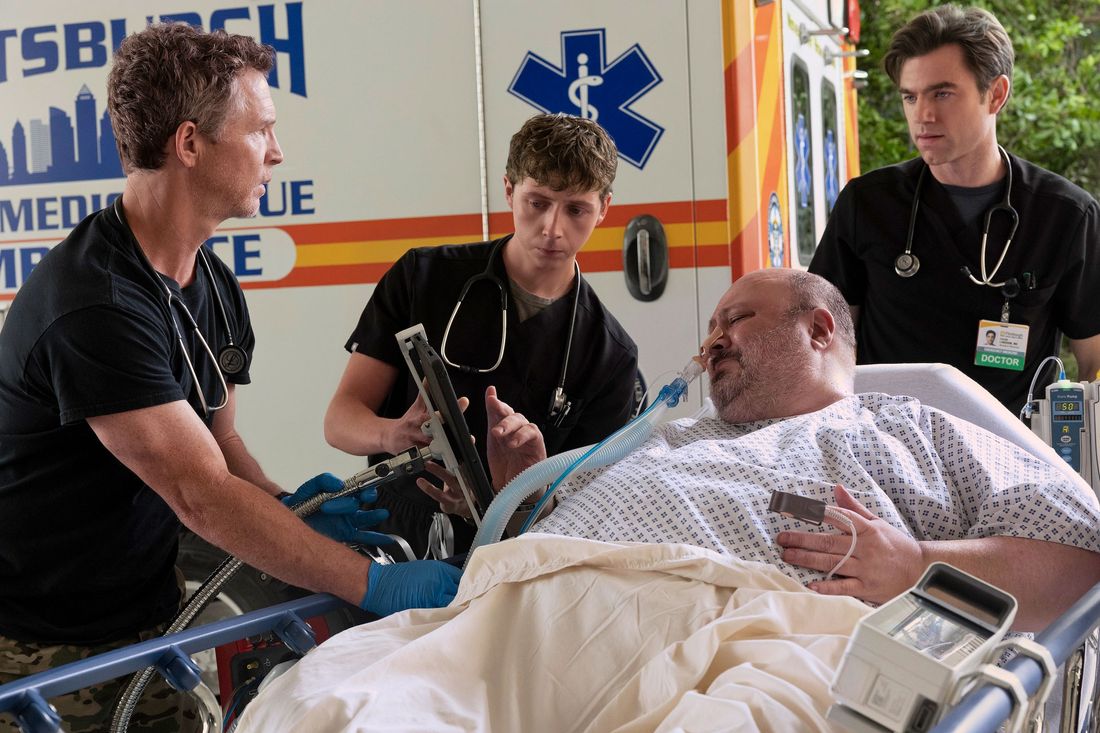
The show The Pitt often uses prosthetics for dramatic injuries, like severed hands or realistic childbirth scenes. However, the character Howard Knox, a 472-pound patient brought into the emergency room in season two, episode eight, was portrayed authentically – without any artificial enhancements.
Craig Ricci Shaynak, known from his role on ER, brings warmth and understanding to the character of Howard, a patient whose weight reflects a difficult journey. The role is partially inspired by Shaynak’s own life experiences. Howard’s story includes a car accident, burns, multiple surgeries, and years of feeling alone, creating a complex and relatable reason for his arrival at the emergency room with a fever and stomach pain.
Young Doctor Ogilvie (Lucas Iverson), like some doctors, views Howard as a warning: someone who overeats, isn’t aware of modern weight loss options like Ozempic, and lacks the motivation to exercise. Despite the complexities of Howard’s situation, Ogilvie first sees him simply as an overweight patient who might be better cared for at a zoo’s animal facilities.
Saying someone might be too heavy for medical equipment is incredibly insensitive, especially when said in front of the patient. However, this is a genuine worry for many people who are larger in size. As actor Shaynak recalls, he feared being weighed at the hospital years ago, and learned that some hospital beds now have built-in scales that can handle patients up to 1,000 pounds. Everything Shaynak’s character experiences in The Pitt – from difficult intubation and rude remarks to the surprisingly high risk of a routine procedure – highlights a harsh reality that Shaynak and many viewers recognize: despite almost 40% of Americans being classified as obese, the medical field – and society in general – often fails to provide adequate care and accommodations for overweight individuals.
As someone who loves a good character study, I really appreciated what the writer of episode eight, Dr. Joe Sachs, was going for. He told me he wanted us to feel for Howard, to understand the experiences that shaped him and really connect with his story on a human level. It wasn’t just about showing us his actions, but making us understand why he was the way he was.
The concept: “A very special need for compassion”
Writer and former emergency room doctor Sachs, who also happened to write an episode of the original ER many years ago, explained that the idea for Howard’s storyline came from wanting to depict a medical procedure – an awake fiber-optic intubation – that hadn’t been shown on the show before. They were also interested in highlighting the challenges faced by patients with larger bodies, a topic the show briefly addressed in its first season.
According to Sachs, Howard’s case is a chance to emphasize the importance of empathy and understanding for individuals with significant weight issues. It also creates a valuable learning opportunity for experienced doctors to guide younger ones, like Ogilvie, who needs to improve his sensitivity and patient care skills. Ogilvie currently prioritizes gaining knowledge and perfecting procedures over addressing a patient’s emotional and personal needs.
The story could only work if they found the perfect actor for the role. Writer Daniel Sachs was so sure of this that he refused to write the episode until the right person was cast. They specifically didn’t want to use prosthetics to make an actor appear larger, so Sachs initially wrote a draft scene with a gender-neutral character to outline the story. Casting directors then searched for actors of all genders who fit the description of being morbidly obese. Sachs wanted to ensure someone of that size could handle the emotional depth of the scene. After reviewing thousands of submissions, Sachs immediately knew Craig was the right choice.
After Shaynak was cast, Sachs called him to discuss the storyline. Shaynak mentioned it was the first time anyone had asked for his input on a character. During their 90-minute conversation, Shaynak shared personal details that were later included in the show.
He admits he barely left home in 2025, only venturing out four times. Working from home and the pandemic led to a very sedentary lifestyle, and he became overly dependent on delivery services. Even a short walk to the mailbox felt like a huge effort. After COVID, he stopped pursuing acting roles, telling his representatives he wasn’t sure he could even get to a film set. He used to be very active – for fifteen years, he performed one-man shows at the Edinburgh Fringe Festival – but after the pandemic, he just stopped leaving the house. Eventually, he even sold his car, which he describes as a major sign of giving up in Los Angeles.
I was really struck by how thoughtfully Sachs handled things in the final script. It truly captured something I’ve often felt. As someone who isn’t small, there’s this constant, underlying embarrassment about everyday things that others don’t even think about. Something as simple as a doctor’s appointment becomes stressful – you’re immediately worried about practical things like whether the examination table can accommodate you, how you’ll get into the building, finding accessible parking, or even just navigating the space. It’s a whole different experience when those logistical hurdles are always on your mind.
On set: “I don’t know if you know this, Noah, but I’m a very big actor.”
Shaynak was hesitant about how easily he could get around as an actor, but the chance to work on The Pitt was too good to refuse. He was still concerned about getting around the set, worrying about long walks from the parking lot and between different areas on set.
The production team really went above and beyond for him, making sure he was comfortable and addressing any worries he had, according to Shaynak. They provided him with a prime parking spot right by the filming location and essentially a personal driver to take him the short distance from his dressing room to the set. Shaynak recalls even Noah Wyle jokingly asking how he’d managed to get such a good parking space, to which he quipped, “Maybe you don’t know this, Noah, but I’m a pretty famous actor!”
Shaynak understood the role would require him to be very open and exposed. In episode eight, when Howard is shown being treated in the emergency room, it’s actually Shaynak’s body you’re seeing. The makeup team created scars on his knees and legs to match the character’s history, but the compression socks he wore were his own. And the weight displayed when Howard is lifted – 472 pounds – was Shaynak’s actual weight at the time. He explains he weighed closer to 500 pounds when he first got the part, but lost some weight before filming began.
Even skilled actors aren’t keen on having a tube inserted through their nose while conscious. So, for The Pitt, the team needed to find a way to depict an awake fiber-optic intubation without using actual patient footage. According to Sachs, such footage is either too poor quality for television or legally protected due to privacy concerns.
The challenge was to visually show a tube traveling down a patient’s throat, past the vocal cords and trachea. Property master Rick Ladomade solved this by creating a realistic silicone throat model. A camera was moved through the model to capture the footage, which was initially filmed weeks in advance. This same setup was also used earlier in the season to show a piece of broccoli being removed from someone’s throat. During Howard’s scene, the production team used cameras with varying lengths to create the illusion of depth and show how far the tube had traveled. According to Sachs, they’d start with a longer shot, then cut to the footage of the tube reaching the correct position, and finally show Dr. Robby using a very short camera right near Howard’s nose – all achieved through careful editing.
The dialogue: “The first time I read the script, I gasped out loud.”
The medical emergency Howard is experiencing is frightening enough, but Dr. Ogilvie’s thoughtless remarks make the situation even worse. He makes comments like questioning why the EMTs couldn’t insert an IV, and he pushes Howard about not using weight-loss drugs like Wegovy or Ozempic. As Dr. Sachs points out, Ogilvie is focused on showcasing his skills to impress his superiors and secure a top residency position, but he seems to miss the bigger picture: a good doctor needs to be compassionate and understanding, and prioritize finding the root of the problem to properly care for the patient. Sachs explains that Ogilvie believes he’s helping, but the real solution lies in empathy and effective patient care.
As a movie fan, I found it really interesting to hear Lucas Iverson talk about playing Ogilvie. He actually felt a shock when he first read the script – he literally gasped! It wasn’t that Ogilvie was completely unlikeable, but this particular moment felt a bit much. What I took away from Lucas’s explanation is that Ogilvie embodies this ‘pull yourself up by your bootstraps’ idea – the belief that you’re fully responsible for your own fate. He applies that thinking to everything, both in his own life and with the people he treats.
According to Shaynak, who describes Iverson as a kind person off-camera, Iverson would always sincerely apologize after Ogilvie made an offensive remark during filming. Iverson hopes viewers recognize how damaging and uncalled-for Ogilvie’s comments were, and that it inspires them to be more empathetic. He believes even small, thoughtless remarks reveal a lack of kindness and curiosity, and that a more open-minded and inquisitive approach would benefit everyone.
Fiona Dourif, who plays Dr. McKay, believes the impact of Ogilvie’s comments stems from how honestly Shaynak portrays Howard. According to Dourif, Shaynak plays Howard with a lot of grace, humor, and vulnerability. She recalls the scenes being surprisingly emotional to film, noting that Shaynak managed to maintain Howard’s dignity in a really touching way.
Dourif explains that McKay’s scolding of Ogilvie in the elevator—as they head to retrieve the VidaTak—shows how far her character has come. She points to Ogilvie’s earlier, insensitive comment about a patient’s weight in the first season, saying this moment felt like a natural progression of her character’s growth over the past eight months.
Recovery: “It actually lit a fire under me”
Howard has a fifty-fifty chance of pulling through his surgery and recovery in episode nine, but Shaynak is optimistic about his health outside of the show. The medical professionals working on The Pitt provided him with helpful advice during filming, and he’s now actively seeking more medical attention and getting out of the house more often.
The experience really motivated me,” Shaynak explains. “I’m hoping to do more acting and get back to being active. Waking up at five AM for the shoot every day for a few weeks made me realize I can get out there and do things. I even got new glasses for the first time in six years! I feel like this is going to be a great year for me.”
Read More
- Gold Rate Forecast
- What is Omoggle? The AI face-rating platform taking over Twitch
- Scientology speedrun trend escalates as viewers map out Hollywood facility
- Japanese Coast Guard rescue a “lone flamingo” that was lost at sea
- Man pulls car with his manhood while on fire to raise awareness for prostate cancer
- Beyond Traditional Risk Metrics: Forecasting Market Volatility with Bayesian Networks
- How To Grow Money Trees In Animal Crossing: New Horizons
- Crimson Desert Guide – How to Pay Fines, Bounties & Debt
- The Boys Confirm Why People Still Look Up to Homelander
- Audible opens first ‘bookless bookstore’ in New York
2026-03-06 18:57