So, there’s this chap named Charles Hoskinson, the brain behind Cardano, who’s currently waving his arms about like a man who’s just realized his towel is actually a regulatory noose. He’s got his knickers in a twist over H.R. 3633, a bill that, according to him, is less about clarity and more about turning the crypto world into a bureaucratic maze where every new token is guilty until proven innocent. Or, as he puts it, “Everything’s a security by default, and good luck proving otherwise.”
The Hitchhiker’s Guide to Crypto Regulation
In a video that dropped on March 2-which, coincidentally, is also the day someone probably lost their car keys in a parallel universe-Hoskinson took a swing at Ripple CEO Brad Garlinghouse’s idea that a bad bill is better than no bill. “Nonsense!” he exclaimed, or words to that effect. “You don’t start by assuming everything’s a security and then hope for the best. That’s like boarding the Heart of Gold and expecting not to end up in a Vogon poetry reading.”
His main beef? The Clarity Act, which he claims would treat new digital assets like they’re all wearing “Security” name tags from birth. They’d then have to convince the SEC they’re actually commodities, a process so convoluted it makes the Vogons look like efficiency experts. “Imagine XRP, Cardano, or Ethereum trying to launch under these rules,” he said. “They’d still be in regulatory limbo, sipping Pan Galactic Gargle Blasters while waiting for approval.”
Hoskinson’s recurring nightmare? The SEC keeping tokens classified as securities indefinitely. “What’s to stop them?” he asked, his voice dripping with the kind of sarcasm that could curdle a Pan Galactic Gargle Blaster. “And do we really trust the same folks who’ve spent the last four years suing everyone and their dog to suddenly play fair?”
He then laid out a series of “attack vectors”-because nothing says fun like regulatory loopholes-that the SEC could exploit. Procedural delays? Check. Vague definitions of “common control” that could make open-source coordination look like a boardroom meeting? Double check. Proving decentralization while identifying pseudonymous wallet owners? “Good luck with that,” he quipped, probably while facepalming.
The upshot? The bill might look harmless on paper but could turn into a regulatory sledgehammer in practice. “It’s like giving a Vogon a megaphone,” Hoskinson said. “Sure, they’re following the rules, but nobody wants to hear it.”
And the real kicker? According to Hoskinson, the political squabble in Washington isn’t even about the bill’s structure. It’s about stablecoin yield. “So, we’re selling this as market reform, but it’s really just a sideshow,” he explained, sounding like someone who’s just discovered the restaurant at the end of the universe doesn’t serve his favorite dish.
His solution? A principles-based rewrite that modernizes securities law, protects developers, and limits regulatory overreach. Otherwise, he warns, established networks will survive, but the next generation of U.S. crypto projects will pack their bags and head offshore faster than you can say “42.”
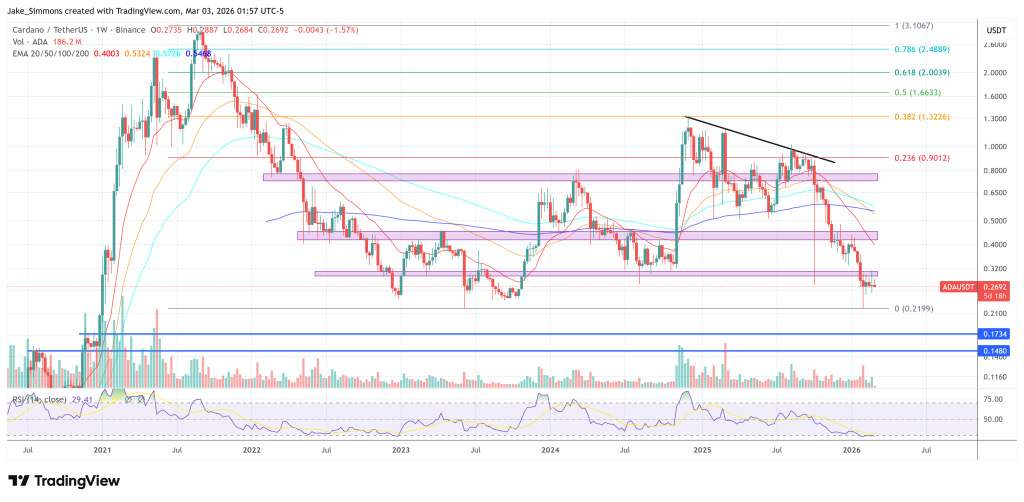
At press time, Cardano was trading at $0.2692, which is either a bargain or a sign of the apocalypse, depending on who you ask.
Read More
- Gold Rate Forecast
- What is Omoggle? The AI face-rating platform taking over Twitch
- Elden Ring Is Back With A New Free Game, Thanks To The Fans
- Audible opens first ‘bookless bookstore’ in New York
- Wartales Curse of Rigel DLC Guide – Best Tips, POIs & More
- 10 Adorable Quotes from Diana in Pragmata
- Netflix’s Remake Of R-Rated Denzel Washington Classic Carries On A Rotten Tomatoes Trend
- Man pulls car with his manhood while on fire to raise awareness for prostate cancer
- Euphoria Season 3 Trailer Confirms The Show’s Identity Has Been Lost
- The Devil Wears Prada 2 Cameos You May Have Blinked and Missed (Plus Lady Gaga)
2026-03-03 14:12