In the shadow of digital forums, where the whispers of doom echo louder than the clinking of coins, the crypto community has once again found a new way to panic-by imagining a global conflict that’s more likely to unfold in their Twitter threads than on the actual battlefield.
Amid the coordinated strikes between the US, Israel, and Iran, the crypto crowd has managed to transform geopolitical tensions into a virtual warzone, complete with memes, panic, and a healthy dose of irony. One might wonder if the real world is still on fire, or if the real action is happening in the comments section.
World War 3 Trends Across Crypto as US-Israel-Iran Conflict Escalates
The spike in “World War 3” chatter comes as the Gulf region becomes a stage for a modern-day drama, where missiles and drones play the roles of ancient warriors. The crypto crowd, ever the dramatists, has taken this as a sign to sell their Bitcoin and buy gold-only to realize that gold is just as likely to crash as a poorly timed meme.
BREAKING: Saudi Arabia has shut down an Aramco oil refinery in Ras Tanura after it was hit by Iranian drones.
– BeInCrypto (@beincrypto) March 2, 2026
As the dust settles on this latest skirmish, the crypto community is left to ponder whether they’ve stumbled into a prequel of a war they’re too busy debating to actually prepare for. Meanwhile, the real-world consequences of these strikes remain a mystery, much like the true value of a Bitcoin wallet.
The U.S. and its allies, ever the reluctant heroes, have stepped in to intercept the chaos, while Iran, the eternal underdog, continues its quest to turn the world into a game of geopolitical chess. The result? A flurry of online panic that would make even the most seasoned trader blush.
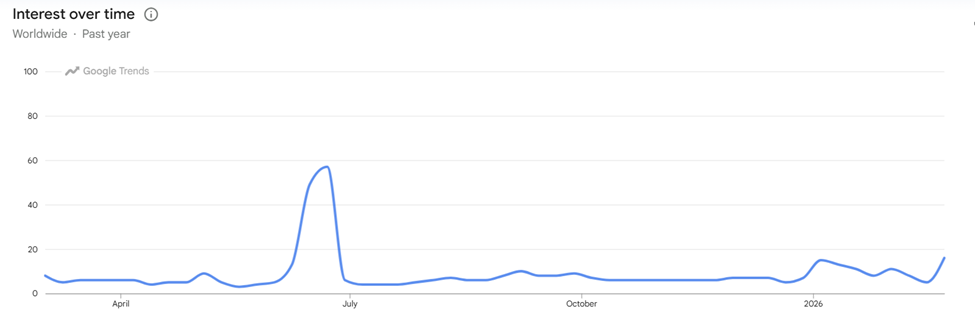
It explains why “World War 3” searches on Google Trends are currently surging toward levels last seen in June 2025-because nothing says “excitement” like a global conflict that’s 90% speculation and 10% actual danger.
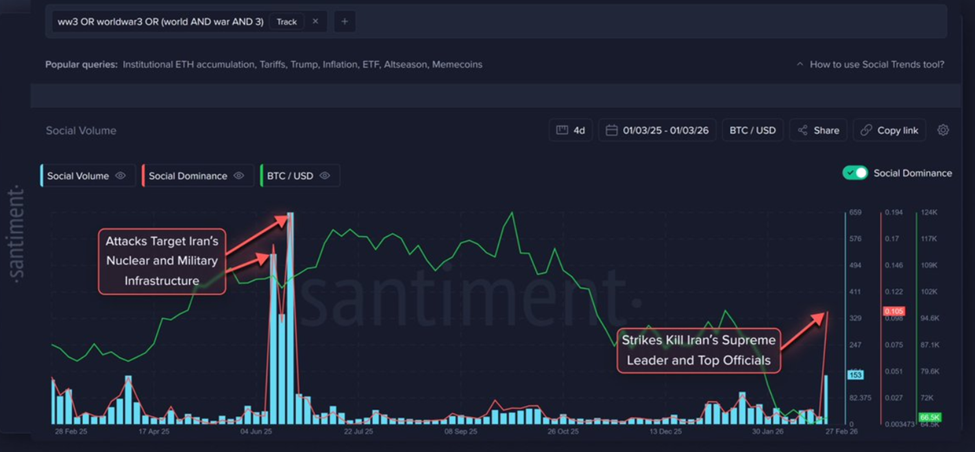
Yet, in the same breath, Santiment notes that the uncertainty of the current fighting, combined with the memory of last year’s 12-day confrontation, has turned the crypto community into a bunch of overwrought playwrights, each vying for the title of “Most Dramatic Trader.”
Social media users, ever the optimists, are now framing the present situation as a potential precursor to a broader global war-because nothing says “hope” like a world war that’s 99% fear and 1% reality.
Yet traditional markets are not behaving as though a world war is imminent. Instead, they’re sipping tea, sipping futures, and sipping on the calm that comes from knowing that the world is far more resilient than the average crypto trader’s ego.
Markets Shrug Off WW3 Fears as On-Chain Data Signals “Zero Panic”
The Kobeissi Letter, ever the voice of reason, argues that futures markets are far from pricing in a systemic event. Why? Because the real world doesn’t care about your Twitter rants, and neither do the markets. Oil may gap higher, but it’s just a temporary blip-like a bad haircut or a failed investment.
The S&P 500, gold, and Bitcoin are all playing their own version of “keep calm and carry on,” with Bitcoin even managing to turn positive on the day. A miracle, some say-but others just call it the market’s way of saying, “You’re all overreacting.”
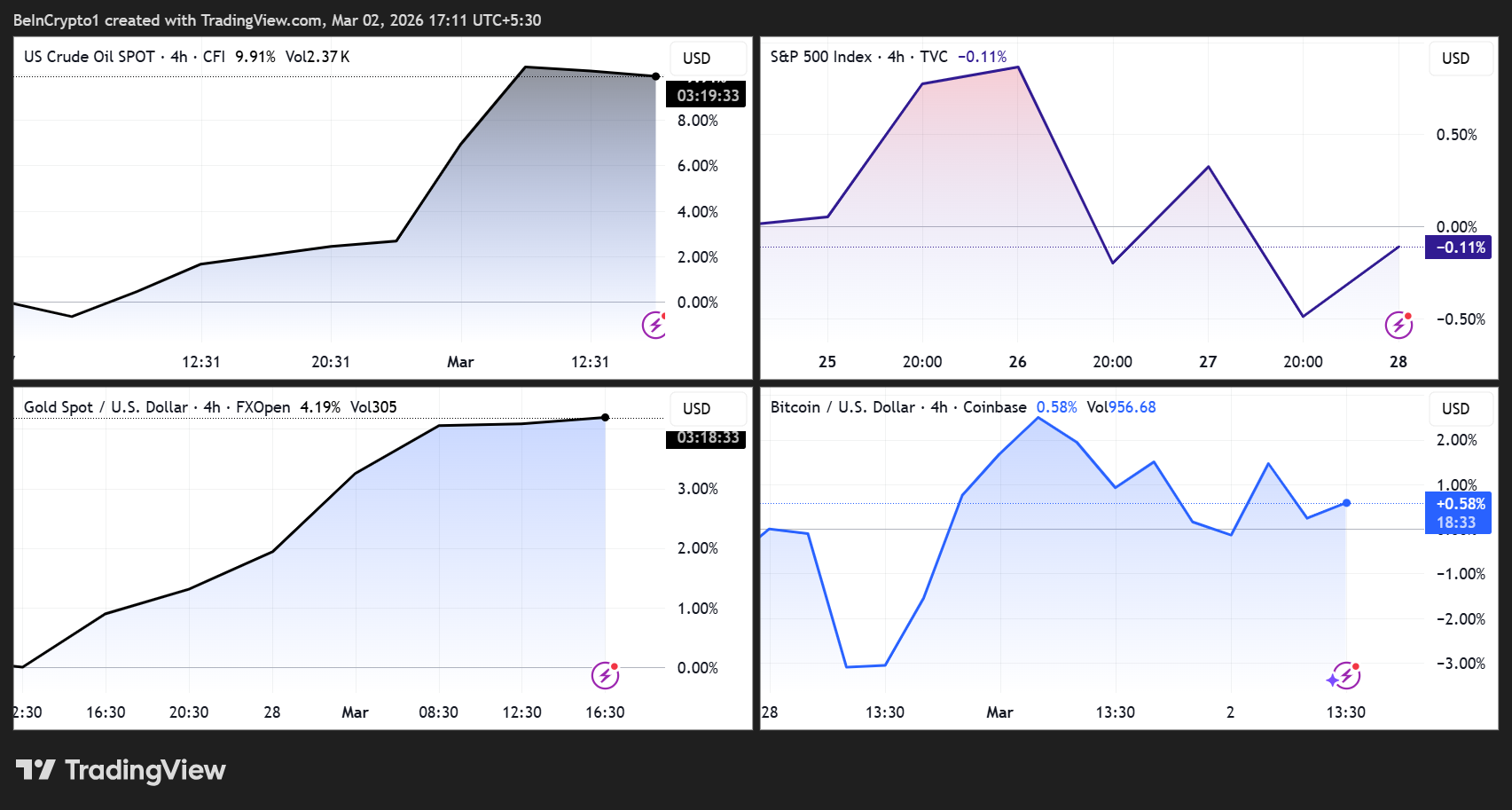
“Don’t panic. The dust will settle,” the outlet stated, highlighting the disconnect between online rhetoric and actual price action.
Market analyst Kyle Doops suggests that while oil is drawing headlines, gold may offer a more meaningful lens. After all, gold has always been the ultimate “I told you so” asset, sitting quietly in the background while the world burns.
During past stress cycles-World War I, World War II, and the inflationary 1970s-gold’s share of global equities expanded significantly. Today, despite record global debt levels and rising geopolitical tensions, that share remains well below historical extremes. A mystery, some say-but others just call it the market’s way of saying, “You’re all overreacting.”
Within crypto-native circles, sentiment is more divided. Some traders argue that retail participants tend to panic first, while larger players accumulate quietly behind the scenes. A classic case of “the rich get richer, and the poor get panic.”
“Volatility is baked in,” one user wrote, suggesting that charts often reflect emotion before reality.
On-chain data appears to support the calmer interpretation. While the crypto crowd is busy imagining the end of the world, the data tells a different story-one of patience, exhaustion, and a surprising lack of panic.
CryptoQuant Data Shows Seller Exhaustion as Short-Term Holders Refuse to Capitulate
Meanwhile, according to blockchain analytics firm CryptoQuant, Bitcoin’s short-term holders, who are typically the most reactive cohort, are not rushing for exits. Why? Because they’ve learned that panic is a poor investment strategy-and that the market, like a drunken sailor, often stumbles back to port.
Iran Escalation, Zero Panic. Bitcoin’s Short-Term Holders Aren’t Blinking – Yet
“The sell-side pressure from recent buyers is fading. Panic is being replaced by patience, or at least exhaustion.” – By @MorenoDV_
– CryptoQuant.com (@cryptoquant_com) March 2, 2026
CryptoQuant’s Short-Term Holder P&L to Exchanges metric, which tracks loss-driven selling from recent buyers, shows that sell-side pressure has been fading since the February 5-6 capitulation event. A testament to the resilience of the crypto crowd-or perhaps their sheer stubbornness.
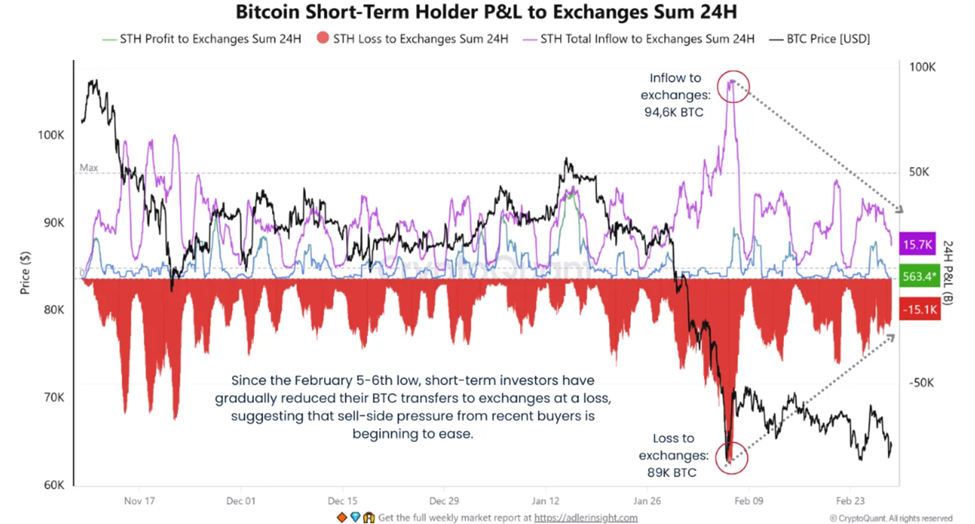
Notably, this was when roughly 89,000 BTC were sent to exchanges at a loss within 24 hours. Since then, loss-driven inflows have progressively declined. A sign that the crypto crowd is learning to breathe, even in the face of existential dread.
Despite Bitcoin dipping toward the $63,000-$64,000 range during the latest geopolitical escalation, there has been no meaningful spike in exchange inflows from short-term holders. A rare moment of calm in a world that thrives on chaos.
“No panic profit-taking, no loss capitulation,” the firm observed.
The shift suggests that much of the recent liquidation pressure may already have been absorbed. Historically, markets tend to stabilize once weaker hands finish selling. A lesson the crypto crowd is learning, one panic at a time.
Crypto social media may be pricing in World War III. However, Bitcoin, gold, equities, and even oil appear to be pricing in contained escalation. A reminder that while the internet may be a warzone, the real world is far more resilient-and far less dramatic.
The key signal ahead will be whether short-term holder inflows remain muted. If panic selling stays absent, the current wave of fear may prove to be another sentiment spike rather than the start of systemic unraveling. A warning, perhaps, to the crypto crowd: the world may not be ending, but your portfolio might be.
Read More
- Gold Rate Forecast
- What is Omoggle? The AI face-rating platform taking over Twitch
- Elden Ring Is Back With A New Free Game, Thanks To The Fans
- Audible opens first ‘bookless bookstore’ in New York
- Wartales Curse of Rigel DLC Guide – Best Tips, POIs & More
- 10 Adorable Quotes from Diana in Pragmata
- Netflix’s Remake Of R-Rated Denzel Washington Classic Carries On A Rotten Tomatoes Trend
- Below Deck Down Under Recap: Battle of the Egos
- The Devil Wears Prada 2 Cameos You May Have Blinked and Missed (Plus Lady Gaga)
- Bitcoin May: The Grim Parade of Institutions and a New Era
2026-03-02 16:46