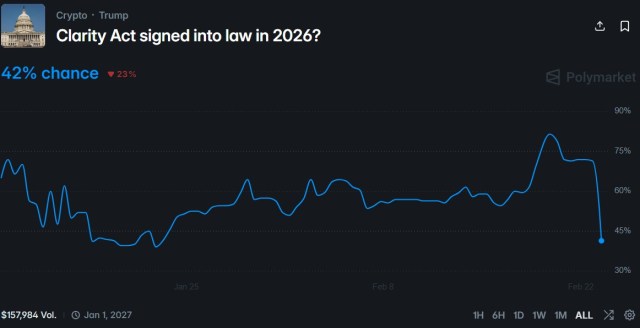
The long-anticipated crypto market structure legislation, the CLARITY Act, now faces a 42% chance of becoming law, according to Polymarket’s data. A grim omen, indeed, as the specter of legislative failure looms over the crypto industry like a poorly timed rainstorm.
Traders, ever the pragmatists, now assign the bill a 42% chance of passing in 2026, reflecting a growing consensus that the negotiations between the crypto industry and the banking sector resemble a chess match between a pawn and a king-both claiming victory, but neither moving an inch.
Crypto And Banks Remain Divided
The drop in confidence comes despite months of high-level discussions at the White House, where lawmakers and industry representatives have been attempting to build consensus around a broader market structure framework. One might say they’ve been playing a game of “Who Can Be the Most Vague?”
However, three key White House meetings between crypto firms and banking representatives have yet to yield a final agreement. Even so, public messaging from officials has remained upbeat, as if the mere act of speaking positively could conjure a legislative miracle.
As Bitcoinist reported last week, Patrick Witt, Executive Director of the President’s Council of Advisors for Digital Assets, described the latest round of talks as “a big step forward.” “We’re close,” Witt wrote, adding that if both sides continue negotiating in good faith, he expects the administration’s March 1 deadline to be met. One wonders if “good faith” is merely a euphemism for “desperation.”
At the center of the discussions is draft legislative language designed to address concerns raised by banks in a document titled “Yield and Interest Prohibition Principles.” A document so convoluted, it could double as a bedtime story for sleep-deprived legislators.
While the proposed text acknowledges the banking sector’s objections, it also makes clear that any restrictions on crypto rewards programs would be narrowly tailored. A narrow tailoring, one might say, that leaves the crypto industry’s ambitions as frayed as a moth-eaten sweater.
One significant outcome of the negotiations is that paying yield on idle stablecoin balances – a major objective for many crypto firms – is effectively off the table. The dream of earning interest on idle stablecoins has been dashed, leaving crypto firms to ponder whether they should offer rewards for user activities instead. A noble pursuit, if one has the time to track every click and scroll.
Instead, the debate has shifted toward whether companies should be permitted to offer rewards tied to specific user activities rather than simple account balances. A question so profound, it could be debated in a philosophy class-though the attendees might prefer a more stimulating topic.
How New Rules Could Change Bitcoin Derivatives Markets
Beyond the political back-and-forth, market expert MartyParty recently highlighted potential structural shifts that could follow the bill’s passage, arguing that the changes may be more significant than many investors realize. One might argue they’re more significant than a toddler’s tantrum at a museum.
In the Bitcoin (BTC) futures market, clearer jurisdictional boundaries would likely cement the Commodity Futures Trading Commission’s (CFTC) authority over digital asset commodities. A development that could either revolutionize the market or render it as dull as a spreadsheet.
The expert believes that could accelerate the growth of regulated US trading venues, similar to CME, and potentially open the door to CFTC-registered perpetual futures platforms. A future where crypto trading is as exciting as watching paint dry, but with more jargon.
According to MartyParty’s analysis, clear commodity classification may also encourage greater institutional participation, particularly from funds that are restricted from investing in assets deemed securities. A delightful irony, as institutions now seek to invest in something they once dismissed as “junk.”
Perpetual futures contracts – a crypto-native product widely used outside the United States – could also evolve. With CFTC registration, US-based perpetual products might emerge with stronger consumer protections, greater transparency around funding rates, and tighter safeguards against manipulation. A utopia for investors, if only they could stomach the bureaucracy.
Greater regulatory clarity could also reduce discrepancies between spot and futures markets, narrowing price gaps and stabilizing funding dynamics. A development that could make the crypto market as predictable as a Russian novel-full of twists, but ultimately unsatisfying.
At the same time, stricter leverage caps or margin requirements imposed under CFTC rules could limit the extreme levels of retail speculation currently seen on offshore platforms. A welcome change, though one suspects the speculators will simply migrate to more exotic locales, like the moon.
Bitcoin options markets would likely experience parallel shifts. The expert asserts that a clearer regulatory framework could encourage the development of additional US-regulated options venues offering both physically settled and cash-settled contracts tied to Bitcoin futures. A future where options trading is as exciting as a tax audit, but with more emojis.

Reduced enforcement uncertainty may also lower implied volatility premiums, potentially making options more affordable for hedging and speculative strategies. A boon for investors, though one might question if the savings are worth the loss of chaos.
Institutional investors, in particular, could more confidently deploy advanced strategies – including collars and straddles – if Bitcoin’s commodity status is firmly established. A development that could make the financial world as predictable as a clockwork mouse, but with more risk.
Read More
- Netflix’s Little House On The Prairie Reboot: Release Date, Cast & Everything We Know
- Off Campus Season 1 Soundtrack Guide
- Silver Rate Forecast
- Prime Video’s New R-Rated Spy Thriller Is Officially No.1 On Streaming Despite Poor Reviews
- Gold Rate Forecast
- Brent Oil Forecast
- EUR ZAR PREDICTION
- YouTuber arrested after viral AI bodycam videos spark real police complaints
- EUR USD PREDICTION
- Inkford Hermitage Chest Locations In HSR (Honkai: Star Rail)
2026-02-25 13:11