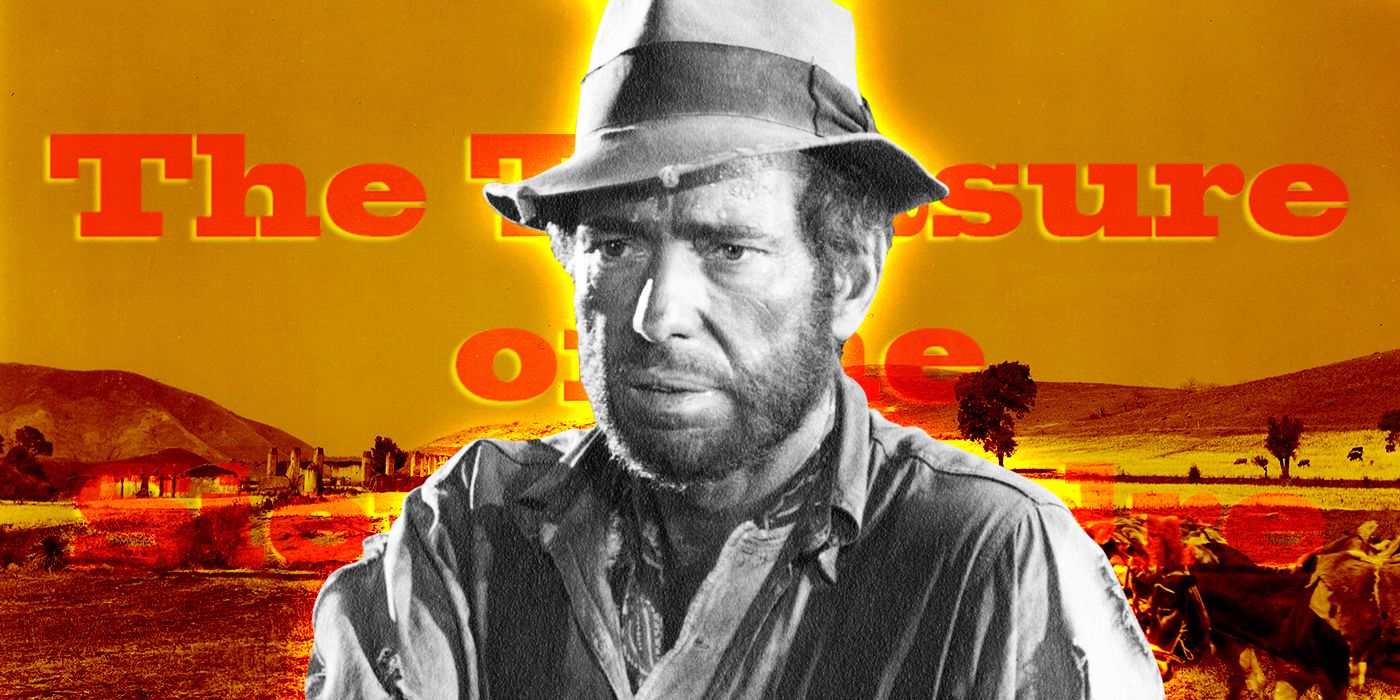
Hollywood has often explored how the pursuit of gold can change people. While recent films like The Wolf of Wall Street have shown this powerfully, the idea was explored even earlier and arguably more effectively in the 1948 film The Treasure of Sierra Madre. This classic movie tells the story of three men who travel to a foreign land hoping to strike it rich by finding gold.
Humphrey Bogart stars in John Houston’s classic film, a powerful critique of greed and its effects. The story follows adventurers on a long journey for treasure, but their pursuit of wealth ultimately corrupts them, turning friends against each other. This sweeping adventure remains as relevant and impactful today as it was nearly 80 years ago.
The Treasure of Sierra Madre’s Literary Roots
Inspired by B. Traven’s novel, The Treasure of Sierra Madre – and intrigued by the author’s enigmatic life – director John Huston planned to make it his next film after a major success. He initially envisioned George Raft, John Garfield, and Edward G. Robinson as the stars, but the outbreak of World War II changed his plans. Huston put the project on hold to instead create documentaries supporting the war.
After the war ended, John Huston decided to make The Treasure of Sierra Madre his next film. He sought out B. Traven to secure the rights to the book, and they arranged a meeting in Mexico City in 1946. However, when Huston arrived, he didn’t meet Traven himself, but a translator named Hal Croves. Croves had the authority to make decisions for Traven and agreed to let Huston film the story, with the condition that Croves be hired as a technical advisor. It soon became clear to Huston, rather amusingly, that Hal Croves was almost certainly B. Traven in disguise.
What Happens in The Treasure of Sierra Madre?
The film The Treasure of Sierra Madre centers around three men: Fred C. Dobbs (Humphrey Bogart), Bob Curtin (Tim Holt), and Howard (played by director John Huston’s father, Walter Huston). The story begins with Dobbs and Curtin combining their meager savings and a lottery win to search for gold. They soon meet Howard, an experienced gold prospector, but dismiss his warnings that the pursuit of gold can drive people insane.
As the three men traveled through the Sierra mountains, they squandered supplies chasing false leads, fought off bandits, weathered a fierce storm, and nearly killed each other. When they finally found real gold, greed began to corrupt their relationships. Curtin considered abandoning Dobbs to die in a mine collapse, and though Howard rescued a child and saved Curtin’s life, he left Dobbs to his fate.
Driven by his obsession with gold, Dobbs descends into madness and crippling paranoia. By the film’s end, he’s lost all reason, becoming more like a wild animal. He shockingly betrays Curtin, shooting and abandoning him. Soon after, Dobbs is ambushed by bandits who kill him and steal everything he has.
Having cared for Curtin until he recovered, Howard and his companion returned to their old campsite only to find Dobbs dead. The gold they’d worked so hard to collect was scattered by the wind, seemingly returning to its original source. Faced with this discovery, the two men realized the futility of their efforts and were overcome with hysterical laughter.
John Huston’s Take on The Treasure of Sierra Madre
John Huston was a fantastic person to interview about movies, and he often talked in detail about his film The Treasure of Sierra Madre throughout his life.
In 1973, when asked which single scene from his films best represented him as a director, John Huston chose a moment from The Treasure of Sierra Madre: his father dancing. He explained, “It would have to be my old man dancing.”
He remembered the scene vividly, explaining that the key was getting the young actor, Tim Holt, to laugh along with them. They found humor in how ridiculous the whole situation was. His father had a gift for creating that kind of connection and genuine laughter in people. He and his father would often laugh together, not always at a joke, but usually because they’d both recognized a shared flaw or vulnerability. He said he hadn’t experienced that same, joyful laughter since his father passed away.
Huston often felt his films defied easy categorization. He noted that critics, and even he himself, struggled to find a single, overarching theme in his work. He didn’t aim to impose his own interpretation on reality, but rather to faithfully present the stories he chose, using every technical and artistic element to bring that vision to the audience.
You know, back in 1974, someone really hit the nail on the head when they suggested a through-line in John Huston’s work – a fascination with dreams falling apart. And it absolutely applies to The Treasure of Sierra Madre. It clearly gave Huston pause. He admitted he hadn’t consciously realized it, but he agreed there was something to it. He quoted a French saying – it’s the pursuit that matters, not the prize. He never really cared for straightforward success stories. Interestingly, despite this observation, he didn’t see a lot of consistency in his own filmography, always feeling like each project was strikingly different from the last.
The Historical Significance of The Treasure of Sierra Madre
The Treasure of Sierra Madre blends the Western and adventure genres with strong influences from film noir. This is especially noticeable in the characters’ bleak outlook and the movie’s dramatic use of light and shadow. Though now considered a classic, it wasn’t always so well-regarded.
Shot on location in Durango, Mexico and Tampico, The Treasure of Sierra Madre was a pioneering film for Hollywood, being one of the first to be filmed almost entirely outside the US. Because the production was so far from the studio, director John Huston enjoyed a great deal of creative control. However, early footage worried the studio executives, and Jack Warner demanded Huston return to the US to finish the film. Ultimately, the movie finished 29 days behind schedule and millions of dollars over budget.
I read this fascinating story about the making of The Asphalt Jungle. Apparently, John Huston got a note from the studio asking him to dial back his dad, Walter, who was playing Howard. Can you believe it? Walter went on to win an Oscar for that role! The reason? Apparently, Bogie – Humphrey Bogart – was getting a little insecure. Walter was just too good and was overshadowing him in every scene. Bogart famously grumbled at the time, “One Huston is bad enough, but two are murder!” It just goes to show, even legends get a little competitive.
While Humphrey Bogart had played tough characters before The Treasure of Sierra Madre, this film allowed him to fully embrace villainy – though his descent into darkness isn’t apparent until later in the movie. His change from a likeable wanderer to a helpful teammate and then a greedy betrayer is captivating. Audiences weren’t used to seeing Bogart so unlikeable, and that’s a major reason this role remains one of his most memorable. He reportedly told a friend he met at a New York nightclub before the film came out, “Wait until you see me in my next picture. I play the worst character you’ve ever seen.”
Like It’s A Wonderful Life and Vertigo, The Treasure of Sierra Madre didn’t initially succeed with audiences. Ironically, the very things people criticized at the time – such as its pessimistic ending and its faithfulness to the source novel – are now what make it a beloved film. It broke from typical movie formulas of the 1940s by prioritizing story and tone.
Despite not winning Best Picture – that honor went to Laurence Olivier’s Hamlet – The Treasure of Sierra Madre still had a successful night at the Oscars. Walter Huston won Best Supporting Actor, and his son, John Huston, won awards for both Best Screenplay and Best Director, marking an impressive achievement for the family.
Perhaps the most lasting impact of The Treasure of Sierra Madre is its influence on later filmmakers. It paved the way for the realistic style Sam Peckinpah used in Westerns, and Stanley Kubrick, widely considered one of the best directors ever, counted it among his favorites. The film also inspired George Lucas and Steven Spielberg, who directly borrowed the fedora worn by the character Dobbs for their creation, Indiana Jones. More recently, Paul Thomas Anderson has said he watched Sierra countless times while developing the atmosphere and tone for There Will Be Blood.
Even after more than seventy years, The Treasure of Sierra Madre remains a powerfully unsettling film, prompting us to consider how far we’d go to achieve financial security. While filled with humor and excitement, the story’s core message is a cautionary one: greed can corrupt anyone.
Read More
- Off Campus Season 1 Soundtrack Guide
- X-Men ’97 Finally Gave Gambit the Hero Moment He Deserved
- 46 Years Later, The Mandalorian & Grogu Answers A Major Empire Strikes Back Question
- 10 Worst End-Game Couples In Sitcom History
- HoI4 fans harsh reactions to the announcement of another DLC pack
- Chainsaw Man Volume 24’s Cover Art Reveals a Brand-New Denji
- Hatsune Miku cosplayer goes viral selling $15 cups of “foot juice” to thirsty anime fans
- Emily Henry Says to ‘Trust the Vision’ For Beach Read Adaptation
- Gold Rate Forecast
- DoorDash responds after customer uses AI to make food look bad and get a refund
2026-04-21 22:41