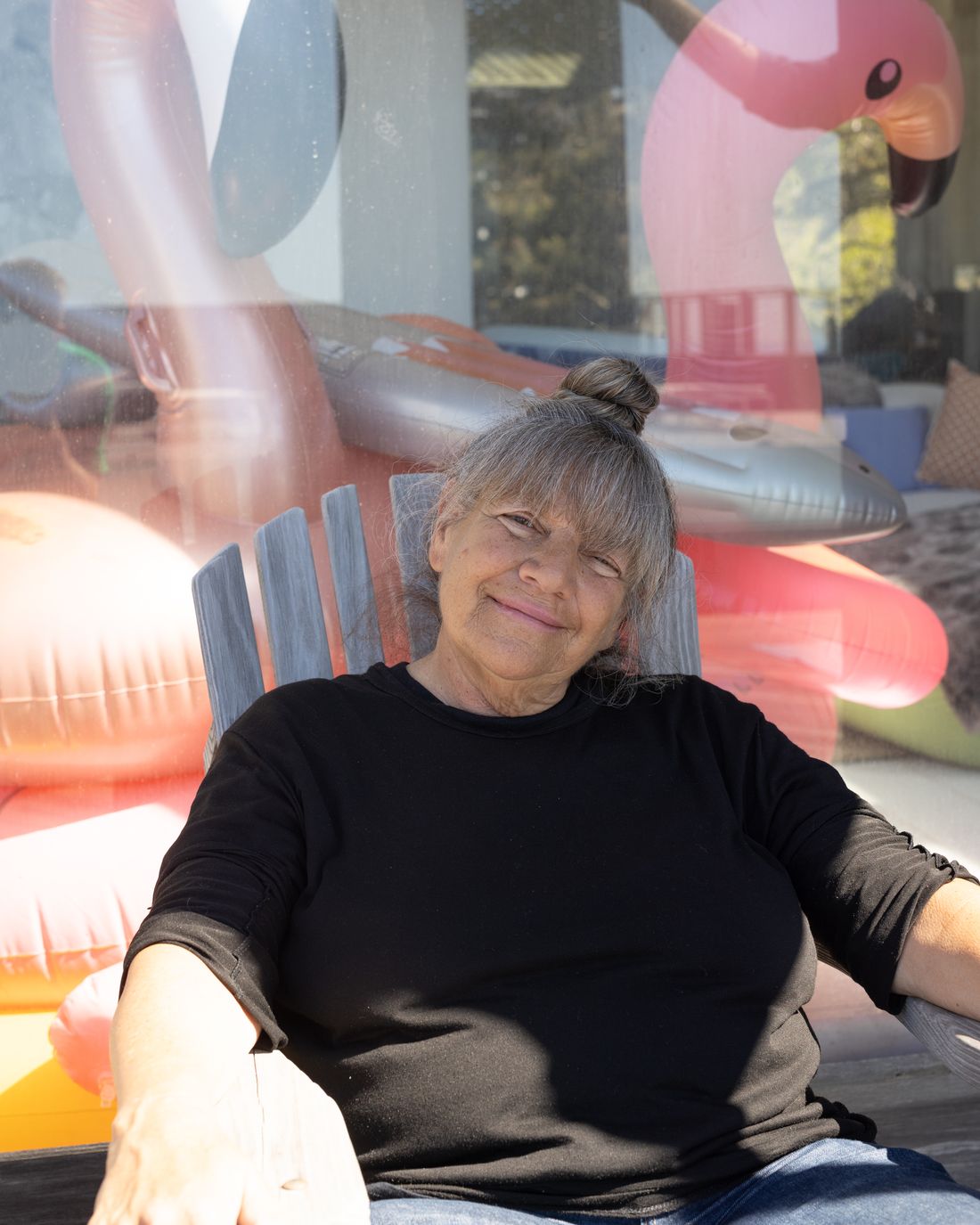
Even though it’s still a bit chilly in early May, 71-year-old Robin Byrd is back at her slightly worn beach house in Fire Island Pines, getting it ready for the summer season. Bright pink and orange inflatable birds are piled up near a folded-away children’s pool, and small rainbow flags decorate the windowsills. It’s clear this house has hosted many parties over the years.
From 1977 to 1998, Byrd hosted a late-night show on Manhattan Cable Network (later Time Warner). The hour-long program was known for its edgy content, featuring performers like strippers and adult film actors, alongside interviews with interesting figures from New York City’s downtown scene, including Sandra Bernhard and Michael Musto. Byrd, a blonde with long hair, always wore a distinctive crocheted bikini top resembling a spiderweb. Between acts, she’d interact with viewers on the phone, strongly encouraging safe sex practices, and introduce the next performer, who came from diverse backgrounds and had varied talents. The show always concluded with a lively group dance, during which Byrd playfully interacted with her guests while lip-syncing to her signature song, “Baby Let Me Bang Your Box.”
She admits the #MeToo movement gave her pause, joking about her past work involving explicit content. The two of us were relaxing in her living room, a space known for hosting lively gatherings with cast members from her show. This conversation took place a month before the documentary Bang My Box: The Robin Byrd Story debuted at the Tribeca Film Festival (and became available on HBO June 30th). Though she wasn’t fully appreciated during her career as a risqué late-night performer, directors Jyllian Gunther and Stephanie Schwam portray Byrd as a champion of free expression. They believe she skillfully used the emerging cable television platform to openly discuss sex during the Reagan era and the AIDS crisis. Sarah Jessica Parker, who produced the film, acknowledges Byrd’s influence on the creation of Sex and the City.
Gunther explains that Byrd paved the way for platforms like YouTube and livestreaming. He also points out that what Byrd went through with traditional media is similar to what Stephen Colbert and Jimmy Kimmel are facing now with the FCC, but the current situation is even more serious.
I’ve heard a lot of people wanted to do a biopic about my life, but honestly, nobody ever seemed interested in telling my story, from my point of view. Thankfully, Gunther and Schwam, who were actually fans of the show, really got me. They filmed me as I am now – mostly retired and taking care of my husband, Shelly, who’s sadly battling dementia. We met way back in 1974, in another little community on Fire Island, and we’ve been married for 43 wonderful years.
She recalls a wild time with her friend, Golden Superman, filled with parties, dancing, and a carefree lifestyle. This was 1976, just before she became known for her role as Mrs. Hardwick in the iconic film Debbie Does Dallas. Back then, she started guest-hosting a local cable show called Hot Legs, eventually taking it over and renaming it after herself. She handled everything – booking guests, producing, and directing – all by herself, using just one camera in a very small studio. She even famously drove her guests to the set in her uniquely named Ford, affectionately called the “Ford Clitoris.”
As someone who loves movies, especially those that capture a specific time and vibe, I found The Robin Byrd Show surprisingly charming. In today’s world, where pretty much anything is available online – seriously, even family members are creating content! – it feels less about shock value and more just…fun. The footage really stands out because it shows people looking genuinely happy and comfortable, with natural bodies, before everything became so filtered and artificial. It’s a little glimpse of a time when people seemed to actually enjoy connecting with each other, and you could see it in their smiles – real smiles, not the kind you get after fillers!
Before mainstream television addressed the AIDS crisis, Byrd consistently and kindly promoted safe sex, reaching many New Yorkers who felt scared and alone. Like Fred Rogers, she had a special talent for connecting with viewers and offering comfort – though her focus was on a very different issue. As Byrd explains, she didn’t depict sexual acts; instead, she aimed to inspire positive feelings and promote well-being, hoping to leave people feeling safe and hopeful.
Byrd’s show originally aired on Channel J by paying for broadcast time. After Warner Communications and Time Inc. merged in 1990, the new management began closely reviewing the program, which was now generating significant revenue through advertising – including ads for phone-sex lines and adult theaters. Byrd recalls being told, “You can’t show anything explicit, keep it clean.” He explains, “They’d insist on seeing all five fingers if a woman touched herself. But if a man did the same thing, it was apparently fine. I thought it was ridiculous and openly encouraged male performers to be more explicit.”
Robin Byrd was a successful television personality who, at her height, hosted several shows, including Robin Byrd’s Men for Men (originally called Byrd Droppings), Byrd Brains, and Get Up With Robin Byrd. When Time Warner tried to restrict access to her adult-oriented content by requiring viewers to request it in writing, Byrd fought back. In 1995, she, along with Al Goldstein, publisher of Screw magazine, and Lou Maletta, founder of Gay Cable Network, filed a lawsuit. The case eventually reached the Supreme Court, which ruled that Time Warner’s restrictions violated the First Amendment. Byrd won the case, but the television industry was evolving rapidly by the late 1990s.
She stopped working when the television studio switched to digital technology. She found it too intrusive – seeing every detail on camera destroyed the illusion. Although the show continued to air in reruns – one station in New York City still broadcasts it – after 25 years in the industry, Byrd was ready to rest. Since then, she’s divided her time between her father’s former antiques shop on the Upper East Side and Fire Island, where she cares for Shelly and her dog, Om Om. When people asked about her career, she simply said, ‘I’m enjoying the life I’ve created for myself.’
Around 4 p.m., Byrd and I walked to Cherry Grove for the first tea dance of the season, an event she hosts twice a month with DJs David Scott and Greg Scarnici, who is also a friend and a producer on the documentary. She was leaving her husband, Shelly, at home, having just warmed up a muffin for him. She promised to call when she arrived and bring him back a burger from Sand Castle, to which he cheerfully agreed. Shelly began showing signs of dementia just before the pandemic, and Byrd is now his primary caregiver. Their relationship is the heart of the film. When she attends the film’s premiere at the Provincetown International Film Festival later this month, she’s only staying overnight. “I don’t want to leave him alone for any longer than that,” she explained.
As Byrd enters Cherry Grove, she passes a group of young men in crop tops who don’t seem to notice her, and she doesn’t mind. However, many of the older residents stop to greet her and ask about Shelly. One man, wearing a blue windbreaker and with thinning gray hair, says hello – he seems like he could have been one of those young men years ago. A woman smoking outside the community theater tells her, “It’s been a tough year. We’ve lost so many people, like Bella, Bobbi, and Al Wolf…”
Byrd explained that everyone was there with the spirit of Johny Poole, a beloved bartender from Cherry Grove who passed away in 2024 and wanted to be surrounded by friends. Upstairs, a classic disco song played as Byrd moved through the crowd, welcoming guests. As the music swelled, she climbed onto a wooden bench and twirled shimmering flags above everyone. “I adore these tea dances because I thrive on a live audience,” she said, “and it brings me joy to make people happy.”
Read More
- Off Campus Season 1 Soundtrack Guide
- X-Men ’97 Finally Gave Gambit the Hero Moment He Deserved
- 46 Years Later, The Mandalorian & Grogu Answers A Major Empire Strikes Back Question
- 10 Worst End-Game Couples In Sitcom History
- HoI4 fans harsh reactions to the announcement of another DLC pack
- Chainsaw Man Volume 24’s Cover Art Reveals a Brand-New Denji
- Emily Henry Says to ‘Trust the Vision’ For Beach Read Adaptation
- Hatsune Miku cosplayer goes viral selling $15 cups of “foot juice” to thirsty anime fans
- Marvel’s New R-Rated Punisher Special Rotten Tomatoes Sets All-Time Audience Record
- Gold Rate Forecast
2026-06-02 14:55