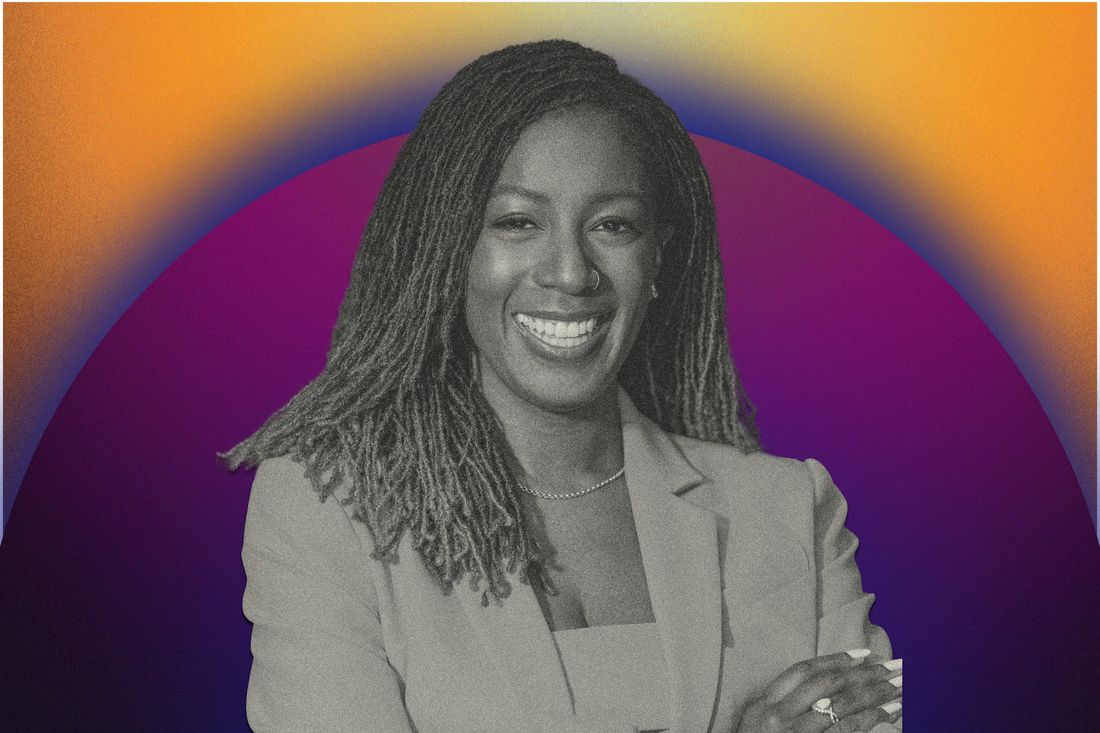
Jazzy Collins is more than just a reality TV personality; she’s the person who creates reality stars. She has a knack for finding ordinary people with the potential to become compelling television characters. She began her career with game shows and then gained prominence in 2017 when she cast the contestants for Rachel Lindsay’s season of The Bachelorette, resulting in the show’s most diverse cast to date. Collins worked on The Bachelor/Bachelorette franchise for five seasons, and in 2020, she publicly addressed the racial biases within the show’s casting process as controversy surrounding the franchise grew. (This led to Chris Harrison stepping down as host in 2021.) She then shifted her focus to finding couples for shows like OWN’s Family or Fiancé and BET’s After Happily Ever After, and in 2022, she received her first Emmy nomination for selecting the dancers on Lizzo’s Watch Out for the Big Grrrls. For Netflix, she identified the larger-than-life personalities that made The Circle a hit. In 2023, she won an Emmy for casting the first American season of The Traitors, where she found non-celebrities who could compete against experienced players like Cirie Fields. Two of her chosen non-celebrities reached the finale, outperforming even the celebrity contestants.
In 2024, Ally Collins joined Dropout, a comedy streaming service led by Sam Reich. Dropout lets Collins cast a uniquely talented group of people – quirky, funny, and creative – that traditional TV channels and streaming services wouldn’t typically choose. She describes it as what she’d been looking for throughout her career in reality TV. At Dropout, she’s found performers who can transform a Dungeons & Dragons game into an improvised show for Dimension 20, share unusual stories on Crowd Control, and play hilariously strange characters – like aliens, zombies, and even sentient hot dogs – on Very Important People. It’s a completely new and exciting approach to unscripted casting, and Collins is perfectly suited to lead the way.
I fell into casting through some unusual jobs, but my first big break was with the show Let’s Ask America. It was a game show filmed entirely on Skype, which was pretty innovative for the time. I even cast my old marine biology teacher and his family – they were hoping to win money for a basement renovation. He called me afterward and was so grateful, saying it was an amazing opportunity and thanking me for remembering him years after I graduated. That’s when I realized I could really make a difference in people’s lives, and I knew I loved this work.
Reality Masterminds
Reality Masterminds
Our inaugural celebration of the most powerful people in unscripted television.
It’s come full circle – you began your career on a game show and now you’re casting for Dropout. Casting involves so many different types of shows, even within reality TV – dating, competition, family-focused programs, and documentaries. I’ve had experience with a lot of these, but I discovered that competition shows are what I enjoy most. I really love recognizing and rewarding talented people.
Okay, so let me tell you about my experience with The Bachelor franchise. Honestly, the show doesn’t always seem to pick the most deserving people, does it? I actually started working on it during Rachel Lindsay’s season – she was the first Black Bachelorette, which was amazing. I hadn’t really watched the show before that, but I got totally hooked while I was working on it! I ended up working on Hannah’s season, and it was such a contrast casting for The Bachelorette right after The Bachelor. The whole process felt completely different.
Finding contestants for a show like The Bachelorette requires a really unusual background check process. A big part of it involved physically searching for potential candidates. I spent countless hours at a Whole Foods in downtown Los Angeles, just looking at men and trying to identify those who might be a good fit for the show. I was there almost every week for three months.
The overall look and feel we were going for heavily influenced how each season of The Bachelorette turned out. We had a pretty clear idea of the type of guy we wanted – the typical ‘Bachelor’ look: athletic and tall. I literally scouted for men over six feet tall at places like Whole Foods, wondering if they’d be a good fit for the show. I approached a lot of guys while they were shopping for vitamins and asked if they’d be interested in auditioning.
As a longtime fan, it really struck me that it took thirteen seasons for that show to finally have a Black Bachelorette. Rachel and I both felt strongly about the lack of diversity and the whitewashing that was happening, and looking back, it was a really important learning experience. I definitely saw some progress in 2020, 2021, and 2022 – networks and production companies were actively seeking diverse casts, which was great. But honestly, a lot of the initial focus was just on skin color. We had a lot of conversations about how diversity goes way beyond that – it’s about including people with disabilities, different gender identities, and sexual orientations. Now, in 2026, it feels like we’ve taken a step backwards, like all that progress is being undone, and that’s incredibly frustrating. Personally, I haven’t changed how I approach casting – diversity is still my top priority. I don’t think it should be affected by who’s in office or the current political climate.
When casting for shows that aim to reflect real life, is there a greater responsibility to ensure accurate representation compared to casting fictional roles? With reality TV, you can introduce someone completely new to the screen and capture a genuine look at who they are, their personality, and how they handle challenges – particularly in competitive formats. Scripted shows, however, already have established characters. Reality TV feels more like a social experiment. Viewers should be able to watch someone and think, ‘I relate to that person.’ That’s why it’s crucial to cast diversely. Ultimately, you’re creating content for a broad audience, and people connect with seeing themselves represented on television – it makes them want to support the people they see.
Instead of working from a pre-written script like a casting director, we actually create the characters ourselves. It starts with a lot of team brainstorming about what types of people would fit well in the show. We often begin by thinking about professions – for example, ‘Let’s have a detective.’ Then, we figure out where to look for that person, dividing the country into regions like the Midwest, West Coast, and East Coast, and begin our search.
The best way to find interesting people for TV is often by looking in smaller towns. I’ll call local businesses, like yoga studios, and ask if they know anyone with a great personality who might be good for a reality show. They usually have someone in mind – someone like a ‘Christie’ – and I’ll connect with them. Not everyone is right for every show, but I keep those connections because they might be perfect for a future project. A great example is Nick from The Circle. I originally tried to cast him on Love Island, but it wasn’t a good fit at the time.
I think it’s important to have a mix of personalities. Everyone puts on a bit of a show and exaggerates their traits to some extent, and that’s good! You want to see different kinds of people on camera, because sameness would be really dull. I especially like people who aren’t easily categorized – someone who might be a scientist during the day but also a dancer at night. Those are the kinds of people I find most interesting.
Looking back on your career, are there any reality TV contestants you’re particularly proud of helping to launch? The first person who comes to mind is DeLeesa from The Circle. I interviewed her early on and was one of the first to suggest her for the show. She ended up winning, and it even led to her husband also appearing on the show.
I also really liked Krystal from The Bachelor, specifically Arie’s season. I remember interviewing her – she had two dogs named Chuckie and Wayne, and was wearing a pink dress. She reminded me of Elle Woods from Legally Blonde – I immediately thought, This woman is a star!
Lee, who was also a contestant on The Circle, was number three. He was an older guy, and the show usually featured a much younger cast. I really thought he’d be a good fit, but they were hesitant at first. I had to convince them to give him a chance, because I knew he’d be fantastic, and he really was!
You won an Emmy for assembling the cast of the first season of the American Traitors. This included both regular people and celebrities.
Someone asked how we put the cast together. Initially, the plan was to use only non-celebrity actors. But about three-quarters of the way through filming, we were surprised to learn they wanted to add some celebrities to the mix!
When we first started the show, we were figuring things out as we went, since it was the first of its kind in the US and viewers didn’t know what to expect. Casting the first season was particularly challenging. We were looking for contestants who were both intelligent – both academically and in terms of social skills – but also somewhat naive. Ultimately, we needed people who could easily get others to reveal information.
Hairdressers are a perfect example of someone you might unknowingly share a lot with. They listen to everything, and they remember details from previous conversations – like asking about an ex-boyfriend on your next visit. We’re looking for people like that for the show – individuals who feel authentic and relatable, but also naturally skilled at gathering information and using it to their advantage. They already have that built-in ability!
And that season was Cirie Fields’s first reality win.
She’s an icon.
When you were choosing the contestants, did you already plan for her to be the villain? Were you setting her up to win?
Actually, since it was the first season, we didn’t have much control over who was cast. Peacock, the network, decided which celebrities to include. If I’d known more about Cirie beforehand, I probably would have made different casting choices, but the cast was great overall. I would have liked to have seen someone directly challenge her and have more players focused on strategy. But hey, we still won an Emmy for that season!
I joined Dropout when Ebony Elaine Hardin, the director of production, contacted me. She’d been following my work and emailed me about a new show, Monét’s Slumber Party. They were looking for an in-house casting director for the first time, and she asked if I was interested. Since then, I’ve been lucky enough to work on some great shows like Very Important People, Dimension 20, Game Changer, and Crowd Control – which is a personal favorite because it’s a really fun mix of reality TV and comedy.
My approach to finding talent hasn’t changed much from my time working on mainstream reality TV. I still scout for people – I go to comedy shows and am starting to become known in the scene. I focus on finding quick, improvisational performers and bringing them to Dropout, suggesting specific shows where I think they’d really shine. I also leverage my experience to identify talent with a proven track record, like people who have been on shows such as Saturday Night Live or Black Lady Sketch Show.
I spend a lot of time discovering new talent – finding people online, following them on Instagram, and tracking their progress. I often identify potential stars before they’ve fully broken through, predicting who will become successful within the next year. I’ve specifically organized my Instagram feed to keep a close watch on these individuals, and I reach out to them when I think the time is right.
Are you hoping one of their videos will suddenly become popular online, or do you focus on making high-quality content? It’s definitely about quality.
As someone who loves cinema and keeping an eye out for fresh talent, I have to say, yes, seeing more and more stand-up clips and crowdwork online has absolutely been helpful! Seriously, thank you to everyone who shares that stuff. I discovered Lucy Darling that way – she’s amazing. She doesn’t just do crowdwork, she turns it into a real performance, incorporating magic. I found a clip of hers on Instagram and immediately knew I had to learn more. It’s a great way to spot unique performers.
I’ve been thinking about shows we could bring to Dropout. A version of Survivor would be amazing, even if it’s a challenge to adapt. It’s incredible how long that show has run and how consistently successful it is, even with a fairly simple format. They tweak things here and there, but it’s a real legacy show. Or, something like Shark Tank – a comedy version of that would be a blast! I’d definitely be on board with that.
Being nominated for an Emmy for Lizzo’s Watch Out for the Big Grrrls was amazing. As a former competitive dancer, working on the show felt like a dream. One of the biggest takeaways was learning how to cast with true body diversity, and the fact that it was not only accepted but celebrated was incredible. It was so powerful to hear discussions focused on performers’ talent, rather than their bodies. It really felt like we were making a positive impact on body positivity.
Now that the Oscars have added an award for casting, do you think it will attract more people to the profession? I certainly hope so! Many people don’t understand the depth of work casting directors do – it’s much more than just contacting agents to check availability. We’re the ones who truly build the onscreen world by carefully assembling the cast and ensuring everyone fits perfectly together. It’s like solving a complex puzzle.
Read More
- Off Campus Season 1 Soundtrack Guide
- X-Men ’97 Finally Gave Gambit the Hero Moment He Deserved
- Chainsaw Man Volume 24’s Cover Art Reveals a Brand-New Denji
- 46 Years Later, The Mandalorian & Grogu Answers A Major Empire Strikes Back Question
- 10 Worst End-Game Couples In Sitcom History
- HoI4 fans harsh reactions to the announcement of another DLC pack
- DoorDash responds after customer uses AI to make food look bad and get a refund
- Gold Rate Forecast
- Emily Henry Says to ‘Trust the Vision’ For Beach Read Adaptation
- Katanire’s Yae Miko Cosplay: Genshin Impact Masterpiece
2026-05-07 15:57