A draft floated among the Bitcoin crowd would give folks about five years to haul their coins over to quantum-resistant addresses, or stand by while them coins sit there frozen as if they’d never learned to spend again on the network.
Key Takeaways:
- BIP-361, co-authored by Casa CTO Jameson Lopp, proposes freezing Bitcoin in legacy addresses within 5 years of activation.
- More than 34% of all Bitcoin has an exposed public key onchain, with quantum attacks potentially viable by 2027-2030, according to McKinsey.
- BIP-360 cleared the testnet via BTQ Technologies in early 2026, laying the groundwork BIP-361 needs before its phased march begins.
Five Years to Move Your Bitcoin or Face a Permanent Freeze, Says BIP-361
The proposal, known to the curious as the Bitcoin Improvement Proposal (BIP)-361 and bearing the title “Post Quantum Migration and Legacy Signature Sunset,” was formally assigned on Feb. 11, 2026. It lists six co-authors, including Casa’s Jameson Lopp. The draft sits in informational status and requires no immediate tug on anyone’s sleeve.
The plain truth behind the thing is this: Bitcoin’s cryptography leans on elliptic-curve math. A quantum computer running Shor’s algorithm could, in theory, backtrack from a public key to a private key. Addresses that have already broadcast a public key on the chain are the most vulnerable. As of March 1, 2026, that slice is reported to cover more than 34% of all Bitcoin in circulation.
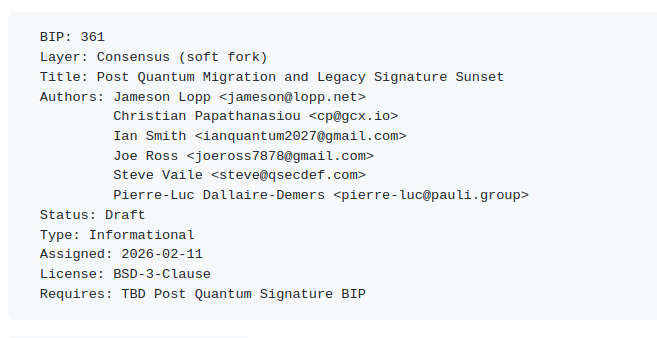
BIP-361 lays out a three-phase soft-fork plan. Phase A would begin roughly three years after a companion quantum-resistant address proposal, likely BIP-360, is activated. In Phase A, wallets would be barred from sending funds to legacy address types, nudging users toward newer quantum-safe formats. Phase B would kick in two years later, rendering all legacy signatures invalid at the consensus layer. Coins that did not migrate would be frozen and unable to move.
A third phase, still under study, would let holders of frozen coins prove ownership via a zero-knowledge proof tied to a BIP-39 seed phrase and recover their funds. In addition to Lopp, co-authors include Christian Papathanasiou, Ian Smith, Joe Ross, Steve Vaile, and Pierre-Luc Dallaire-Demers. This isn’t Lopp’s first rodeo with this idea; a mid-March 2025 blog post flirted with burning vulnerable coins as the least-worst option.
In a blog post, Lopp argues that letting quantum computers “recover” Bitcoin from vulnerable addresses would legitimize theft and concentrate wealth in the hands of a few tech-savvy actors, undermining Bitcoin’s security by making the whole thing look like a rigged river. A better outcome, he says, is to “burn” those vulnerable coins-turn them into ash so the river stays fair and insightful rather than a plot to rob the poor of their pennies.
That would render those coins permanently unspendable to avert a financial stampede, shield user confidence, and preserve fairness across the network. True, it might injure some careless users who forgot to upgrade, but he sees it as the lesser of two evils compared to a broad reshuffle of wealth and trust. In his eyes, the whole matter boils down to a game theory puzzle: push folks to migrate to quantum-safe systems and you strengthen Bitcoin in the long run.
When the post appeared, it stirred up quite a convulsion on Reddit’s r/Cryptocurrency, described as “controversial” by the thread’s keepers. The top comment suggested that Bitcoin would stop being Bitcoin if you forked it to muzzle wallets you deem too risky for your investment. Others chimed in that those with vulnerable addresses should brace for the day a quantum thief might pry them open. “Let them get hacked and crash the price for a month. We’ll buy the dip, just like last time there was an existential crisis,” one stern Redditor quipped.
The authors point to the brisk pace of quantum hardware progress and algorithmic advances as the reason for urgency. McKinsey and academic roadmaps cited in the proposal place a cryptographically relevant quantum computer as early as 2027 to 2030. Researchers also warn of a covert attack, where a quantum actor drains addresses quietly over weeks or months without triggering on-chain alarms.
The plan would touch coins long tied to Bitcoin’s mysterious creator, Satoshi Nakamoto. Early pay-to-public-key outputs-the scheme Bitcoin used in its first year or two-have fully exposed public keys and would be covered by the freeze. Estimates put roughly 1.1 million BTC in those early addresses. The authors argue that leaving those coins spendable would leave a future attack surface large enough to destabilize Bitcoin’s price and miners’ incentives all at once.
Critics call the move authoritarian and confiscatory, while supporters say the upgrade must be voluntary and well-ordered, not forced by a sudden stampede of rule-changing. A few X (formerly Twitter) voices groused that it’s a fool’s errand to force upgrades; others argued that waiting for a confirmed quantum breach leaves no time to coordinate wallets, exchanges, miners, and custodians-a coordination that has historically stretched on for years even under the best of conditions. Still others called it blunt force governance, not gentle persuasion.
We enlisted Grok to read the X thread and tell us whether the crowd’s mood leaned positive or negative. “The comments to this post are ~95% negative,” Grok replied, noting that out of 74 replies, almost none sang praises for the plan. “The sentiment is extremely one-sided against it.”
“No replies show clear support or enthusiasm for the proposal. The sentiment is extremely one-sided against it.”
The proposal frames the freeze as defensive rather than punitive. Migrants who move in time lose nothing. Those who don’t would end up with funds they may no longer control once quantum computing matures. The authors observe that abandoned keys left frozen would tighten circulating supply, a notion Satoshi himself once described as a donation to the network.
BIP-360, which introduces quantum-resistant address types that BIP-361 depends on, moved into testnet implementation through BTQ Technologies in early 2026, giving the migration timeline a tangible starting point. Activation, alas, remains in the ether. Bitcoin Core and the wider developer chorus tread carefully. Other schemes float around, including rate-limited spending from vulnerable outputs and voluntary migration paired with supply burns. A failed consensus could even invite a chain split, a risk no one waxes about with a smile.
The question the proposal asks is a stubborn one: How much rule-change is acceptable to stave off a cryptographic threat that may not arrive for years, yet could wreck the whole carnival the moment it does arrive?
Read More
- Off Campus Season 1 Soundtrack Guide
- X-Men ’97 Finally Gave Gambit the Hero Moment He Deserved
- Chainsaw Man Volume 24’s Cover Art Reveals a Brand-New Denji
- 46 Years Later, The Mandalorian & Grogu Answers A Major Empire Strikes Back Question
- 10 Worst End-Game Couples In Sitcom History
- HoI4 fans harsh reactions to the announcement of another DLC pack
- DoorDash responds after customer uses AI to make food look bad and get a refund
- Gold Rate Forecast
- Emily Henry Says to ‘Trust the Vision’ For Beach Read Adaptation
- Dragon Quest II HD-2D Remake: Where to get the Magic Key
2026-04-15 17:28