In a world where the heavens themselves seem to conspire with the whims of billionaires, SpaceX and Cursor AI have announced a partnership so audacious, it could only be penned by the hand of fate-or perhaps a particularly bored accountant. On a Tuesday as unremarkable as any other, the two entities revealed a deal that grants SpaceX the option to acquire Cursor for a sum so vast, it could fund a small war-or, more fittingly, a large space station.
Key Takeaways, for Those Who Skim:
- SpaceX, in a move that screams “why not?” has secured a $60 billion option to acquire Cursor AI, a startup that has somehow convinced 67% of the Fortune 500 that it knows how to code better than their own employees.
- Cursor AI, with its $1 billion in ARR, is the belle of the ball, leaving one to wonder if it’s the AI or the marketing team that deserves the credit.
- SpaceX’s Colossus supercomputer, a behemoth of a machine, aims to train models that will presumably write sonnets, solve world hunger, and perhaps even find a use for Twitter-excuse me, X.
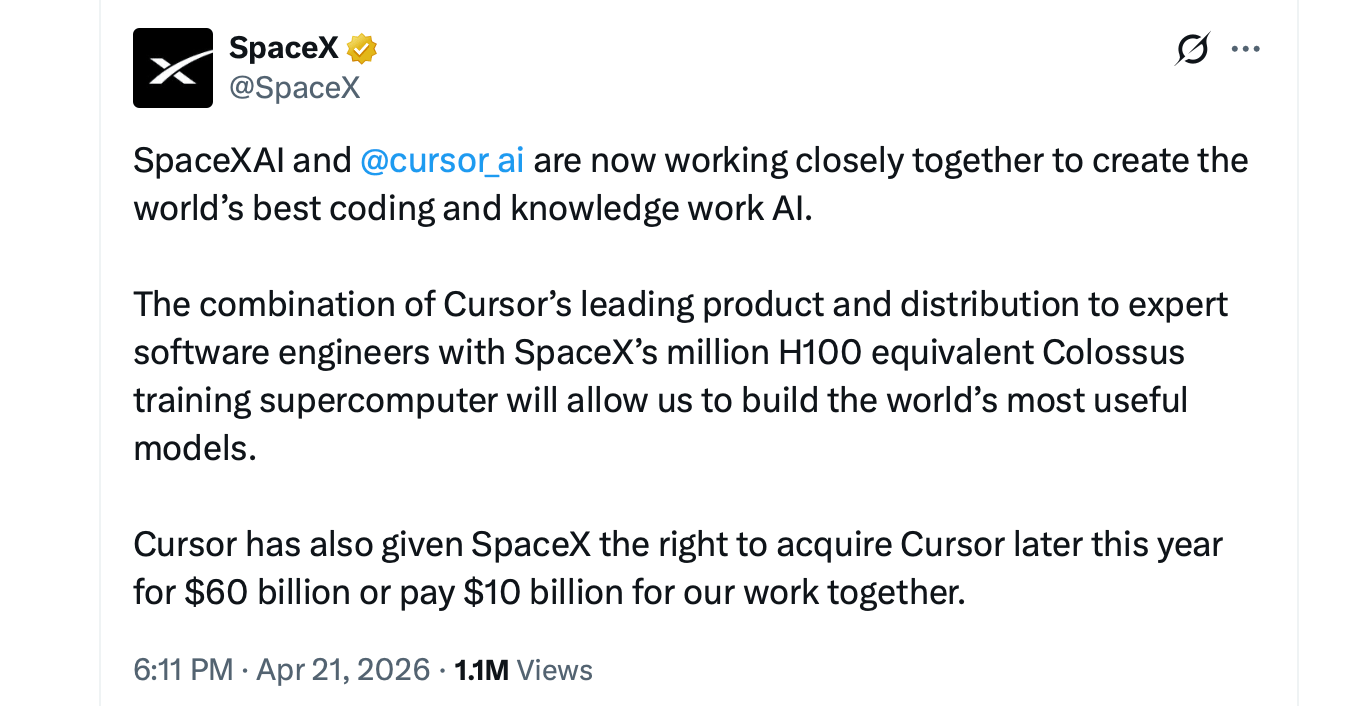
The partnership, announced with all the fanfare of a rocket launch, pairs Cursor’s AI-native code editor with SpaceX’s Colossus supercomputer. Together, they aspire to create “the world’s best coding and knowledge work AI,” a claim that, if true, might finally render human programmers as obsolete as a rotary phone. The New York Times, ever the purveyor of breaking news, had earlier suggested that SpaceX was set to buy Cursor outright for $60 billion. However, SpaceX clarified that it’s merely an option, leaving Cursor’s founders to nervously twiddle their thumbs until the end of 2026.
Cursor, the brainchild of four MIT classmates, is a fork of Visual Studio Code with AI integration so deep, it’s practically a psychological profile. Its founders, Michael Truell, Sualeh Asif, Arvid Lunnemark, and Aman Sanger, have expressed a desire to scale their Composer model, a goal now within reach thanks to SpaceX’s compute resources. One can only imagine the late-night coding sessions fueled by cold pizza and existential dread.
The deal structure is as peculiar as a rocket scientist at a poetry slam. SpaceX holds a call option to buy Cursor for $60 billion or pay $10 billion for the joint development work. It’s the corporate equivalent of “let’s see how this goes before we commit,” a sentiment anyone who’s ever dated in their 20s can relate to.
Cursor’s growth has been nothing short of meteoric, with year-over-year revenue growth exceeding 9,900%. Over one million developers use the platform daily, and 67% of Fortune 500 companies have adopted it, collectively generating enough code to fill the Library of Congress-twice. In November 2025, Cursor raised $2.3 billion in a Series D round, valuing the company at $29.3 billion. By April 2026, it was in talks for another $2 billion round, because apparently, there’s no such thing as too much money.
SpaceX, never one to shy away from ambition, acquired Elon Musk’s xAI in February 2026, valuing the combined entity at $1.25 trillion. The Colossus supercomputer, originally developed by xAI, is now under the SpaceX umbrella, with plans to expand it into orbital data centers. Because, of course, why store data on Earth when you can store it in space?
The Cursor partnership builds on this foundation, directing SpaceX’s compute capacity toward software tooling for professional developers. It’s a move that pits them directly against OpenAI and Anthropic, because nothing says “innovation” like a good old-fashioned corporate rivalry.
SpaceX, fresh off setting an annual launch record in 2025 with 165 orbital missions, is preparing for what could be one of the largest IPOs in history. Analysts predict a listing as early as June 2026, though whether the company will actually go public remains as uncertain as the weather in Siberia.
As for Cursor, the startup turned down prior acquisition interest from OpenAI, perhaps sensing that SpaceX’s offer was too good to pass up-or too bizarre to ignore. Whether SpaceX exercises its $60 billion option will depend on the success of their joint model development, a process that promises to be as dramatic as a Chekhov play.
For now, both companies remain privately held, their futures as intertwined as the orbits of planets. And as we watch this celestial dance unfold, one can’t help but wonder: in a world where billions are thrown around like confetti, what does it all mean? Perhaps, as Chekhov might say, it’s not the money that matters, but the absurdity of it all.
Read More
- Off Campus Season 1 Soundtrack Guide
- X-Men ’97 Finally Gave Gambit the Hero Moment He Deserved
- 46 Years Later, The Mandalorian & Grogu Answers A Major Empire Strikes Back Question
- 10 Worst End-Game Couples In Sitcom History
- HoI4 fans harsh reactions to the announcement of another DLC pack
- Chainsaw Man Volume 24’s Cover Art Reveals a Brand-New Denji
- Hatsune Miku cosplayer goes viral selling $15 cups of “foot juice” to thirsty anime fans
- Emily Henry Says to ‘Trust the Vision’ For Beach Read Adaptation
- DoorDash responds after customer uses AI to make food look bad and get a refund
- Gold Rate Forecast
2026-04-22 06:27