Spoilers follow for the plot and ending of Backrooms.
Horror movies have gone from being low-budget and dismissed by many to a hugely successful, billion-dollar industry, and this change has actually improved the quality of the films. Older American horror movies, especially those from the 1960s to 1980s, often featured what’s called the ‘idiot plot’ – characters making unbelievably foolish choices. For example, they’d split up when being chased by a killer, or investigate strange sounds and bloodstains by going into the darkness alone. Filmmakers were more focused on creating shocking deaths than on making sure their characters acted realistically, as long as it led to more on-screen kills.
Modern horror movies often try to create tension by having characters make obviously bad decisions, prompting viewers to shout warnings at the screen. The new film Backrooms, created by Will Soodik (known for Ash Vs. Evil Dead) and up-and-coming director Kane Parsons (a popular figure on YouTube), takes this idea even further. Instead of quick, frustrating choices, the film deliberately lets the main character act strangely for most of its runtime, only later explaining the reasons behind their unsettling behavior.
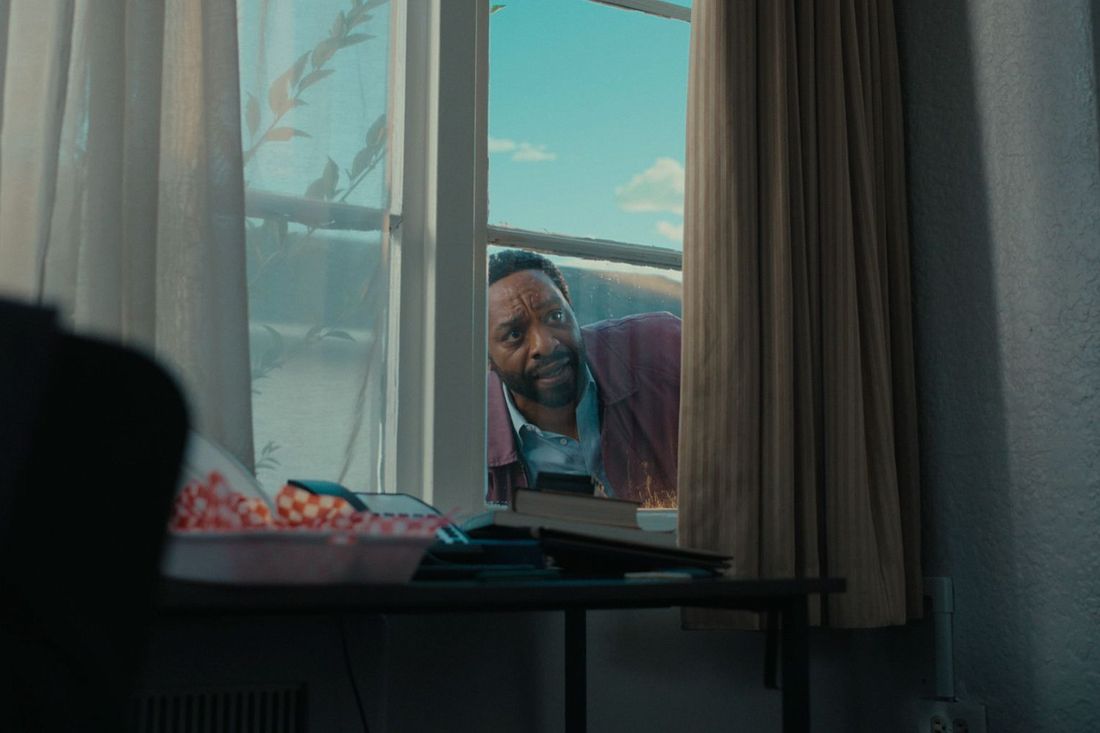
At the start of the film, Clark (Chiwetel Ejiofor), a man struggling with his career and business, finds a doorway to a strange, empty world. This place, called the “Backrooms,” is filled with unsettlingly familiar, yet distorted, copies of rooms, objects, and neighborhoods. The Backrooms are designed to feel creepy – they’re still, overly clean, and built with impossible, confusing designs. A constant buzzing from the fluorescent lights adds to the unsettling atmosphere. Clark quickly realizes he could easily get lost, as it’s unclear whether the Backrooms remain fixed or if they change and shift around him. He doesn’t even know if the space follows normal rules of geometry, or if simply retracing his steps will lead him back to where he started.
It doesn’t take long to realize this place Clark’s exploring isn’t just abandoned – something seriously dangerous lives there. And honestly, it’s frustrating because instead of getting smart, he drags his employee, Kat, and her boyfriend, Bobby, into the mix to help him document everything! Clark isn’t a hero by any stretch – he jumps at every noise and runs when things get close. He knows he’s in over his head. Yet, he keeps going back, venturing further and further into this creepy, deserted world with the same reckless abandon as those teenagers in a Friday the 13th movie heading into the woods. The whole time I was wondering why he’s so insistent, and the answer finally comes in a pretty shocking climax.
Even before strange things start happening, Clark is clearly struggling. He’s battling alcoholism, and his wife, Barbara, has left him due to his constant drinking and the lies he tells to cover it up. During a therapy session where his therapist, Mary, role-plays as Barbara to help him see things from her point of view, Clark becomes incredibly angry, lashing out at Barbara and anyone else who prevents him from accepting responsibility for his life.
When Clark vanishes, Mary ventures into the Backrooms to find him, initially appearing to take on his role as the one facing the dangers. This search reveals why Clark kept returning to this strange place. Unlike most people who find the Backrooms frightening and unsettling, Clark finds a strange comfort in their simplicity. He already feels disconnected from the real world, believing his failures aren’t his fault but due to the actions of others. Entering the Backrooms allows him to escape judgment and the consequences of his past.
His escape also highlights just how deeply self-absorbed he is. While earlier in the film, his comments to Barbara and Mary come across as simply selfish or sad, taking ownership of the Backrooms allows him to feel morally superior. He even knocks Mary unconscious, drags her to a hideout he’s created, and ties her up, attempting to recreate their therapy sessions – seemingly to prove to “Barbara” how well-adjusted and happy he is without her. Like a stereotypical villain, he’s eager to explain how he’s been misunderstood and justify his actions. Ultimately, his own satisfaction is what allows him to coexist with the terrifying creature in the Backrooms: the monster is a grotesque version of Clark, mirroring the pirate costume he wears in his store’s commercials.
Clark shares striking similarities with the villainous scientist from the film Event Horizon. Both men venture into a disturbing, otherworldly realm that reflects their deepest, darkest impulses. They both commit horrific acts, believing it’s necessary to control this world, and then use the world’s reaction as an excuse for their cruelty. As described by Parsons, this entity, nicknamed “Pirate Clark,” is almost certainly responsible for Bobby’s death and likely Kat’s as well (though Clark himself could have done it – her head is found in his hideout). Despite this, Clark feels a strong connection to his monstrous, twelve-foot-tall double. He not only accepts it but feels empathy for it and actively cares for it. This acceptance extends to rationalizing the creature’s actions, which is simply a continuation of how Clark justifies his own terrible deeds – including kidnapping Mary, keeping Kat’s head, and harming other beings in the Backrooms.
The other beings we’ve encountered don’t seem to be alive or capable of feeling pain. They likely represent warped versions of other people, and their lack of response might be because the people they’re based on aren’t around. It’s also possible they’re simply less developed than Clark’s creation, perhaps because the forces that formed them weren’t as strong. We haven’t observed them long enough to be sure. However, if Clark’s area of the Backrooms truly reflects his mind, his mental state could be keeping them subdued. He essentially lives in a perfect world for someone self-absorbed, surrounded by silent, passive figures who don’t react when he uses them for whatever he needs – even taking parts of their bodies for props or food. It’s unsettling to think about how he discovered they wouldn’t scream or bleed, and that their insides were… edible.
Mary throws Clark off balance within the strange reality of the Backrooms by directly confronting him about his flaws and refusing to accept his justifications. This causes his darker side, represented by the character “Pirate Clark,” to emerge and attack him, leaving him emotionally wounded. It’s unclear why this happens – is it a result of Clark’s own self-loathing, a momentary lapse in control, or a projection of his anger towards Mary? Even the creator, Parsons, jokingly suggested that Pirate Clark might have simply been acting on impulse, as if Clark was just feeling particularly aggressive at the time.
It’s striking how Clark connects with and even seems to nurture his own hidden anger, until an outside influence disrupts him, causing that anger to overwhelm him. What this reveals about the Backrooms themselves is open to interpretation – we don’t yet know if the space reacts differently to each person. Future installments planned by the creator, Parsons, might offer more clues, including whether Mary’s understanding of the Backrooms affects her double, briefly seen at the end of the film.
Perhaps the unanswered questions are the most important part of the Backrooms. Among the strange beings in Clark’s nest is a small, red figure that strongly resembles the silent Little Man From Another Place from David Lynch’s Twin Peaks. That show, like the Backrooms, involves characters entering a mysterious alternate reality filled with powerful, hidden darkness and confronting twisted versions of themselves. Throughout the series and film, Lynch intentionally left the Black Lodge—a key location in Twin Peaks—unexplained, and it remains one of the franchise’s most compelling mysteries.
Parsons and Soodik might not fully unravel the mystery of the Backrooms, and honestly, that’s probably a good thing – the unknown is more captivating than a simple explanation. However, by the end of their book, Backrooms, they do clarify what drives Clark’s actions. He seems like a typical, clueless horror movie character focused only on survival, but like the Backrooms themselves, he’s surprisingly complex. The subtle, intriguing, and ultimately shocking way the book reveals his depths is a major reason why it’s such a chilling and exciting read.
Read More
- Off Campus Season 1 Soundtrack Guide
- X-Men ’97 Finally Gave Gambit the Hero Moment He Deserved
- Chainsaw Man Volume 24’s Cover Art Reveals a Brand-New Denji
- 46 Years Later, The Mandalorian & Grogu Answers A Major Empire Strikes Back Question
- HoI4 fans harsh reactions to the announcement of another DLC pack
- 10 Worst End-Game Couples In Sitcom History
- Gold Rate Forecast
- DoorDash responds after customer uses AI to make food look bad and get a refund
- Emily Henry Says to ‘Trust the Vision’ For Beach Read Adaptation
- Dragon Quest II HD-2D Remake: Where to get the Magic Key
2026-05-30 02:00