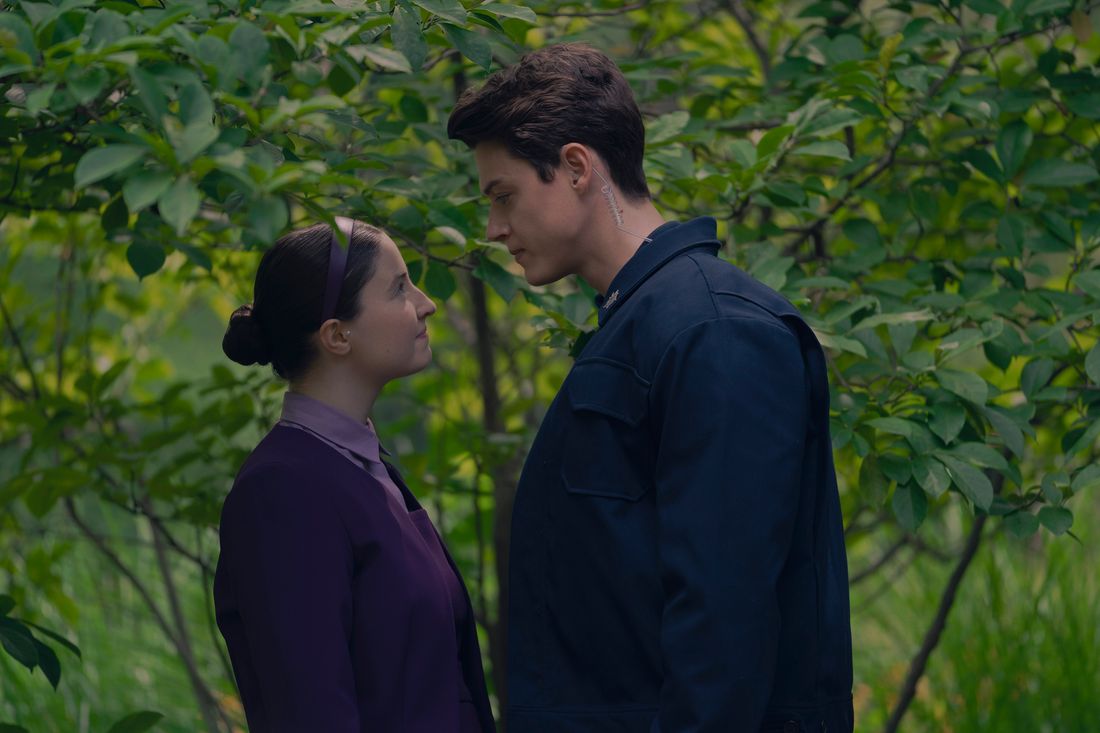
Despite the show’s generally slow pace, the season finale of The Testaments ends up taking us surprisingly far from the beginning. We first met the Plums as young girls, obediently following rules and hoping to find love through arranged marriages. If romance didn’t work out, they were expected to become mothers – a requirement in Gilead. For privileged young women, having powerful husbands and healthy babies was seen as the ultimate achievement, even if they lacked real freedom.
Wow, things have really spiraled in this show. It’s heartbreaking to see where the story has taken these women. Remember Hulda, the one Shu always dismissed as too innocent? She’s now suffered a terrible abuse at the hands of a doctor. And Becka? She’s utterly devastated, not just by her own actions, but by the immense sacrifice her mother made. Then there’s Shunammite, who desperately wanted to begin her womanhood, now facing the terrifying possibility she might never be able to have children – and in Gilead, that essentially means a life of isolation and shame. It’s just… a lot to process.
Then there’s Agnes, June’s daughter. At the start of The Testaments, she seemed destined for a comfortable, ideal life. But now, her engagement to a powerful Commander has been broken, damaging her standing. To make matters worse, her best friend is married to the man Agnes was seeing. Finally, Daisy reveals a secret everyone else already knew: Agnes is actually the biological daughter of June Osborne, the woman responsible for the Night of Tears. Agnes is shocked, exclaiming, “The terrorist?” when she finds out.
The year turned out terribly for a group of young women who simply dreamed of marriage and motherhood. However, the series concludes with a somewhat over-the-top moment of female strength. Shu, Daisy, and Agnes stride confidently down the Aunt Lydia School hallway, directly facing the viewer, their hands linked and a powerful song swelling in the background. The song features a sample from Miley Cyrus proclaiming, “I’m a female rebel,” highlighting how these women experienced a political awakening while others focused on weddings and traditional roles.
Agnes seems the most resistant to accepting what’s happening, likely because she feels she has the most to lose. After Becka is taken by the Eyes, Vidala gathers the girls and vaguely announces that Dr. Grove has died and his daughter won’t be at school. But Agnes has grown tired of the lies and hypocrisy in Gilead. She leaves Vidala’s prayer session to find Garth, determined to discover Becka’s whereabouts. The truth is, Garth doesn’t know what will happen to his fiancé. Heartbroken, Agnes breaks down in his arms, and he awkwardly tries to comfort her, touching her shoulders – a forbidden gesture. When Aunt Estee arrives and orders Garth to let Agnes go, he tells the former Pearl Girl – who I’m really curious about – to be understanding. What a good guy.
Though Agnes appears devastated by recent events, she’s actually gearing up to take action, much like her friend June would. After a brief strategy session with her friends in the bathroom, she immediately focuses on saving Becka from being executed. She confronts Vidala, demanding to know how she plans to help the girl she’s wronged, reminding her that, as someone who claims to act on divine authority, Vidala has a responsibility to do what’s right. Agnes believes this is true, citing the teachings Vidala has constantly emphasized.
Watching Agnes grapple with her faith is compelling. While Christianity is a key tool for control in Gilead, the girls raised at the Aunt Lydia School genuinely believe in their religion. Agnes doesn’t think Vidala’s empty promise to pray will help Becka, so she goes directly to Weston, the head of the Eyes and her fiancé, hoping he can intervene. This shows Agnes is beginning to realize that people can hold more power than faith itself. When Agnes reveals she was one of Dr. Grove’s victims, Weston promises to help, and Becka is placed with her mother while authorities investigate. Agnes doesn’t fully grasp that her confession might jeopardize her marriage, but it’s clear she would have made the same choice regardless.
When Lydia last saw Becka in the detention center – where Margaret Atwood surprisingly works as a guard – she couldn’t offer any help. Commander Judd, who wants Becka executed for murder, won’t listen to her now. However, Lydia might find an ally in Vidala, if they can overcome their old rivalry. As Agnes pointed out to Vidala, and Vidala now tells Lydia, they are more than just Aunts within Gilead’s system. They are meant to be instruments of God, connected in a universal duty to help one another, regardless of any earthly hierarchies.
Daisy, having been raised outside of religious influence, seems to grasp the situation immediately. When she learns there’s no plan to rescue Becka, she tells her handler she’s leaving Mayday. This defiance is exactly what triggers the escape plan Daisy has been requesting. That night, she’s secretly transported to a coastal border, where June is waiting to bring her back. It’s not because Daisy completed her assignment, but because her outspokenness and disobedience – qualities June recognizes in herself – have eroded her trust in Daisy’s ability to carry out the difficult and unpleasant tasks.
Daisy argues with June, insisting June is the one who doesn’t understand. She explains that Becka and the other girls are genuinely real, experiencing typical teenage things like crushes and making close bonds with each other – bonds June has forgotten. While Becka did kill her father, Daisy reveals it was to protect Agnes. Agnes – who used to be June’s daughter, Hannah. This finally gets June’s attention. She asks Daisy to describe her daughter, and Daisy says she’s beautiful, brave, kind, well-liked, and not particularly funny, much like June herself. June then asks if Agnes is happy, but Daisy confirms she isn’t. It’s left unclear whether June allows Daisy to stay at Gilead because she believes in her changed perspective or because she can’t bring herself to separate Agnes from her friend. After a risky journey hidden inside a honey vat, Garth manages to smuggle Daisy back into the school, though she does receive a demerit for smoking.
This episode mainly consists of intense one-on-one conversations. We see confrontations between Agnes and Weston, Vidala and Lydia, Daisy and June, and then Daisy and Lydia again. During their talk, Lydia tries to explain herself to Daisy, claiming she’s always tried to care for those around her, but Daisy is deeply affected by this. Daisy recently lost her own mother while protecting her, and just spent time with June, who has dedicated her life to fighting the oppressive system that took her daughter. Daisy can’t understand how Lydia can consider herself a mother figure when she so easily abandoned Becka after a simple warning from Judd.
Daisy is more than just a motivator for Lydia; she helps the headmistress finally understand what needs to be done. Nothing is stronger than a mother’s love, and Vidala and Lydia plan a confession with Becka and Mrs. Grove. Despite Becka’s objections, her mother insists Mrs. Grove must take the blame for her husband’s murder. With both her husband and daughter gone, and her reputation ruined, Mrs. Grove couldn’t continue living there anyway. While a legal argument against releasing young people into their parents’ custody exists (“Secateurs”), it’s ignored. Gilead operates on imitation, twisting reality to uphold its power. Justice for Dr. Grove, the pedophile and sexual abuser, was never a possibility; simply maintaining the illusion of law and order is enough.
Taking the blame for her daughter was a huge sacrifice, but in the slow-moving world of Gilead, it mostly just caused people to talk. Commander Mackenzie informs his daughter that her groom won’t be there, but she doesn’t seem to care, only wanting to know how this affects Becka. When she learns of Mrs. Grove’s selfless act for her daughter, Agnes becomes overwhelmed with emotion. It’s a powerful demonstration of how deeply a mother can love – a love so strong it can leave you breathless.
Instead of a loving family connection, Agnes has Paula, who, while drunk, cleans up the blood of a man named Grove from the floor of her beautiful home. She shares this home with her seemingly perfect husband and his daughter. Late at night, Paula reveals that Gilead wanted to kill her as punishment for the actions of the Handmaids, but Mackenzie intervened and saved her – proving that a father’s love can be helpful. Thinking about this final confrontation between Agnes and Paula makes more sense when you consider Agnes’s next move. How will Agnes and Garth manage one last secret meeting? Agnes could simply leave the house at night. But why would she suddenly risk running away when she’s never done that before? That’s when it clicks!
Watching Agnes rush towards the Guardian barracks, I’m struck by how much courage she’s found. Late at night, she urgently pleads with Garth to keep his promise to Becka and offer her the safety of a powerful protector. She fears all her efforts will be meaningless if he refuses. And then everything happens quickly. Mrs. Grove is convicted and executed. Garth is promoted to Commander and marries Becka, who is numb with grief. Before the ceremony, Becka and Agnes share a tender kiss—a reminder of their enduring friendship, though Gilead doesn’t allow for such bonds in adulthood. It’s a clear end to their childhood, a loss of innocent crushes and shared secrets. Garth brings Becka to the small house he’d chosen earlier, hoping it will allow her to stay connected to the family she’s lost. It feels like a twisted form of justice, formalized by the wedding. Ultimately, these are lives reduced to simply surviving.
June receives a jar of Pearl Girl honey at her doorstep back in Toronto. Hidden inside is a letter from Daisy, outlining a daring plan: to build a secret group of teenage girls who will work to disrupt Gilead from within. Currently, the group consists of just three members. There’s Daisy, an orphan driven by revenge and full of confidence, and Shu, a clever and capable girl who’s always looking out for her sisters and has a knack for gathering information.
Then there’s Agnes, who, despite Daisy’s initial plans, has become the true leader. It’s really June’s followers all along. The episode reveals that Daisy is June’s biological daughter, but Agnes had already sensed a different path for her. Hidden among her treasured possessions is an old drawing signed with the name “Hannah”—a reminder of the mother she’d almost forgotten.
In the last moments of the “Secateur” episode, Agnes reveals to Lydia that she understands Lydia’s secret – something viewers largely knew from the start of The Testaments. While this reveal of Agnes’s parentage isn’t a huge surprise, it suggests exciting things to come. Throughout the first season, Agnes has struggled between her natural desire for connection and independence and the pressure to fit the strict role assigned to her within Gilead’s oppressive world. Now that she knows who she truly is, it’s clear she was never meant to conform. She can’t be the perfect wife and mother Gilead expects, and that allows her to finally embrace her true self: the perfect daughter of June Osborne.
Read More
- Off Campus Season 1 Soundtrack Guide
- Chainsaw Man Volume 24’s Cover Art Reveals a Brand-New Denji
- DoorDash responds after customer uses AI to make food look bad and get a refund
- Dragon Quest II HD-2D Remake: Where to get the Magic Key
- HSR Banner Schedule (Honkai Star Rail)
- Hideo Kojima says Metal Gear Solid 2 became the future he hoped would not happen
- Euphoria Season 3’s New R-Rated Sydney Sweeney Scene Proves The Show Is Trolling Us
- Zero Parades: For Dead Spies Original Game Soundtrack is available to stream now
- Gold Rate Forecast
- How to Get to the Undercoast in Esoteric Ebb
2026-05-27 15:58