It’s a classic pastime for fans of Gene Roddenberry’s Star Trek to argue about which story – episode, series, or movie – is the very best. Though it comes down to personal preference, one film stands out as the most complete realization of Roddenberry’s vision. It might not be the most action-packed or entertaining, but it perfectly embodies what the creator intended.
Forget, for a moment, what the film means culturally as we currently understand it. Its difficult creation resulted in a movie that failed to impress critics, fans, or even the studio. However, despite all the problems surrounding it, The Motion Picture perfectly embodies Roddenberry’s original dream for a science fiction story that celebrates the best of humanity.
Star Trek: The Motion Picture Gave the Enterprise an Iconic Cinematic Upgrade
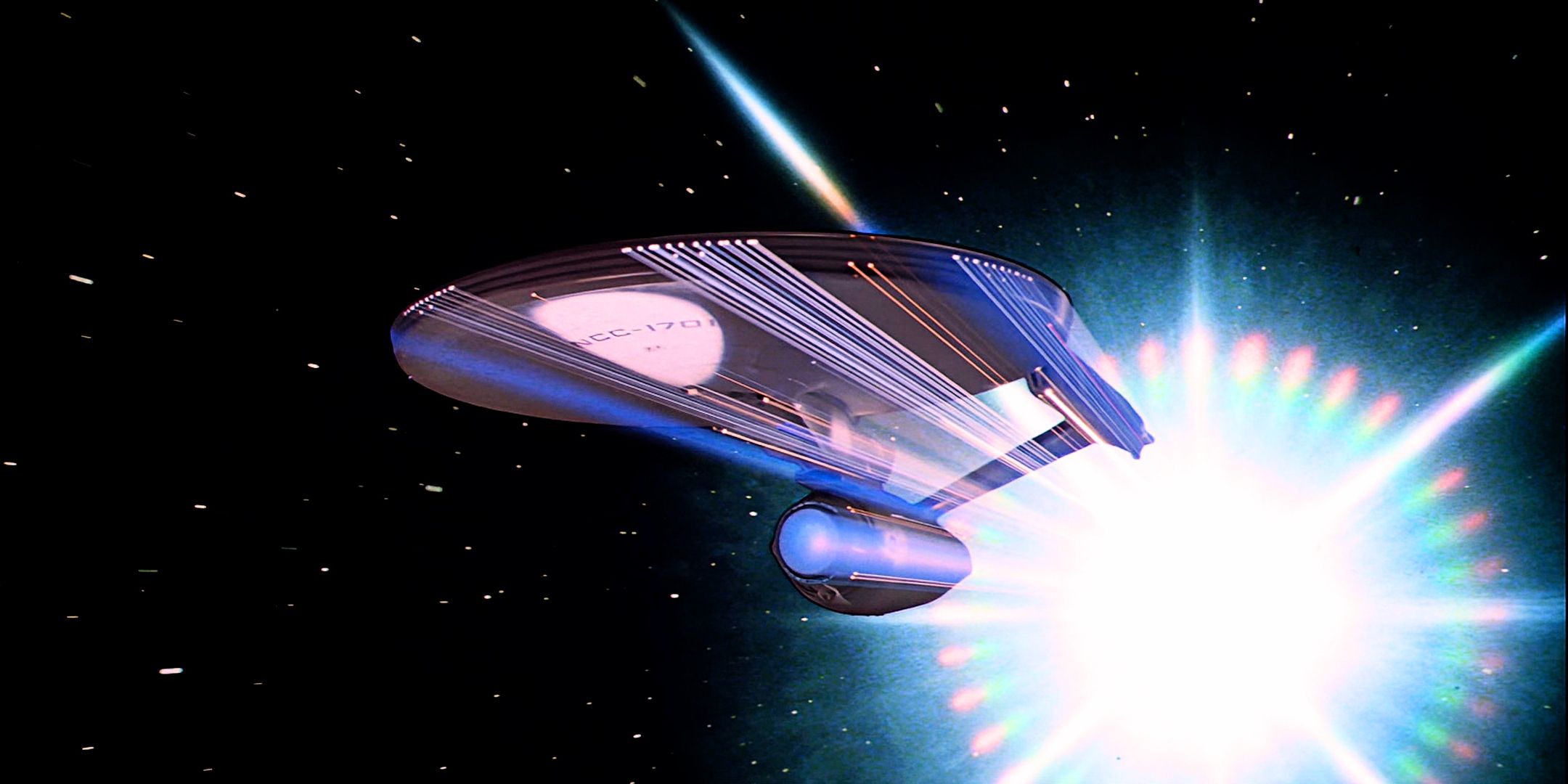
As a lifelong movie and TV buff, the original Starship Enterprise is just…instantly recognizable. Walter Matt Jefferies designed it for the original series, and it’s amazing how simple the design is – basically five lines and a circle, and even non-fans know what it is! But honestly, he was working with a really tight TV budget and the limitations of 1960s technology. When they finally had a proper movie budget and access to groundbreaking special effects, that first updated Enterprise? That was the ship at its absolute peak. It really showed what it could be.
The film presents the new ship as a renovation of an existing one, keeping major changes to a minimum. Famously, The Motion Picture slowly revealed the ship’s design in a five-minute sequence accompanied by Jerry Goldsmith’s iconic score. Now, thanks to the Director’s Edition and modern remastering, this scene is a treat for starship fans. Just as John Williams’ music enhanced Star Wars, Goldsmith’s score powerfully elevates the film and has become the unofficial theme song for the entire Star Trek franchise.
The movie started as the first episode of a planned new TV series, but Paramount decided it worked better as a full-length film. Designer Andrew Probert considered several major changes – one of which eventually became the Enterprise-D from The Next Generation – but the final ship design is very similar to his original concept. It successfully combines his innovative ideas with polished details, making it look impressive enough for the big screen.
Almost the Entire Film Takes Place in Star Trek’s Greatest Location: The USS Enterprise
Honestly, one of the biggest reasons I’ve always struggled with some of the newer iterations is that they just didn’t capture the feeling of the original Enterprise. It wasn’t about changing the look too much – it was more that the ship itself didn’t feel like a living, breathing part of the story. What made the original movies so special, especially The Motion Picture, was that continuity. Even though the ship looked updated, it felt like the same Enterprise we knew and loved from the original series, and that connection was powerful.
What really struck me about The Motion Picture wasn’t just the exterior of the Enterprise, but how fully realized the interiors were. The production team, despite being constrained by budget and time, really delivered. We got to see so much more of the ship than ever before – a greatly expanded engineering section, a huge briefing room, and even rooms with carpeting and comfortable furniture! It wasn’t the gritty, used-future feel of Star Wars or Alien, nor the cold, clinical metal of a lot of other sci-fi. More than any other Star Trek film, The Motion Picture truly made the Enterprise feel enormous and as complex as the people who lived and worked within its walls. It felt like a real, functioning space, not just a set.
I’ve always felt the USS Enterprise, particularly in The Motion Picture, was something truly special. It wasn’t just a spaceship; it felt like a home, a comforting space even during those long five-year missions. While the movie didn’t send us soaring across the galaxy, it took us on an incredible journey within the ship itself. All the drama, the tension between the crew, and the conflict with the villain unfolded right there, within those gleaming, newly painted walls. It was a character all its own.
V’Ger Is a Perfect Star Trek ‘Villain’ Because It Can’t Be Defeated, Only Understood
His fascination with Star Trek wasn’t just about spaceships and battles. He saw it as a hopeful vision of the future – one where humanity overcame its weaknesses and came together to value knowledge, peace, and differences. While the action was entertaining, the story of V’Ger was particularly impactful because it wasn’t a problem to be solved through force. It was something that needed to be understood.
Let me tell you, making The Motion Picture was a real scramble. The script wasn’t finished – seriously, director Robert Wise was practically shooting the ending as he went! It’s ironic, considering the hopeful message of Star Trek, because creator Gene Roddenberry and writer Harold Livingston spent more time arguing than collaborating. Interestingly, the Voyager probes launched just months before filming started, and the way the film incorporates that future technology is actually pretty brilliant. The real twist? The ending we all know wasn’t Roddenberry’s idea at all – it came from producer and writer Jon Povill.
It’s interesting that despite all the debate, the ending of The Motion Picture is actually what makes the film so distinctly Star Trek. NASA’s Voyager probes explored our solar system, but also carried a “golden record” hoping other intelligent life might find it. Star Trek’s Starfleet, however, actively searches for new life. In the film, V’Ger returns to Earth after becoming self-aware and wanting to evolve to a higher form by merging with a human. Though not a typical action-packed finale, this idea of growth and understanding perfectly captures the heart of Star Trek.
The Conflict Over Spock’s Dual Nature Is Finally Settled, and He Goes to His True ‘Home’
What made Star Trek truly successful wasn’t just its cool spaceships, fascinating aliens, or optimistic vision for the future. It was the characters. Creator Gene Roddenberry intentionally crafted Spock as a half-Vulcan, half-human character to create compelling internal conflict. The first full scene in The Motion Picture, following a quick appearance by redesigned Klingons, really showcases the impact of that struggle.
Despite fully embracing and completing a ritual demonstrating his commitment to Vulcan logic, he’s rejected by his people once more. Interestingly, he’s the only character to appear in both original pilot episodes. His popularity stemmed from fan response, and his storyline in The Motion Picture reflects that. He’s able to sense V’Ger due to his Vulcan psychic abilities, which motivates his return to the Enterprise. When he comes back, his friends are thrilled to see him, but they have to convince him to reconnect with them.
Spock experiences rejection from his own people, but ultimately finds acceptance. He ventures outside the ship to connect with V’Ger, a powerful being of pure logic, and discovers its emptiness stems from a lack of emotional understanding. Kirk saves V’Ger, and in doing so, Spock realizes the value of both his Vulcan logic and his human side. He comes to understand that his true home isn’t on Vulcan or Earth, but with his friends aboard the Enterprise.
Star Trek: The Motion Picture Kicks Off James T. Kirk’s Best Narrative Arc
As a huge fan of classic Star Trek, one episode that always stuck with me is “The Naked Time” from The Original Series. It’s fascinating because a virus makes Kirk reveal just how deeply he cares about the Enterprise – he literally says he’ll never let it go! Then, when The Motion Picture kicks off the film series, we really see that devotion continue. Even though he’s been promoted to Admiral, all Kirk really wants is to be back commanding the Enterprise. It creates some great tension with the new captain, because he’s not ready to give up his ship or his place with the crew.
Thanks to popular culture, many people recognize Captain Kirk. Despite his tendency to act quickly and fall into passionate relationships, he’s a remarkably effective leader in Starfleet. He avoids unnecessary conflict, but will always stand his ground when challenged. He’s willing to take risks, but he’s proven he deserves his position. The Motion Picture highlights both his desire to be part of the Enterprise crew and confirms that he truly belongs there.
Over the next six films, a central storyline revolved around Captain Kirk struggling to hold onto his position and feeling left behind as the galaxy changed. Hints of this conflict first appeared in The Motion Picture.
I recently revisited Star Trek: The Motion Picture, and if you’re looking to experience (or re-experience!) this classic, you’ve got plenty of options. You can buy it on DVD or Blu-ray, or if you prefer, stream it digitally or through Paramount+. It’s easily accessible for any Trek fan!
Read More
- Gold Rate Forecast
- What is Omoggle? The AI face-rating platform taking over Twitch
- Man pulls car with his manhood while on fire to raise awareness for prostate cancer
- Audible opens first ‘bookless bookstore’ in New York
- 10 Adorable Quotes from Diana in Pragmata
- Netflix’s Remake Of R-Rated Denzel Washington Classic Carries On A Rotten Tomatoes Trend
- Wartales Curse of Rigel DLC Guide – Best Tips, POIs & More
- Elden Ring Is Back With A New Free Game, Thanks To The Fans
- How To Grow Money Trees In Animal Crossing: New Horizons
- XRP ETFs’ April Triumph: A Tale of Millions and Muted Prices
2026-05-07 23:38