In a stunning act of defiance against the universe’s natural tendency to fumble things, Input Output managed to deliver 16 of 18 commitments across Q4 2025 and Q1 2026. The other two-Acropolis and tiered pricing-were apparently canceled due to a cosmic oversight, a paperwork snafu, or perhaps the universe itself losing interest. Funding for those? Returned to the treasury, because even the cosmos knows not to waste money on doomed projects.
The report’s thesis: “Funding either produces trackable output, or it goes back.” A bold claim, especially considering the universe’s track record. Still, IO insists every outcome is “publicly verifiable,” which is reassuring until you realize “publicly verifiable” could mean anything from a blockchain ledger to a sticky note on a fridge door.
The most immediate adoption milestone? USDCx launched 84 days after announcement. That’s 84 days of waiting, which in blockchain terms is about as fast as a snail on a bureaucratic mission. Still, 15 million USDCx minted in a week? Impressive, or just a sign that people are desperate for anything besides meme coins.
Interoperability was the second major theme, with LayerZero connecting Cardano to 160+ blockchains and $80B in assets. For context, that’s like plugging your TV into the entire multiverse and hoping it still works. IO called it “the single largest interoperability unlock,” which is probably true if you define “unlock” as “unlocking the door to a room full of confused developers.”
External milestones included CME Group launching Cardano futures, Coinbase letting ADA owners take out loans, and ADA being accepted at 137 SPAR stores in Switzerland. If that last one sounds suspiciously like a joke, you’re not wrong-it’s the kind of thing that would make Douglas Adams roll in his grave, muttering, “Of course it’s not a real store. It’s a metaphor.”
Engineering updates focused on node reliability, security, and upgrade readiness. Versions 10.5.4 and 10.6.2 were released, which is great news for stake pool operators who might have been worried about cryptographic key management turning into a cosmic game of Jenga. The KES agent hit version 1.0, reducing attack surfaces for pools-a relief, perhaps, but not enough to stop the universe from eventually collapsing under its own entropy.
UTXO HD moved the UTXO set from memory to disk, slashing node memory usage by 80%. That’s good news for operators, assuming they care about infrastructure costs. If not, they can just let the nodes run until they melt, which would be a poetic end to a system designed by committees.
Scaling was presented as a three-track strategy: Mithril, Hydra, and Leios. That’s three tracks, which sounds like a plan concocted by a committee of three-dimensional chess enthusiasts who’ve never heard the word “simple.” Mithril reached its first stable release, Hydra made production strides, and Leios produced a working prototype-though whether it’s a prototype or just a prototype pretending to be a prototype remains to be seen.
Developer tooling got an upgrade, with Plutus adding Van Rossem features and optimized primitives. Meanwhile, Cardano High Assurance opened early access to five companies testing formal verification. Because nothing says “trust us” like asking five companies to do something complicated and then hoping they don’t all quit mid-project.
Research continued, with Work Package 25 closing after a public consultation reaching 24,000 people. Two papers were published, and IO’s chief scientist became an ACM Fellow. All very impressive, unless you count the fact that 24,000 people might have been coerced into participating via a mandatory survey at gunpoint.
Q2 targets include protocol version 11, node v10.7, and a Leios testnet. The universe, ever the optimist, seems to think this will all go smoothly. It won’t. But it’s worth trying anyway, because that’s the only way to guarantee a story where something goes wrong.
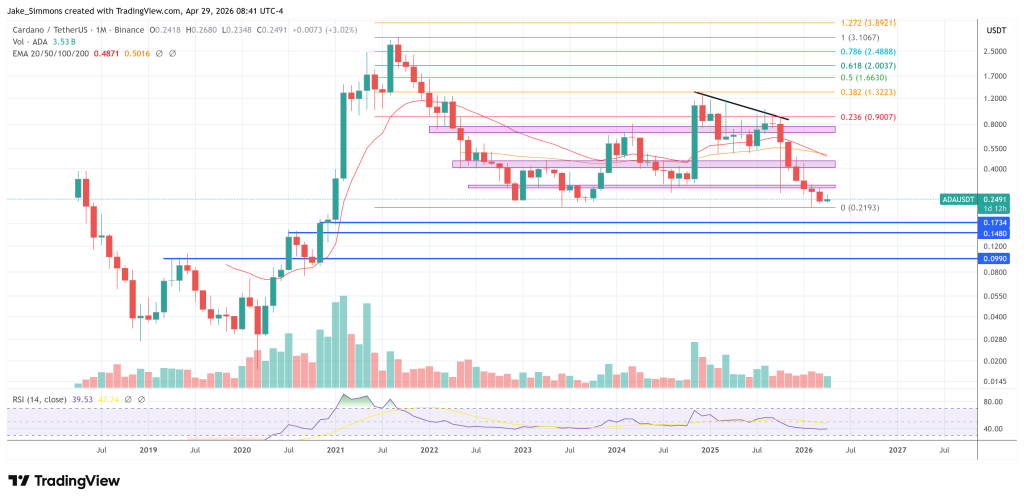
At press time, Cardano traded at $0.2491-which is about as thrilling as watching paint dry but with more math.
Read More
- Scientology speedrun trend escalates as viewers map out Hollywood facility
- NBA 2K26 Season 6 Rewards for MyCAREER & MyTEAM
- Where Winds Meet’s new Hexi expansion kicks off with a journey to the Jade Gate Pass in version 1.4
- Makoto Kedouin’s RPG Developer Bakin sample game is now available for free
- How to Get to the Undercoast in Esoteric Ebb
- What Fast Mode is in Bannerlord and how to turn it on
- MrBeast lets fans from every country vote for Beast Games Season 3 contestants
- Vegan nugget startup founder charged with assaulting influencer ex-girlfriend Evelyn Ha
- Vibe Out With Ghost Of Yotei’s Watanabe Mode Music While You’re Stuck At Work
- 10 Best American Turn-Based RPGs of All Time
2026-04-30 05:42