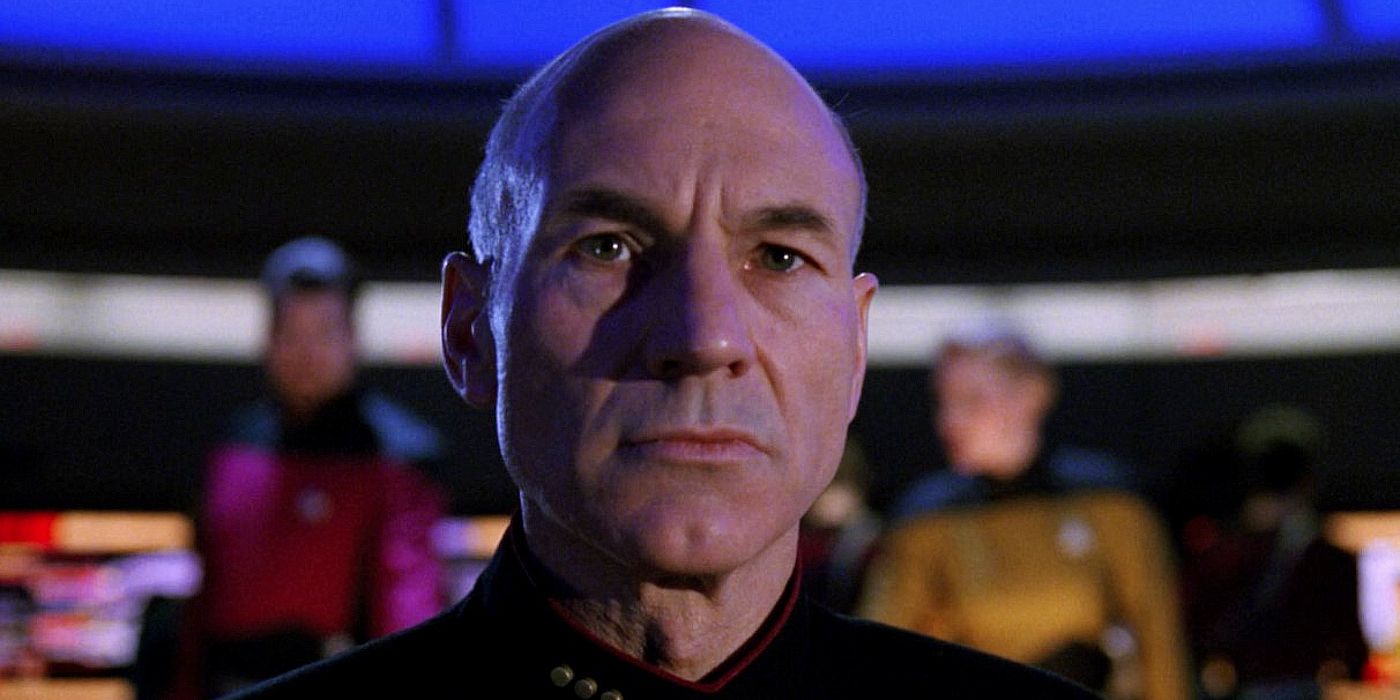
As a huge fan of Star Trek, I always thought Jean-Luc Picard, played by Patrick Stewart, was one of the wisest captains ever. He always seemed to have the perfect thing to say, and a lot of that came from what he learned at Starfleet Academy. Some of his quotes are truly iconic and have really stuck with me – and with a lot of other fans, I think. One that really stands out is from Season 6, Episode 3 of The Next Generation, an episode called “Man of the People.”
One of the things I admire most about Captain Picard – and what the Federation stands for – is summed up in his conversation with Ves Alkar. He basically questioned whether achieving a good outcome could ever make a truly wrong action okay. It’s a powerful moment that really highlights the core themes of fairness and doing what’s right that Star Trek always represented, and honestly, it feels even more important now, as the show hasn’t always stayed true to those ideals lately.
Picard’s Line in the ‘Man of the People’ Sums Up the Captain’s Main Principles
The Enterprise is tasked with transporting Ambassador Alkar, who is working to negotiate a peace agreement between the Rekag and Serionians. When Alkar’s mother unexpectedly passes away, he asks Counselor Troi for help with a traditional ceremony. During this ceremony, he transfers all of his painful feelings to her. As a result, Troi starts behaving aggressively and erratically, overwhelmed by Alkar’s intense emotions.
Towards the episode’s conclusion, Picard confronts Alkar, who reveals he exploited Deanna Troi to achieve a successful peace treaty between their peoples. Picard, with his characteristic wisdom, replies, “You can’t justify a deliberately unethical action simply because you believe it serves a greater good.”
Right from his first appearance in Star Trek: The Next Generation (Season 1, Episode 1), Captain Picard consistently spoke out about fairness, moral principles, and taking responsibility for your actions. Above all, he valued the rights of individuals over the needs of organizations or political agendas.
In the Star Trek: The Next Generation episodes “The Offspring” and others, Captain Picard consistently championed the rights of artificial life forms. He refused to turn over Data’s android daughter, Lal, to Starfleet, believing she deserved to live as an individual, not be treated as property. He also powerfully argued that Data’s consciousness entitled him to the same rights as any living being, famously questioning whether children created from their parents’ DNA should be considered property. Throughout the series, Picard prioritized ethical considerations, believing that potential gains for Starfleet or others never justified compromising an individual’s right to exist and be treated with respect.
Chinua Achebe’s “Man of the People” illustrates a simple idea: good intentions don’t excuse bad behavior. While Alkar claims his peace mission justifies burdening Troi with his negative feelings, he’s still taking advantage of her for his own benefit, hiding behind the idea that it’s for a noble cause.
This statement clearly shows Captain Picard’s strong belief that harming any living creature is never justified. He consistently lived by this principle, often prioritizing his morals over quick wins. For example, he chose not to destroy the Borg with a virus, even though he could have, because he considered it an act of wiping out an entire race. Similarly, he refused to sacrifice Data so his technology could be copied, as seen in the episode “Measure of a Man.”
Throughout the series, Picard consistently stood by his principles, even when it meant disagreeing with the Federation. His statement in the episode “Man of the People” best captures his core belief: some actions are simply wrong, no matter how good the results might be. He believed that any just system must recognize and respect this fundamental limit.
Picard’s Line Represents a Theme Star Trek Has Since Forgotten
Captain Picard’s statement reflects the core values of the Star Trek franchise, particularly its focus on ethics and justice. Throughout the series, from the original to Voyager, Star Trek has consistently used individual episodes to examine the rules of its universe and how they impact personal freedoms.
Throughout the Star Trek series, captains have frequently broken Federation rules, known as Directives. While sometimes motivated by personal reasons, these breaches usually happen when a captain believes following the rules would cause harm to others or allow suffering to continue. We see this with Kirk in “The Return of the Archons” and Picard in an episode of The Next Generation, where they both chose to break the rules to protect other species or fix unfair situations. As Picard explained, they make these difficult choices because they believe it’s wrong to allow harm to happen, even if it means disobeying orders.
It seems the Federation in the late 33rd century has strayed from its core values. They’ve developed a devastating new weapon called Omega 47, based on a molecule originally seen in Voyager. Think of it as the Star Trek universe’s version of an atomic bomb – it can disrupt subspace over large areas, effectively cutting off warp travel. This allows the Federation to isolate any civilization they consider a threat.
This is especially worrying because the galaxy is still recovering from a recent catastrophe that disrupted faster-than-light travel, causing the collapse of many civilizations and powerful empires. With travel now reliable again, the Federation seems to be intentionally creating the same weakness as a potential weapon.
This action violates the Federation’s established rule against researching or utilizing Omega, as seen in Season 4, Episode 21, and goes against the moral standards set by previous installments. By creating Omega 47, the Federation is essentially saying that potential harm is acceptable if it leads to greater security – a justification that Captain Picard previously criticized in the episode “Man of the People.”
As a long-time fan, I’ve noticed that recent installments, particularly Starfleet Academy, haven’t quite captured the spirit of Star Trek. It feels like they’ve forgotten what made the original series so special – its focus on ethical dilemmas. Remember Picard’s famous lines about what Starfleet should be? That wasn’t just about one story; it was the heart of Star Trek at its best. Sadly, the newer shows seem to have lost sight of that important standard.
Found an error? Send it so it can be corrected.
Read More
- All Itzaland Animal Locations in Infinity Nikki
- Paramount CinemaCon 2026 Live Blog – Movie Announcements Panel for Sonic 4, Street Fighter & More (In Progress)
- Cthulhu: The Cosmic Abyss Chapter 3 Ritual Puzzle Guide
- Persona PSP soundtrack will be available on streaming services from April 18
- Rockets vs. Lakers Game 1 Results According to NBA 2K26
- Raptors vs. Cavaliers Game 2 Results According to NBA 2K26
- Gold Rate Forecast
- Spider-Man: Brand New Day LEGO Sets Officially Revealed
- Focker-In-Law Trailer Revives Meet the Parents Series After 16 Years
- The Boys Season 5 Spoilers: Every Major Character Death If the Show Follows the Comics
2026-04-21 16:37