Oh, what a jolly good mess we have here! Polymarket’s delightful little contract predicting that the Strait of Hormuz would be back to its bustling self by April 30 took a nosedive down to a mere 28% confidence as of Saturday! Why, you ask? Well, it seems that the pesky Iranian Revolutionary Guard Corps decided to play pirate and fired upon at least one unsuspecting tanker while sending over 20 vessels back to their homes like naughty schoolboys!
Key Takeaways:
- On April 18, Iran conducted its own version of a “how to ruin a party” by firing at a tanker and turning around over 20 vessels, sending Polymarket’s odds of normalcy plummeting 41% to a paltry 28%.
- The May normalization market is hanging in there at a rather optimistic 69% Yes, supported by a hefty $1.3 million in volume, after peaking at a rather cheeky 82% on April 17.
- To get a full “Yes,” the IMF Portwatch needs to log a 7-day moving average of at least 60 ships arriving before May 31, 2026. Good luck with that!
Iran Reimposes Hormuz Restrictions Just Hours After Opening the Floodgates; Polymarket Contracts Do the Cha-Cha!
In an astonishing plot twist worthy of a Dahlian tale, Iran’s Foreign Minister had the audacity to declare the Strait “completely open” to commercial vessels on April 17, citing a ceasefire brokered by Pakistan. Oil prices dipped about 10% in celebration, and equity markets danced like nobody was watching. The May normalization contract on Polymarket briefly flirted with intraday highs near 82%. But hold onto your hats, folks, because within just 24 hours, everything flipped faster than a pancake!
Yes, Iranian officials were quick to announce that the U.S. continuing its naval blockade constituted a “breach of trust” and a violation of their ceasefire terms. As a result, the April 30 Polymarket contract dropped 41% from its recent peak. Meanwhile, the May contract, which had spiked to an exuberant 73% on April 17, settled down to approximately 69% Yes as of April 18. Quite the rollercoaster, wouldn’t you say?
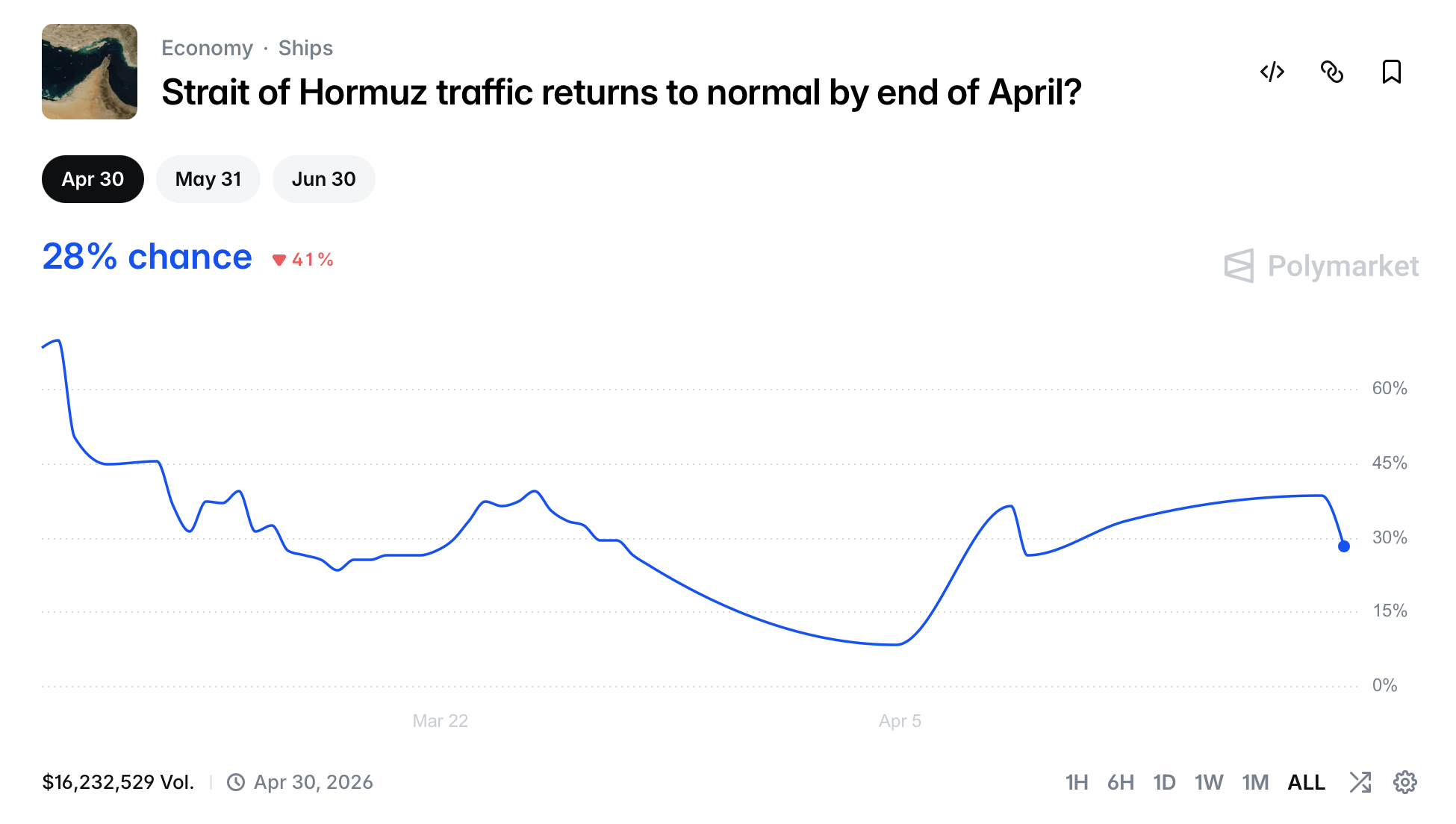
The April 30 market boasts a whopping total of over $16 million in volume, with nearly $4 million exchanging hands during a single session on April 7, following an earlier Iranian pledge to reopen the waterway. Who knew chaos could be so lucrative?
But wait, there’s more! Resolution for both contracts hinges on IMF Portwatch reporting that magical 7-day moving average of at least 60 ship arrivals covering container, dry bulk, Ro-Ro, general cargo, and tanker vessels. Before this grand escapade began in early March 2026, daily transit calls routinely exceeded 60. Now? We’re looking at a sad little range of 5 to 16 ships daily. Quite the drop in attendance!
According to Kpler data, 8 brave tankers ventured through early Saturday before the crackdown resumed like an unwanted encore. MarineTraffic reported multiple vessels performing U-turns near Larak Island as Iranian enforcement returned to spoil the fun.
The math for the April 30 contract presents a riddle wrapped in an enigma. The seven-day moving average has been sitting pretty near zero for weeks! Even if commercial traffic resumes immediately and miraculously, hitting that coveted 60-vessel average within the remaining 12 days would require a throughput that traders are clearly not willing to bet on. Not even with a chocolate éclair!
The Strait of Hormuz plays host to roughly one-fifth of global seaborne oil and a substantial amount of LNG. Iranian forces declared it effectively closed back on March 4, 2026, after U.S. and Israeli military operations against Iran kicked off in late February. By early March, at least 10 vessel attack incidents had been reported. I dare say, that’s more drama than a soap opera!
President Trump welcomed the April 17 announcement with open arms but insisted the U.S. blockade would remain until a comprehensive deal was struck. On Saturday, the White House stuck to that script like glue.
Meanwhile, a companion Polymarket market on normalization by the end of June is perched at approximately 81% Yes, suggesting traders believe that a longer-term resolution is far more likely than any sort of near-term stabilization. Insurance premiums for vessels daring to attempt Hormuz transit are skyrocketing, and shipping firms are scratching their heads and suspending sailings until clearer security guarantees roll in. What a pickle!
And let’s not forget our good friend Pakistan, who’s been playing the role of intermediary between Washington and Tehran. Alas, no formal talks are currently scheduled, nor is there a timeline for a broader deal regarding Iran’s nuclear antics. So, stay tuned, dear readers!
The April 30 contract will resolve as soon as IMF Portwatch publishes qualifying data or at the deadline if no qualifying data appears. With only 12 days left and daily vessel counts languishing in the single digits, the 72% No side reflects where most capital has settled. Oh, the suspense is positively thrilling!
Read More
- The Boys Season 5 Spoilers: Every Major Character Death If the Show Follows the Comics
- All Itzaland Animal Locations in Infinity Nikki
- Gold Rate Forecast
- Cthulhu: The Cosmic Abyss Chapter 3 Ritual Puzzle Guide
- Solo Leveling’s New Manhwa Chapter Revives a Forgotten LGBTQ Story After 2 Years
- Persona PSP soundtrack will be available on streaming services from April 18
- Dungeons & Dragons Gets First Official Actual Play Series
- DTF St. Louis Series-Finale Recap: You Can’t Hold the Sun in Your Hand
- ‘The Hunt For Gollum’ Reveals Cast, Including New Aragorn
- Nitro Gen Omega full version releases for PC via Steam & Epic, Switch, PS5, and Xbox Series X|S on May 12
2026-04-18 21:27