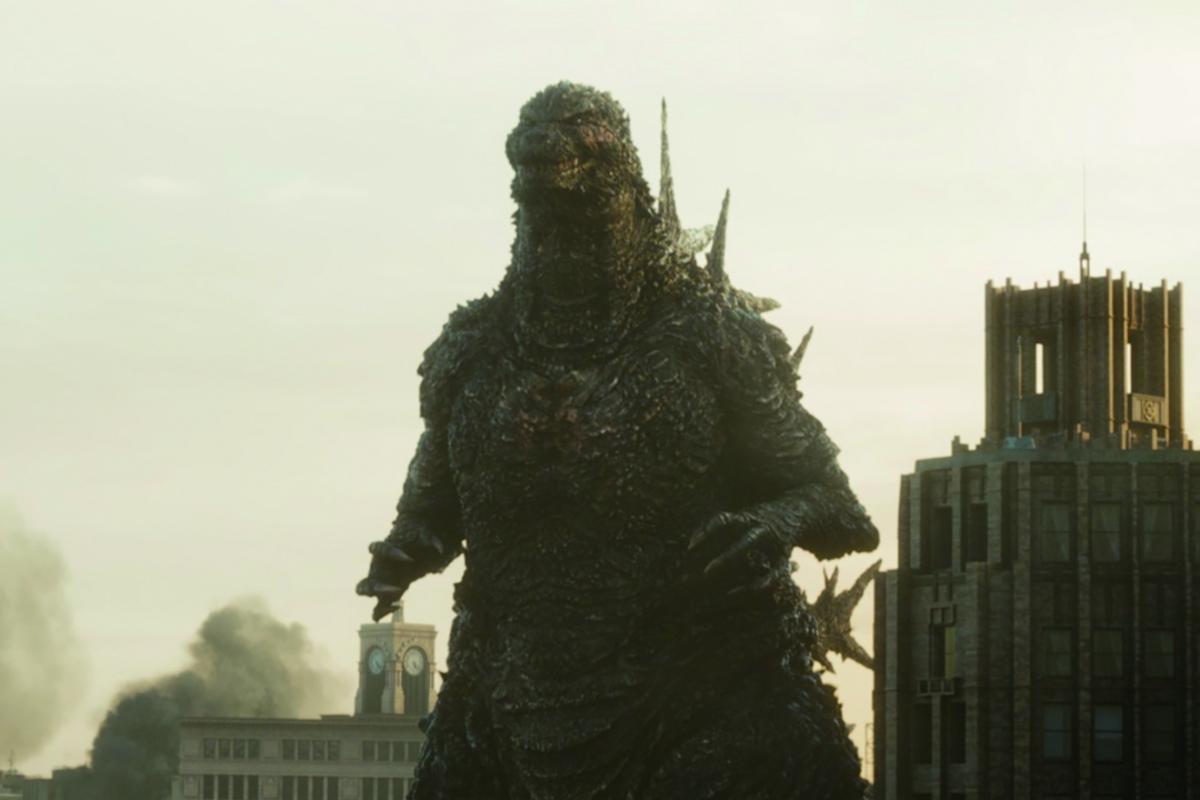
At CinemaCon in Las Vegas, director Takashi Yamazaki shared a preview of his next Godzilla film, Godzilla Minus Zero. The footage shown revealed that Godzilla will appear in New York City in the new movie.
Deadline reports that a clip shown at the convention ended with Godzilla appearing behind the Statue of Liberty, and notes the movie will be released in the United States.
People watching a preview at Caesars Palace reportedly gasped when they saw the moment, as they didn’t anticipate the famous monster appearing in the U.S. in the new film by the director of last year’s Oscar-winning Japanese monster movie, which was set in Tokyo after the war.
Speaking to the crowd, Yamazaki said the “journey from Minus to Zero will not be an easy one.”
He announced at the event that they’re dedicating all their technological resources to bringing this new story – a tale of both hardship and optimism – to cinemas globally. He also revealed that the next installment will feature even greater challenges for Japan and the Shikishima family.
As reported by Variety, the next Godzilla film will take place two years after the events of Minus One, following the continuing story of the survivors. Godzilla Minus Zero is scheduled for release in North American theaters on November 6, 2026.
Released in the U.S. in December 2023, Godzilla Minus One is set in post-World War II Japan. The film centers on a former pilot haunted by his experiences during the war, who hopes to find purpose when a giant monster, powered by nuclear energy, attacks Tokyo.
The 2024 Oscar winner for Best Visual Effects became a surprising success around the world. With a budget of just $15 million, the film earned $116 million internationally, making it the highest-grossing Godzilla movie ever released in Japan.
Horror Movie Sequels That Successfully Reinvented a Franchise

Aliens (1986)
Ridley Scott’s Alien is a landmark sci-fi horror film, making a successful sequel a huge challenge. How could any follow-up measure up to the terrifying atmosphere of the 1979 original? James Cameron’s Aliens solved that problem by changing the genre. Instead of slow-building dread and isolation, the 1986 film delivers high-energy action – trading chills for thrills. Both movies have their devoted fans; some prefer the original’s quiet, eerie, and cosmic feel, while others enjoy the second film’s explosive, action-packed energy – complete with space marines and massive weaponry! – but Aliens undoubtedly expanded the possibilities for the entire franchise.

Ouija: Origin of Evil (2016)
It’s unusual for a sequel to drastically surpass the original, to the point where people forget the first movie even existed. (Honestly, who remembers the 2014 film Ouija?) Mike Flanagan’s Ouija: Origin of Evil, a prequel, completely turns things around. It fixes all the problems with the first film and delivers a genuinely spooky and tragic haunted house story, reminiscent of classic gothic horror and comparable to the first two Conjuring movies. Unlike the original Ouija, which was set in the present day, Origin of Evil takes place in 1967, and that period setting really enhances the atmosphere.

Gremlins 2: The New Batch (1990)
Gremlins is a beloved classic from the 80s – a standout creature feature and a great introduction to the horror genre. Joe Dante’s original film expertly blends dark humor – like the surprisingly intense story about the protagonist’s father – with impressive practical effects, creating a thrilling and entertaining experience. While a sequel could have easily repeated the same formula, Gremlins 2: The New Batch boldly moves Gizmo from a quiet suburban setting to the chaotic world of a corporate skyscraper, swapping small-town mischief for over-the-top, comedic mayhem. The sequel amplifies the original’s dark humor, embracing a campy, satirical style that playfully pokes fun at itself – and it’s incredibly effective.

Wes Craven’s New Nightmare (1994)
The A Nightmare on Elm Street series, created by Wes Craven, always had a bit of a playful, over-the-top quality—perhaps because of all the fake blood! While the original movie was a pretty direct and scary horror film, the sequels tended to become more comical and bizarre. However, with the sixth film, Craven returned to the series after a long break and brought Freddy Krueger back to his truly terrifying self. He did this with a clever, self-aware approach that not only revitalized the franchise but also influenced his later film, Scream.

10 Cloverfield Lane (2016)
Matt Reeves’ 2008 film, Cloverfield, doesn’t get the recognition it deserves, in my opinion. While it was hugely popular when it came out thanks to its clever marketing, it’s often overlooked when people talk about the best horror movies of the 2000s – despite launching a whole franchise. Surprisingly, the sequel, 10 Cloverfield Lane, took a very different approach. Originally planned as a completely separate story, it abandoned the shaky, found-footage style that made the first film so memorable. Instead, it opened up the franchise with a new type of story, moving the action from a city under attack to a secluded, underground bunker. This second film isn’t a big, explosive action movie like the first; it’s a suspenseful, claustrophobic thriller that relies on strong performances from Mary Elizabeth Winstead and John Goodman.

Doctor Sleep (2019)
It once seemed impossible to revisit the world of Stanley Kubrick’s 1980 horror masterpiece, The Shining. The film felt unique and self-contained, almost existing outside of typical cinema. However, 36 years after the original novel was published, Stephen King wrote Doctor Sleep, a true sequel to The Shining, which was later made into a film by Mike Flanagan. Doctor Sleep centers on a grown-up, troubled Danny Torrance who must return to the Overlook Hotel to stop a dangerous group that preys on children with special abilities. While the original was a slow-burn, psychological horror film, Doctor Sleep is a faster-paced supernatural thriller with a focus on mystical elements, offering a fresh perspective on the Torrance family’s story.

Prey (2022)
The Predator movies are known for being big, action-packed blends of science fiction, horror, and intense thrills. But Dan Trachtenberg’s Prey takes the series in a completely new direction, and ends up being one of the best installments yet. This prequel is set in the 1700s on the Great Plains and follows a young Comanche woman trying to prove her worth to her tribe while battling a deadly alien hunter. Unlike most Predator films, Prey ditches the futuristic technology and focuses on a raw, primal fight between warriors, driven by a fantastic performance from Amber Midthunder. The film is incredibly immersive and cleverly reimagines the franchise, creating exciting possibilities for the future (hopefully better than Predator: Badlands!).

Terminator 2: Judgement Day (1991)
Like another film on this list (clearly Aliens), Terminator 2: Judgment Day takes the ideas from its more frightening 1984 original and turns them into a big, action-packed sequel. This new film changes the story and sets the direction for all future Terminator movies. Set eleven years after the first film, Terminator 2 reimagines Arnold Schwarzenegger’s character (now a T-800) as a surprising protector, tasked with safeguarding young John Connor, who is destined to save the world. While still retaining some scary moments, the film fully embraces its science fiction action roots, and is made even more powerful by the genuinely touching relationship that develops between John and his robotic guardian.

Bride of Chucky (1998)
The first three Child’s Play movies aimed to genuinely scare audiences and make them look at their childhood toys differently, with a bit of dark humor mixed in. But the fourth film, Bride of Chucky, completely changed the tone. It shifted the series from a straight-up horror franchise to a self-aware, darkly comedic one. Bride of Chucky focuses on Chucky reconnecting with his old partner-in-crime, Tiffany Valentine, and trying to escape being a doll using a magical amulet. While it’s still a horror movie, the scares aren’t as strong in this installment—and the human characters aren’t very memorable. What really makes this film stand out is the playful and gruesome dynamic between Chucky and Tiffany, which set the stage for the series’ increasingly over-the-top and campy style.

Evil Dead II (1987)
While many consider 1992’s Army of Darkness the most impactful Evil Dead film, Evil Dead II was truly essential to its success. Sam Raimi’s second film broadened the scope of the series beyond the original’s cabin setting and established the iconic Ash we all know. It was the first to really mix different genres, taking the campy style and over-the-top violence of the first film and turning it into a full-blown horror-comedy. Although later installments have leaned back towards more serious horror, Evil Dead II was groundbreaking in that it allowed the franchise to evolve by successfully changing its tone and reinventing the original concept.
Read More
- Solo Leveling’s New Manhwa Chapter Revives a Forgotten LGBTQ Story After 2 Years
- Gold Rate Forecast
- The Boys Season 5 Spoilers: Every Major Character Death If the Show Follows the Comics
- How to Get to the Undercoast in Esoteric Ebb
- All Itzaland Animal Locations in Infinity Nikki
- Mewgenics vinyl limited editions now available to pre-order
- Smarter, Faster Networks: Optimizing Early-Exit Architectures for Edge AI
- CBR’s Official Spring 2026 Anime Series Power Ranking (Week 1)
- YouTuber Karl Jobst sues Billy Mitchell for defamation
- Silver Rate Forecast
2026-04-14 21:57