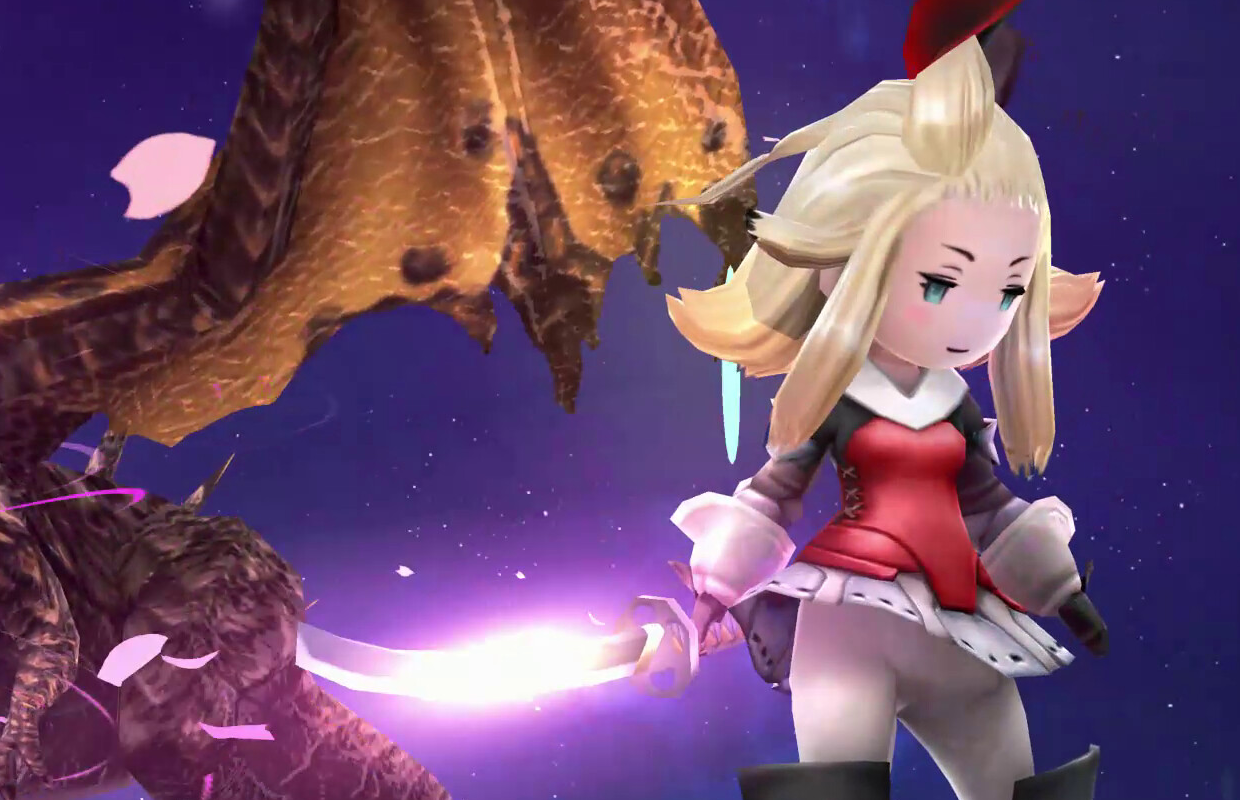
A few days ago, Bravely Default Flying Fairy HD Remaster came to PC and Xbox Series consoles, after first appearing in June 2025 as a launch title for the Nintendo Switch 2. This is the first time the classic 3DS game has been re-released on modern platforms. I’ve been revisiting the Switch 2 version, as well as trying out the new releases on Steam and Xbox, to see how well the game performs on each system. In this article, I’ll break down the performance across platforms to help you choose the best version. I’ll also compare it to the original 3DS game, similar to how I’ve compared other Square Enix titles like Triangle Strategy, Chrono Trigger, and the Final Fantasy Pixel Remasters.
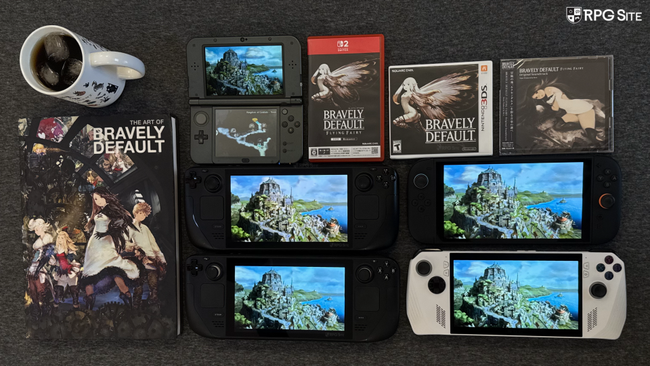
Bravely Default release timeline
Before diving into the different versions and how they compare, it’s worth noting that Bravely Default has had a somewhat unusual release history since it first came out over ten years ago.
- October 2012: Bravely Default Flying Fairy releases on 3DS in Japan.
- December 2013: Bravely Default For the Sequel, an expanded and updated version, releases on 3DS in Japan and this is when Bravely Default makes its debut in the West in EU and AU.
- February 2014: Bravely Default launches in North America on 3DS.
- June 2025: Bravely Default Flying Fairy HD Remaster launches for Nintendo Switch 2 worldwide as the first re-release of the game following its 3DS debut.
- March 2026: Bravely Default Flying Fairy HD Remaster launches on Xbox Series X|S and PC Steam.

Bravely Default feature differences across platforms: Flying Fairy HD Remaster and the 3DS original
Bravely Default first came out in Japan in 2012. When the game was released in the West on the 3DS as Bravely Default For the Sequel, it included several improvements to enhance gameplay. These additions included options to speed up battles, adjust encounter rates, and visual upgrades, as well as a helpful event viewer. The Western version also featured some changes to character designs and ages. Beyond these changes, Bravely Default For the Sequel added new content that connected it to the later game, Bravely Second: End Layer (which I’d love to see remastered), like a new video and gameplay mechanics from Bravely Second.
The Switch version of Bravely Default Flying Fairy HD Remaster is based on the original 2012 Japanese release. It largely removes content from the sequel, Bravely Second, but incorporates helpful improvements from the later game, Bravely Default (known as ‘For the Sequel’ in Japan), and adds new features specifically for this remastered version. These new additions include options to speed up gameplay, enhanced map features, a convenient button to heal the entire party, a redesigned user interface for a better experience on one screen, and improved online functionality. The game also features two mini-games previously covered, and changes how often you encounter enemies. Initially, you won’t be able to adjust the encounter rate to zero, or turn it off completely, until you reach the town of Florem and complete enough of the new mini-games to earn Petal Tokens, which are used to unlock these options.
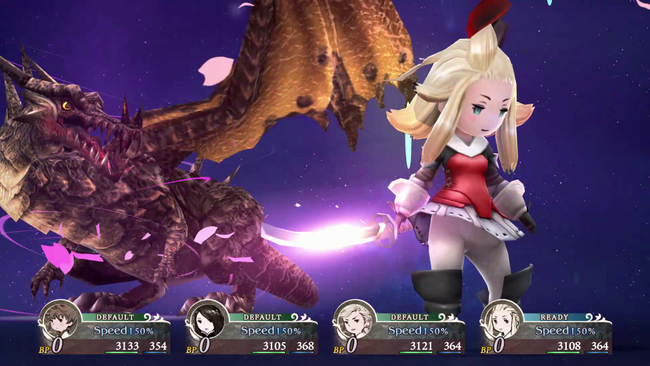
The Switch, Steam, and Xbox versions of Bravely Default Flying Fairy HD Remaster have different content depending on the region. The Western Switch version keeps the character designs and ages that were changed for the original Western 3DS release. The Japanese Switch version has English language support and uses the original character designs. Language support differs too: the Japanese release includes Japanese, English, Korean, Simplified Chinese, and Traditional Chinese, while the Western release offers Japanese, French, German, Italian, Spanish, and English. It seems the Steam and Xbox versions are based on the Western release, as they mention some graphics have been updated from the original game.
Even ignoring the updated graphics and smoother gameplay, Bravely Default Flying Fairy HD Remaster is the strongest version of the game. However, I was let down that a lot of the content from Bravely Second is missing.
Bravely Default Flying Fairy HD Remaster Switch 2, Xbox, Steam Deck, and PC visual differences
Playing Bravely Default again on my 3DS has been surprisingly wonderful, even after enjoying the HD remaster on Switch last year. Starting a new game reminded me how much I appreciate the 3D visuals in this type of game, and how convenient it is to have the map and menus on the 3DS’s bottom screen – it keeps the top screen clear for playing. Before I get carried away praising the 3DS as an RPG machine, let’s focus back on Bravely Default Flying Fairy HD Remaster.
Bravely Default Flying Fairy HD Remaster features a streamlined user interface, optional mini-map, and improved graphics, primarily for 3D models and the UI. While the backgrounds haven’t been updated, the remaster successfully blends a modern, high-resolution look with the original game’s style. It’s a smooth presentation that feels much more cohesive than some of the visual choices in Bravely Default II.
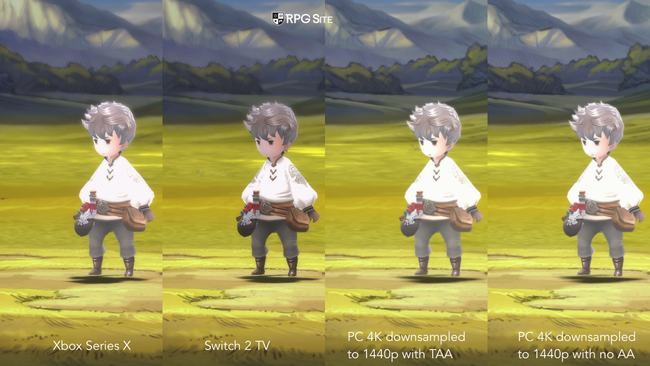
Since I can’t capture footage from the 3DS, my comparison of Bravely Default Flying Fairy HD Remaster will focus on the Switch 2, PC, and Xbox Series X versions. As always, I’ve done two comparisons: one for handheld mode and one for playing on a TV. When played on a TV or while docked, the Switch 2 and Xbox Series X versions don’t have great anti-aliasing and seem to run at or are limited to 1080p resolution. I tested this in five different areas with both systems outputting at 4K. This causes the edges of 3D models – and especially the world map – to look jagged. These issues are less noticeable on the Switch 2’s smaller handheld screen, which appears to be close to, if not at, 1080p resolution.
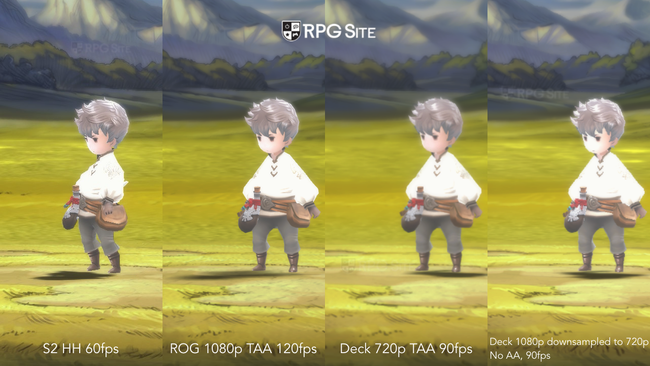
On PC, you can choose between TAA and FXAA to smooth out the graphics. TAA makes the image a little softer, but it avoids the flickering and jagged lines seen on the console versions. The PC version also supports 4K resolution and downsampling, which significantly improves image quality on TVs or high-resolution monitors. Hopefully, Square Enix will improve the graphics on the console versions and add anti-aliasing, as the PC version shows the Switch 2 and Xbox Series X have the potential for much better visuals.
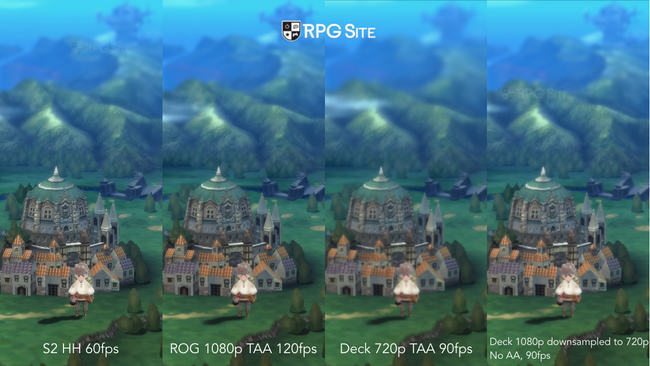
I felt the Switch 2 didn’t look as good when played on a TV compared to its portable mode – which is where I played it most of the time. However, Square Enix really should have optimized the game better for both the Xbox Series X and the docked Switch 2. Since the PC version can run with unlimited frame rates, I anticipated a smooth, 4K resolution at 120 frames per second on the Xbox Series X, but the game’s performance falls far short of that, especially with the 3D graphics.
When playing on the go, Bravely Default Flying Fairy HD Remaster looks sharp on the Switch 2 and offers a visual experience comparable to the ROG Ally. It runs at a higher resolution than on the Steam Deck, which is limited to 720p due to its 800p screen – although you can adjust settings on the Steam Deck to improve visuals. Because the game is designed for a standard 16:9 screen, you’ll notice black bars at the top and bottom when playing on the Steam Deck or any ultrawide (21:9) monitor. Hopefully, a future update or mod will fix this aspect ratio issue.
Bravely Default Flying Fairy HD Remaster performance on PC, Xbox, Steam Deck, and Switch 2
So, I’ve been playing Bravely Default on a bunch of different platforms, and the performance varies quite a bit. On the 3DS, it aimed for 30 frames per second, but the Switch 2 version actually hits 60fps. On PC, it’s even better – it can run at whatever frame rate your system can handle, and I easily got 90fps on my Steam Deck, and over 120fps on my ROG Ally! But here’s the weird part: on Xbox Series X, it seems locked to 60fps, no matter what resolution I tried, even when I set my console to 120Hz and used slow-motion footage to double-check. It’s a little disappointing, honestly, especially since the PC version and even the Switch 2 can do so much more. Some people might say a higher frame rate isn’t necessary for this kind of game, but given the power of the Xbox Series X, it just feels a bit held back. I initially assumed the Switch 2 would also be capped at 60fps because the remaster seemed built around that, but it clearly has more headroom on PC, so it’s a bit of a letdown on Xbox.
Bravely Default load times across 3DS and the remaster on Switch 2, Steam Deck, PC, and Xbox
To check how quickly the game loads, I installed Bravely Default Flying Fairy HD Remaster on several different systems. This included the Switch 2, Xbox Series X, ROG Ally, and Steam Deck, using both digital and physical versions where available. I also tested with the physical 3DS cartridge on a New 3DS XL. I timed how long it took to reach the title screen from each system’s home screen, and also how long it took to load an early save file. I quickly pressed the confirm button to skip any introductory screens. The loading times listed below are in seconds and were measured with online features turned off to get the most accurate results.
| Platform | Dashboard to title | Loading a save |
| 3DS | 12 | 6 |
| Switch 2 | 22-23 | 3 |
| Steam Deck | 15 | 2 |
| ROG Ally Steam | 15 | 2 |
| ROG Ally Xbox | 22 | 2 |
| Xbox Series X | 11-12 | 3 |
| Switch 2 JP | 22-23 | 3 |
Loading times in Bravely Default Flying Fairy HD Remaster are generally quick across all platforms. While the Switch 2 is slightly slower than most, the Xbox Series X takes about the same amount of time. The Xbox Series X has the fastest start-up and uses Quick Resume for even faster loading. On the ROG Ally, the PC version of the game takes almost as long to start as the Switch 2 version. Keep in mind that enabling online features will increase load times. The original 3DS version starts quickly, but loading saved games and certain parts of the game takes a bit longer compared to the newer versions.
Which is the best version of Bravely Default Flying Fairy HD Remaster
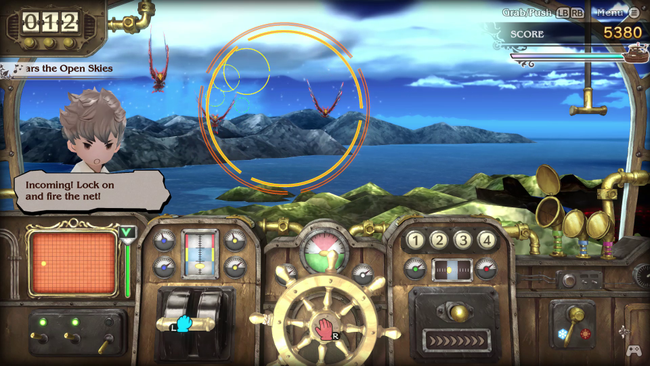
Let’s break down the best ways to play this game. I’ll cover handheld play, playing on a TV, and my overall recommendation. When connected to a TV, the Xbox Series and Switch 2 versions are very similar, though the Xbox loads faster. The Steam and Xbox PC versions look and run better, letting you play with unlimited frame rates. On consoles, the experience is largely the same, but Xbox offers Quick Resume and achievements, while the Switch 2 shines as a hybrid console you can play on the go. Also, the Switch 2’s Joy-Con 2 controllers are ideal for the mini-games – the analog sticks just don’t feel as good. If you plan to spend a lot of time with the mini-games, the Switch 2 and its detachable Joy-Cons are the way to go.
When it comes to playing on the go, the Switch 2 is good, but PC handhelds like the Steam Deck OLED or ROG Ally offer a superior portable experience with better graphics and performance. If you plan to play both at home and while traveling, the Switch 2 works well in either mode, and really excels as a handheld. The Xbox version lets you play on PCs and devices like the ROG Xbox Ally and continue your progress, but its syncing between devices isn’t as smooth as Steam or the Switch 2, which makes switching between handheld and docked play effortless.
Considering battery life, screen quality, how comfortable it is to hold, and performance, I prefer the Steam Deck OLED. I can connect it to a monitor or TV and play games at a smooth 90 frames per second on the go, and even higher resolutions – 1440p at 60 frames per second – when docked, which is better than both the Nintendo Switch 2 and Xbox Series X currently. While the original Steam Deck LCD version might feel better to use right out of the box compared to the Switch 2’s handheld mode, you can adjust the Steam Deck’s settings to get a very clear picture with smooth edges. It’s a close call, and I want to emphasize that the Switch 2 still offers a great portable gaming experience – it just could have had slightly better image quality.
Which version of Bravely Default Flying Fairy HD Remaster should you buy to play
Since everyone has different preferences, I’ll wrap up this article by outlining the pros and cons of each version of Bravely Default Flying Fairy HD Remaster.
- Bravely Default Flying Fairy HD Remaster on Nintendo Switch 2: This is the original release of the remaster and it plays and looks great handheld, but it should have targeted a higher resolution when playing docked. That aside, it is great for seamlessly moving between docked and portable play and has no real performance issues. The Switch 2’s Joy-Con 2 controllers also were what the mini-games were built for as opposed to the mediocre analog stick implementation for the second mini-game with a controller.
- Bravely Default Flying Fairy HD Remaster on Xbox: If you have access to a PC handheld or play on Xbox Series consoles and PC, the Play Anywhere feature is a big selling point in addition to the Quick Resume feature on Xbox consoles, but the longer initial load times thanks to the syncing hold this version back a bit. I also am a bit disappointed the developers didn’t push for 120fps or a higher resolution since it can easily do that on PC handhelds and the Xbox Series consoles should’ve had a higher frame rate target with better anti-aliasing. It feels like a bare-bones port of the Switch 2 release with some changes to controls rather than a version that scales up based on the hardware capabilities.
- Bravely Default Flying Fairy HD Remaster on Steam: If you play on Steam Deck or PC in general, this is the only version you should consider. It plays fantastic on Steam Deck out of the box at 90fps and can even do well above that on other PC handhelds like the ROG Ally or laptops. The PC port is a bit bare-bones, but it can go well above the console versions.
- Bravely Default on 3DS: Usually, I’d say avoid this, and it is hard to buy it now given prices of the physical release, but the 3DS version of Bravely Default will always be worth experiencing for the content that was cut, the 3D visuals (especially on a New 3DS system), and the dual screen setup. It rules and I’m going to replay it once I finish my Steam Deck playthrough of Bravely Default Flying Fairy HD Remaster
Hopefully, this information helps you decide where to buy Bravely Default Flying Fairy HD Remaster, or encourages you to play it if you already have it. It would be fantastic if this also leads to an HD remaster of Bravely Second: End Layer for the PlayStation 5!
Bravely Default is out now for Nintendo 3DS. A remastered version, Bravely Default Flying Fairy HD Remaster, is available on Nintendo Switch, Xbox Series X|S, and PC through Steam. Check out our game guides here.
Read More
- Off Campus Season 1 Soundtrack Guide
- Euphoria Season 3’s New R-Rated Sydney Sweeney Scene Proves The Show Is Trolling Us
- Gold Rate Forecast
- DoorDash responds after customer uses AI to make food look bad and get a refund
- Brent Oil Forecast
- What is Omoggle? The AI face-rating platform taking over Twitch
- 8 Funniest Billy Butcher Quotes From The Boys
- EUR CLP PREDICTION
- MNT PREDICTION. MNT cryptocurrency
- Crypto Chaos: Are Your Bitcoins and Ethereums Ready for a Wild Ride? 🚀😱
2026-03-15 17:59